The
endless
Journey of
liemba
On the History, Present,
and Future of a
Legendary Ship
from Lake Tanganyika.

Foreword.
The passenger and cargo vessel LIEMBA is one of the most famous ships in the world, looking back on a turbulent century of history. Built shortly before the First World War at the behest of the East African Railway Company at the Meyer Werft shipyard in Papenburg on the River Ems – and originally named GOETZEN – the ship was transported in sections by sea to Dar es Salaam, in what was then the colony of German East Africa. From there, it traveled via the recently completed Central Railway to Lake Tanganyika, where it was fully assembled under arduous conditions at a newly constructed shipyard by mid-1915.
As Lake Tanganyika formed the border with Germany’s now-hostile neighbors – the Belgian Congo lay on the western shore, and British Northern Rhodesia at the southern end – the 67-meter-long steamship was armed and deployed to secure the borders and transport troops. However, as the military situation for the German “Schutztruppe” (colonial defense force) deteriorated rapidly, the GOETZEN was scuttled by German colonial troops during their retreat – just one year after entering service.
Following the First World War, the territory came under British administration. With great difficulty, the ship was raised and underwent extensive restoration; it was during this process that it received its new name: LIEMBA.
The history of the LIEMBA has thus been anything but linear: the ship has witnessed various forms of governance and the decades-long transformation of the region – from a German colony to a British mandate territory, and finally to an independent nation. It has also witnessed wars in neighboring countries, along with the ensuing streams of refugees – many of whom were evacuated across the lake aboard the ship itself. It has been scuttled, raised, and worn down by years of continuous service and neglect. In the 1970s, it was even slated for the scrapyard. But, somehow, always the decision was made to preserve it. Every now and then, thanks to international donors, major maintenance work could be carried out; however, it was primarily the local staff who kept the vessel running.
And this was absolutely essential, for until 2018, this oldtimer played a pivotal role in sustaining the people living along Lake Tanganyika – one of Tanzania’s most remote and infrastructurally underdeveloped regions. Businesspeople engaged in trade… individuals wishing to visit relatives… patients needing to travel to the hospital in Kigoma… refugees from Burundi or the Congo…: They all relied on the LIEMBA to sail!
Consequently, the LIEMBA evolved into a central symbol of national identity for Tanzania. Against this backdrop, it can be understood that the vessel was officially designated as a National Heritage site in Tanzania in 2012.
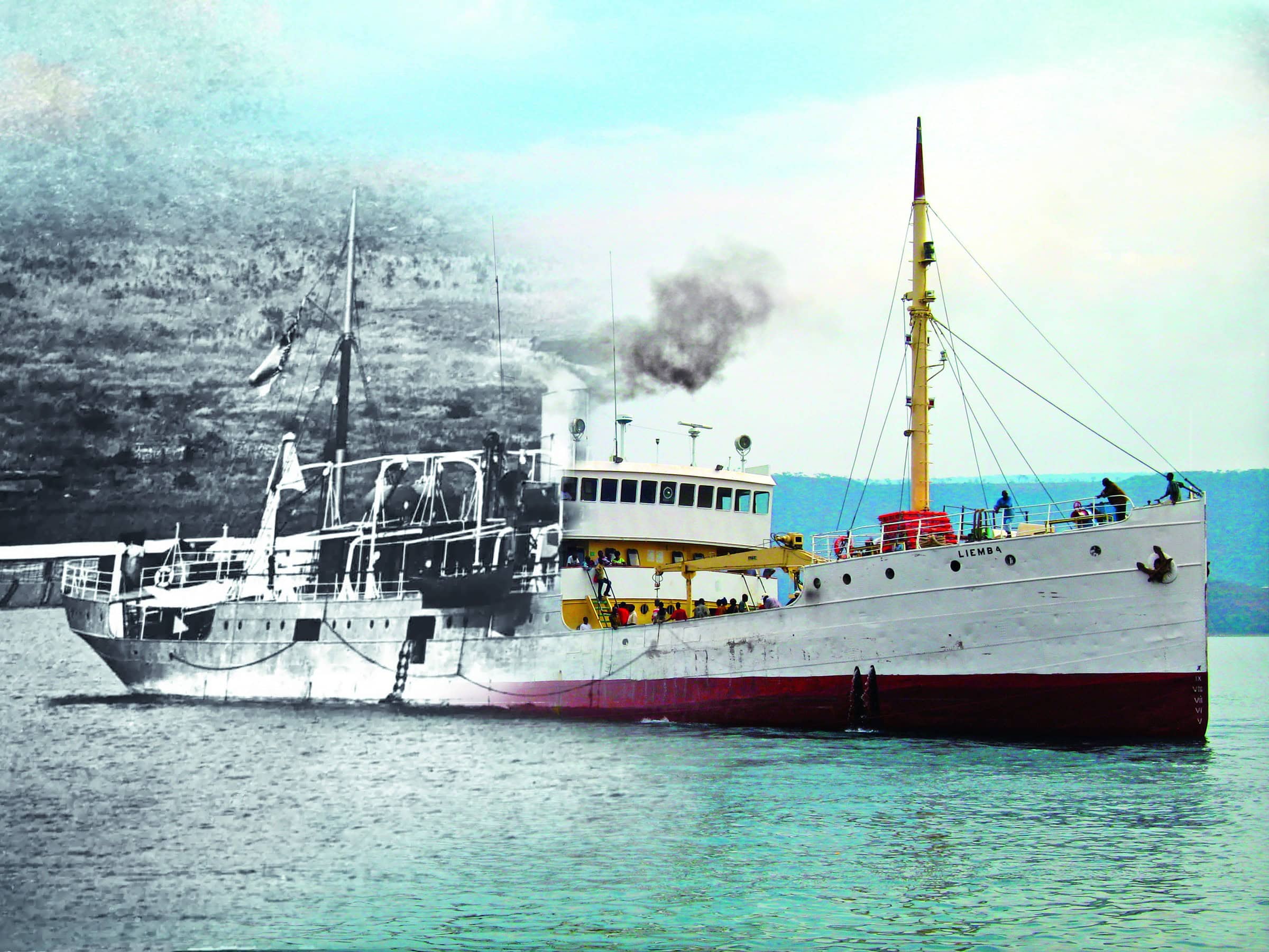
Hanns-Stefan Grosch, Oliver Lohrengel, Deutsche Seeschifffahrt editorial team, Hamburg.
And it is likely precisely this significance and history that continue to fascinate so many people about this ship to this day: it seems strangely out of time – hailing from a different country and originally intended for an entirely different purpose. Even travelers aboard the LIEMBA who know only the broad outlines of its history grasp that they are traveling on a historical mode of transport – an authentic artifact that invites them to take a retrospective journey into the past.
Reflecting this prominence, the LIEMBA featured heavily in the media for several years: articles appeared in newspapers and magazines, and segments aired on television and radio, both domestically and abroad; two films were even produced for theatrical release. Online, countless backpackers discovered a newfound interest in Lake Tanganyika – a region still virtually untouched by mass tourism – and debated the likelihood of the LIEMBA being operational at specific times, the conditions one might expect on board, the cost of a voyage from one port to another, and how to go about obtaining tickets. I, too, traveled aboard the LIEMBA – making the round trip from Kigoma to Kasanga and back – in 2008 and in 2011.
During her final voyages in 2018, even the African passengers reportedly complained—a remarkable fact that casts a stark light on the conditions that must have prevailed at the time. Subsequently, the LIEMBA was taken out of service, and to outsiders, it appeared as though her end had come. In 2020, I was involved in creating a 3D documentation project that allows for a virtual walkthrough of the ship in the state she was in at the time; we were convinced that we were documenting her final operational condition.
Then, surprisingly, in mid-2024, it was announced that the Croatian shipyard Brodosplit JSC and the Tanzanian firm Dar es Salaam Merchant Group Ltd. would undertake a comprehensive restoration of the vessel. Two years have been allotted for the work, which is budgeted at just under 16 million euros. Thoroughly refurbished, the LIEMBA is scheduled to resume sailing in the second half of 2026 – perhaps even for another century.
About me: Around 2004 – during my studies in history – I watched a documentary on television about the LIEMBA and thus heard of her fascinating history for the very first time. Eager to learn more about this German-African vessel, I began by visiting various archives and libraries across Germany. This research culminated in a preliminary manuscript, completed in 2009. Over the ensuing years, these investigations were intensified and the text was further refined accordingly – a process that included a short period of collaboration with Professor Hans-Jürgen Ihnen of Hanover regarding source analysis. The result is that the history of the LIEMBA has now not only been comprehensively and scholarly reconstructed for the first time, but can also be vividly illustrated through numerous images.
The German colonial era.
On the example of this multifaceted era the question arises of how to examine it objectively, but also of the fundamental tasks of historical scholarship: to quote Leopold von Ranke, one of Germany’s most significant historians, its role is not “to judge the past”, but to “show how things actually were”. For Ranke, thorough source-based research always clearly took precedence over the unchecked reproduction of retrospective insights by third parties. Ranke’s aim was to view and explain the past through the eyes of the people of that time: understanding history is only possible in this way – even if this may sometimes be uncomfortable.
Accordingly, it would be wrong for historians to contribute to promoting current socio-political trends, as demanded, for example, by the resolution “on current threats to democracy” adopted at the 2018 German Historians’ Conference, which calls on academics to place themselves at the service of politics. Such an approach would be entirely unsuitable for grasping complex historical facts objectively – based on an understanding of the situation at the time and viewed in their entirety.
As is well known, no historical event consists solely of light or shadow. And viewed in retrospect, the Germans as a colonial power were not significantly “better” or “worse” than other European nations. However, the Germans went through their learning process{{ref}} at a rapid pace – in the few decades during which they possessed their patchwork “colonial empire”. During this period, however, impressive achievements were made alongside significant mistakes.
Let us turn to German East Africa: This largest and most populous colony of the German Empire existed between 1885 and 1918 and consisted of today’s Tanzania (excluding Zanzibar), Rwanda, Burundi and a part of Mozambique. The German rule in this colony had a positive effect in several ways. Mentioned should be the abolition of the slave trade, which had been a lucrative business for the Arabic minority there for centuries and which culminated in the suppression of an uprising by the Arab slave traders from 1888 to 1891. But violence also prevailed between the individual African ethnic groups at the beginning of German rule – robbery and murder were common. The fight against various diseases such as malaria should also be mentioned, which was accompanied by the establishment of health stations and the general improvement in hygienic standards and the drainage of wetlands. Mention should also be made of the work of the Christian mission, whose schools at least guaranteed the attainment of a simple level of education and from which part of the post-colonial African elites emerged. Also worth mentioning is the colonial jurisprudence, which on the one hand differentiated between colonial rulers and locals, but at least placed the latter on an equal level and in this way eliminated various injustices from pre-colonial times. This also includes the so-called “nation building” in the form of fostering peace between the various ethnic groups and stripping clan leaders, warlords and priests of their power; these figures had often kept their tribal members in a state of dependency and lawlessness up until that point. The introduction of the common language Kiswahili is also worth mentioning here. The increasing establishment of farms, plantations and other productive industries also offered previously unknown opportunities for work and income. Colonialism could therefore also mean progress, security and the rule of law for the “natives”.{{ref}}
Another important field was the creation of a modern transport infrastructure – especially from an economic point of view. However, the construction of railways, roads and shipping served here not only – as is often falsely claimed – merely to “plunder” the colonies, since at the same time considerable quantities of technical goods, building materials etc. also made their way into the interior of the country in the opposite direction. Imports to the value of 53.4 million marks are mentioned for 1913, compared with exports to the value of 35.6 million marks.{{ref}} Not only with the example of the Mittellandbahn (today: Central Line), which had been opened in several stages from Dar es Salaam to Kigoma on Lake Tanganyika by 1914, it also became clear, that the towns along the route were beginning to develop economically in a positive way; especially if they had previously been away off the traditional caravan routes. For example, as early as 1914 between Dar es Salaam and Kikombo, almost all of the hundred European farms were in the immediate vicinity of the railway. And workers, craftsmen, traders and hoteliers also increasingly settled along the route.
The choice of the western end point of the Mittellandbahn in Kigoma on Lake Tanganyika was by no means due to chance. Both modes of transport – the Mittellandbahn as well as ships for the transport of goods across the lake – should not only serve the economic development of the own colony, but also and especially an inter-colonial freight transport. The construction of these means of transport was a prerequisite for the cheap transport of raw materials from Northern Rhodesia as well as from the Belgian Congo{{ref}} (here especially the Katanga area to be developed with its rich deposits of gold, coal, copper, salt, tungsten and tin), where transporting it to the west across the Congo River on Belgian territory had turned out to be much more expensive. This situation was not to change in Belgian Congo until 1929 with the completion of the Benguela Railway.
Accordingly, there was also a German interest in collecting freight charges. In addition, the removal of foreign goods through the territory of German East Africa increased the political and strategic importance of the own colony.{{ref}}
A modern transport infrastructure understandably also served to secure political rule. On the one hand, in the event of war, when troops were transferred – Lake Tanganyika represented a border several hundred kilometers long, on the German shore of which there were only three military stations: Usumbura, Udjidji (with the port of Kigoma) and Bismarckburg (today: Kasanga). On the other hand, means of transport also served to pacify internal unrest. The various uprisings had shaken up the German public: They were by no means ready to back down from the rebels; the sacrifices made should not have been in vain.
The development of a colonial transport infrastructure must be viewed from a broader perspective:
On the one hand, there is one aspect that could be described as “civilizational appropriation through settlement” – or, as Ramaer wrote very clearly, the freshly established colonial governments began to put furniture into their newly occupied houses.{{ref}} It was not only a question of shaping the colony to a certain extent as an image of the distant homeland (German culture established itself especially along the railways, and the stations were also considered social meeting points), but in a certain way the means of transport even played the role of one “National performance show in the age of imperialism”: Here it was possible to demonstrate what the strong German Empire was capable of. Ships and railways in the colonies are therefore never to be seen only as a mundane means of transport, but always as a staging of technology and one’s own ability: They were designed and constructed in the mother country with special consideration of the conditions and requirements in their destination areas, they had to be transported to these destinations under often difficult conditions, then had to be fully assembled there and finally had to be put into service and operated successfully.
On the other hand, it was about a kind of “civilization of Africans according to European ideas”. Baltzer used the example of the Uganda Railway to mention that it had transformed the wild Kikuyu warriors into peaceful, sometimes hard-working country people, the formerly feared spear-armed Maasai into harmless shepherds, whom one encounters today as skillful rubber tappers in the plantations of Usambara.{{ref}} Schnee mentioned that in a similar way: Those tribes whose existence had previously been based on murder and robbery, the Maasai, the Wangoni, the Wahehe, were thrown down by the brave protection force, some of them under hard fighting, and had, albeit reluctantly, at first accustomed to peaceably pursue their acquisition. The Maasai were no longer cattle robbers, but only cattlemen, the Wahehe and Wangoni peaceful farmers and cattlemen. The Wangoni, whose proficiency had previously been shown in wars, now emerged in peaceful competition, were sought-after workers on European plantations.{{ref}} Integrating Africans into paid work processes in structures based on the European model naturally meant not only economic advantages, but also being able to control them more easily.
For a positive development of the colony and a properly function of the production, an efficient transport infrastructure was required. The construction of the passenger and cargo ship GOETZEN, the later LIEMBA, must be seen in this overall context.
Plans to establish a shipping service on Lake Tanganyika.
So, the first step was the building of the rail connection from Dar es Salaam to Kigoma, on Lake Tanganyika. Preliminary work on construction of this section was started by the Deutsch-Ostafrikanische Gesellschaft (DOAG, German East Africa Company) in 1896. After the German parliament refused to grant a subsidy of 100,000 German Marks in 1900, it wasn’t until 1904 that the finance for the project was secured via a bank consortium. Prince Adalbert of Prussia ceremoniously turned the first sod of earth in Dar es Salaam on 9 February 1905 and the first rail section to Morogoro was opened in December 1907, followed by the section to Tabora in June 1912. On 2 February 1914 the railhead reached the terminus in Kigoma on Lake Tanganyika.{{ref}} The railway is still in operation today under the name “Central Line”.
With that, considerations started of building three large steamships to establish a regular transport service on Lake Tanganyika. Among other things, experiences with means of transport in the neighboring protected areas could be used:
From 1906 a report exists written by a government councilor Chrapkowski about his trip from Chinde to Lake Nyasa, in which he mentions river navigation, road and rail traffic as well as transport by African carriers. The report also clearly mentions the situation on Lake Nyasa, including the navigation there.{{ref}}
In June 1910 the German colonial administration made inquiries at the railway administration in Tabora about the dimensions of similar British steamers on Lake Victoria. Most had a displacement of between 600 and 1,200 tonnes. The first step was to establish the cost of building and provisionally assembling a ship in Germany, including its transport to Dar es Salaam. The ship was to have a displacement of 1,000 tonnes and a draught of around four metres. A vessel of these dimensions would be able to anchor at most places on the lake at a distance of between 400 and 500 metres from the shore. The cost was estimated at between 400,000 and 500,000 Marks.{{ref}}
From 1911, the question of whether the ship should have diesel engines or steam propulsion fired with wood or coal was examined in detail. At first diesel was favoured as the technology of the future, particularly in view of promising attempts to produce fuel from various plants or fruits abundantly available in the colony, such as the palm or the peanut plant. However, construction of the facilities needed for local oil production proved too costly.{{ref}}
In March 1914 final consideration was given to fuelling the ships on Lake Tanganyika and the steam locomotives on the Central Line using coal from Lukuga, on the other side of the lake, in the Belgian Congo. The coal would be transported from Albertville (now Kalemi) straight across the lake to Kigoma. This required the acquisition of two 200-tonne barges, to be pulled by the steamer Hedwig von Wissmann.{{ref}} The payroll records of the Meyer Werft shipyard show that this company was engaged in building these barges from 6 June 1914 to the beginning of 1916 but due to the war delivery to German East Africa was no longer possible, so they were then dismantled again. Since this was the end of the idea of coal power for the projected passenger and cargo ship with the hull number S 300, it ended up with wood-burning steam engines.{{ref}}
Pre-assembly of the GOETZEN in Papenburg.
In 1912 completion of the Central Line was in sight. The Ostafrikanische Eisenbahn-Gesellschaft (OAEG; East African Railway Company) then made an input to the imperial colonial office concerning the establishment of shipping on Lake Tanganyika.{{ref}} At the turn of 1912/13, the OAEG commissioned the shipyard Joseph L. Meyer in Papenburg, to build a twin-screw passenger and cargo ship for service on Lake Tanganyika. It was scheduled for delivery by the end of 1913. The ship was to cost 406,000 Marks, to be paid in five instalments between ordering and its delivery in Hamburg.{{ref}} The name GRAF VON GOETZEN was chosen to commemorate the former governor of the colony.{{ref}}
According to a certificate from Germanischer Lloyd dated 14 April 1913, the commissioned ship had a length at the waterline of 67 metres, a breadth of 10 metres and a displacement of 1,150 tonnes. Its hull had a height of 3.4 metres above the waterline and a draught of 2.3 metres when loaded with 480 tonnes of cargo, 60 tonnes of fuel and 10 tonnes of water. It had two round “Scotch” marine boilers with a heating area of 79 m², designed for burning wood and coal which could be converted to oil firing. Its two triple expansion steam engines could deliver a combined power of 500 ihp, and the 2 metre diameter propellers were designed to give the ship a top speed of 9.5 knots at 155 rpm in calm waters.{{ref}} However, on test runs in June 1915, the top speed reached due to wood-burning was only 8.25 knots.{{ref}}
In delivery condition the ship had seven single-berth cabins for first class passengers, five two-berth cabins for second class travellers and a dining room and smoking lounge each for first and second class.{{ref}} The cabins were fitted out in teak and were comparable to other German steamers of the time. It was particularly emphasised that the ship boasted a carbonic ice-making and refrigeration system which, in addition to cooling a meat storage room, could also produce three kilograms of ice per hour. It also had an electric lighting and ventilation system powered by two 110 V DC generators, each coupled directly with a single-cylinder steam engine.{{ref}} The ship was designed to be operated by a crew of 60 and four officers.{{ref}} In the ship’s bows there was a room with “bunks for 54 blacks”, which suggests that the ship was also designed for transporting Askaris. The interior fittings also included various sanitary installations for the different classes.
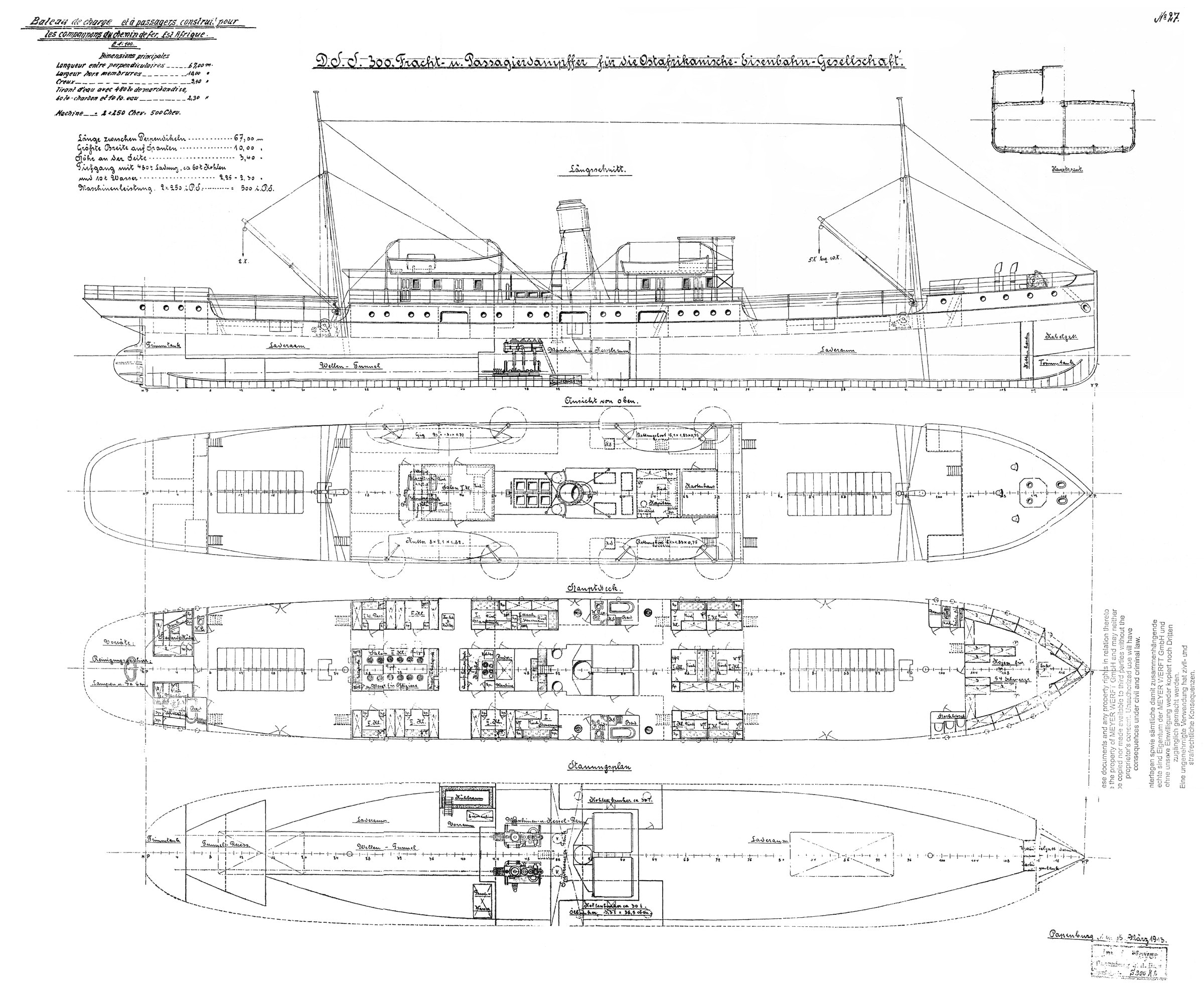
Meyer Shipyard Papenburg.
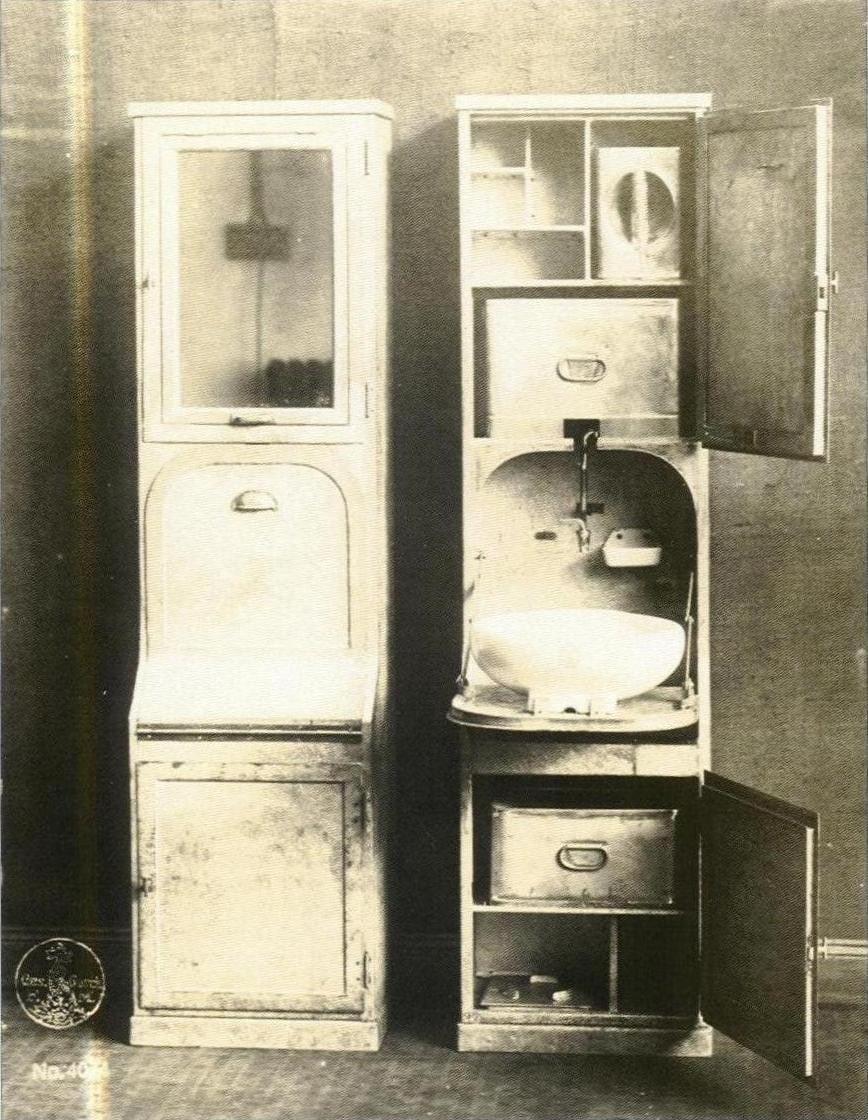
Meyer Shipyard Papenburg.
On 20 September 1913, the Director of the OAEG urged the Imperial Colonial Office to order a second ship with the same dimensions from the same shipyard. Thanks to falling prices and the fact that plans were already available, the cost of this vessel was 16,560 Marks less than its predecessor. Permission was granted on 20 October, and the ship, which was to be named FREIHERR VON RECHENBERG, after the governor of German East Africa from 1906 to 1912, was commissioned.{{ref}}
However, the outbreak of the First World War prevented delivery of the FREIHERR VON RECHENBERG. Major work on this ship continued up until 1916. Between 1917 and 1919 there were plans to convert it to a purely cargo vessel and put it into service elsewhere. Work continued up until July 1921 on a smaller scale but thereafter the ship was broken up for the raw materials and spare parts.{{ref}}
The order for a third ship of this class was never placed.{{ref}}
On 7 November 1913, at the order of Wilhelm Heinrich Solf, State Secretary of the Imperial Colonial Office, the names of the two planned ships were changed from GRAF VON GOETZEN and FREIHERR VON RECHENBERG to GOETZEN and RECHENBERG.{{ref}}
The components of the first two ships were manufactured at the Meyer Werft shipyard in Papenburg, under the direction and supervision of Germanischer Lloyd, for the class created specifically for these ships: “100 A 4 Lake Tanganyika”. Since the Goetzen was intended to be dismantled for transport to Lake Tanganyika, its components were not riveted during preliminary assembly in Papenburg but simply bolted together as a temporary measure. Between 15 and 22 November 1913, an inspection of the ship’s construction was carried out on the launch slip. This even included firing up the steam boilers and testing the steam engines.{{ref}} Acceptance by the OAEG took place between 20 and 26 November 1913.{{ref}}
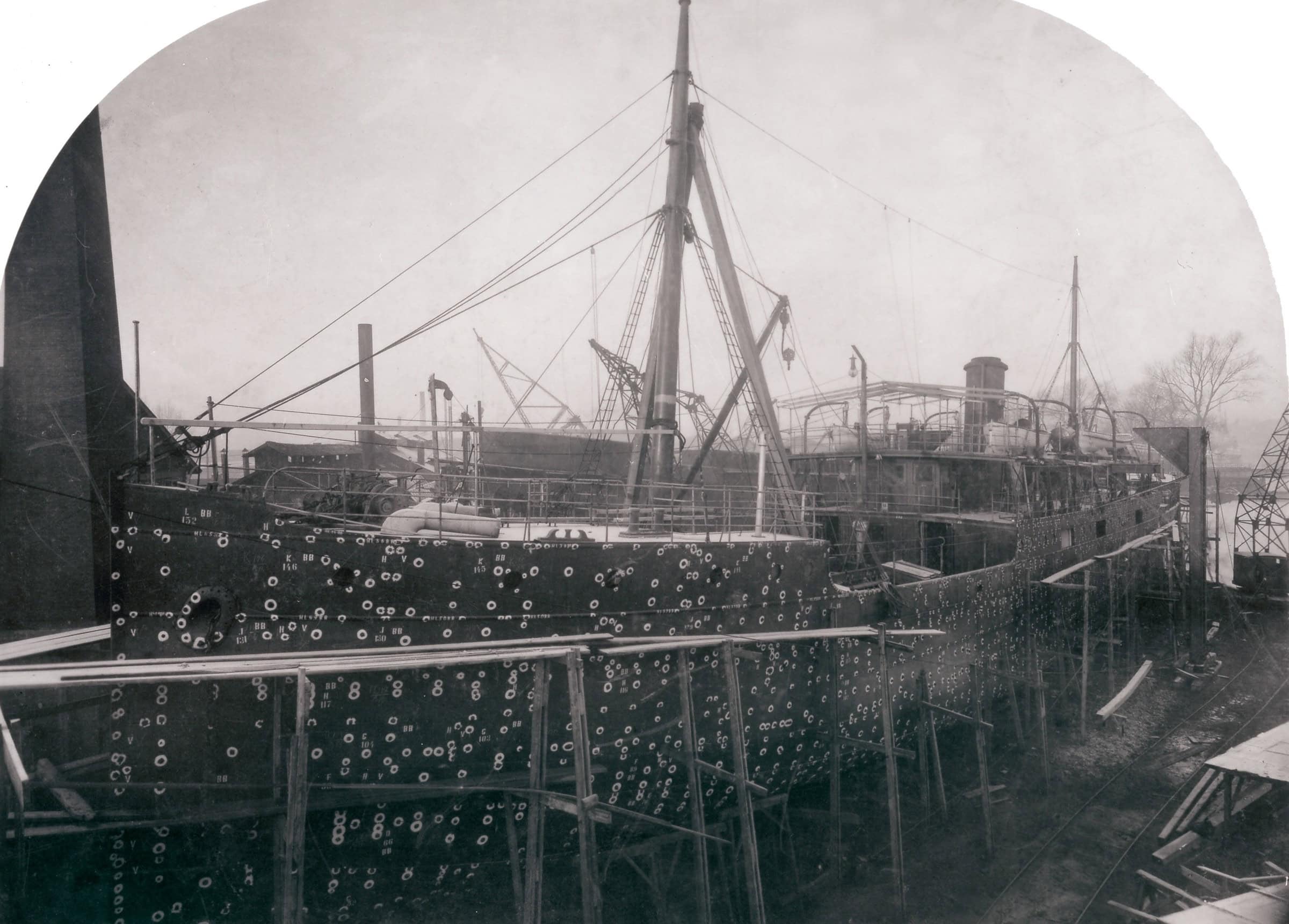
http://www.maritimejournal.com/__data/assets/image/0003/861708/Goetzen-1.jpg (accessed 22 February 2015).
The payroll records of Meyer Werft for 1913 and 1914 also offer interesting insights into the individual construction processes of “Ship No. 300, Passenger and Cargo Steamer for Lake Tanganyika”, since on the double pages 65 to 74 and page 98 the various construction jobs are listed for each person working on the vessel.
Between 25 January 1913 and 4 April 1914 extensive however unspecified work is listed, which presumably relates to building of the ship’s hull and superstructure.
For the propulsion system, two steam engines listed as “2 engines No. 39” were built between 18 January 1913 and 7 February 1914; the two “boilers No. 215/16” between 1 March 1913 and 10 January 1914; the propeller shafts between 15 March and 29 November 1913; the steam boiler fittings between 7 July and 29 November 1913 and a “device for installation of engines and boilers” between 20 September and 18 October 1913.
Also recorded are the construction of
- the pipelines between 17 May 1913 and 7 February 1914;
- the “ventilation machine (incl. casing)” between 17 May 1913 and 7 February 1914;
- the rigging between 24 May and 29 November 1913;
- the steering gear from the helm on the bridge to the rudder for the mechanical power transmission, including steering rods, rollers, guides and protective plates over deck between 2 August and 29 November 1913;
- the windlass between 6 September and 29 November 1913;
- the reversing engine between 13 and 27 September 1913;
- two cargo winches between 13 September and 29 November 1913;
- the bilge and ballast line between 20 September and 29 November 1913;
- the electrical system between 20 September 1913 and 7 February 1914;
- the ice machine between 11 October and 29 November 1913.
Finally, between 8 November 1913 and 31 December 1914, “inventory and spare parts, tools and subsequently ordered spare parts” were manufactured.
For the period 15 to 22 November 1913 there is a record of “testing on the stocks, heating the boiler, testing engines, etc.”.
“Disassembly, packing and loading of the ship” took place between 31 October 1913 and 31 December 1914.{{ref}}
The first thing that stands out when examining the figures from the payroll records is that various components were being constructed well into 1914. Up until 10 January 1914 these were the boilers, up to 7 February 1914 the steam engines, pipes, ventilation system and electrical system. Up to 4 April 1914 work was done on parts for the hull and superstructure, while inventory and spare parts, tools and subsequently ordered spare parts were even constructed up to the end of 1914. But these were mainly small items, presumably residual work, constructive alterations, subsequent orders or suchlike.
The head of company records at the Meyer Werft shipyard explains this as follows:
After 22.11.1913 a further 779.38 Marks were invoiced under the heading “shipbuilding”, of which 100 Marks were paid to the master shipbuilder (Rüter?) in April 1914, presumably as a bonus. Of the remaining 679.38 Marks, 3 marks were for tools, 0.90 Marks for the screw cutting machine, 90.60 Marks for shipbuilding (painting, cleaning, cementing), 9.86 Marks were received by the Master, 3.41 Marks by the forge, 3.93 Marks by the forge workers, 163.93 Marks went to the riveters and caulkers, 8.94 Marks were received by the carpenters for the woodwork, 55.68 Marks by the cabinet makers, 116.65 Marks by the (shipbuilding) fitters and 222.48 Marks by the shipbuilders and workers.
I assume that this was all residual work, perhaps even “repairs” to the installations for acceptance of the vessel. For the engines, the “outstanding amount” is just 54.65 Marks. Of which 39.48 Marks falls to the engineering works fitters and 3.15 Marks to the cabinet makers, who seem to have made a chest for the parts (?). For the boilers there is a sum of 0.50 Marks booked to the Master; then there was another 10.96 Marks for the boiler shop. Certainly, sums which could almost be disregarded. There is a similar scenario for the pipes.{{ref}}
Another surprising aspect is the data in connection with the “disassembly, packing and loading of the ship”. Evidently initial work on this started relatively early – on 31 October 1913 – and thus before the official acceptance, which took place between 20 and 26 November 1913. What the minor work carried out beforehand may have consisted of remains unclear. The bulk of the disassembly work was undoubtedly done in December 1913 and January 1914. Even though the amounts decreased significantly from February 1914, there are still records of work performed during the period from February to December 1914 in connection with the disassembly, packing and loading of the ship. Presumably, however, this consisted simply of residual work, subsequent orders or contractual changes. It is to be assumed that, from the beginning of July 1914, manufactured parts would no longer have been able to reach their destination due to the outbreak of war. This is true for instance of the slipway trolleys. The entries which continue up to the end of 1914 could be understood as an indication of a general hope for a rapid end to the war, i.e., an assumption that it would soon be possible to deliver to the colony again but it is also possible that the words “packing and loading” are to be interpreted in the sense of “storing” in anticipation of better times.{{ref}}
Transport from Papenburg to Kigoma and final assembly.
After disassembly in Papenburg, the individual components of the ship were packed into watertight crates (measuring 2 m x 2 m x 2 m) and then transported by rail to the port of Hamburg. There the freight was loaded onto the three ocean-going steamers ADMIRAL, FELDMARSCHALL and WINDHUK. The ships sailed via the Mediterranean and the Suez Canal to East Africa. The cargo on the ships ADMIRAL and FELDMARSCHALL comprised the equipment for construction of a complete shipyard for final assembly at the destination and also the entire components for the ship’s hull, whilst the WINDHUK transported the masts, boilers, steam engine and other accessory parts. The ADMIRAL reached Dar es Salaam on 17 January 1914, the FELDMARSCHALL on 31 January 1914 and the WINDHUK on 16 February 1914. The report by Cane also mentions the ADOLF WOERMANN, which is also supposed to have transported parts for the GOETZEN. It is reported to have reached Dar es Salaam on 2 March 1914 and was loaded with deckhouses, equipment for the interior fittings, as well as installation parts and spare parts.{{ref}} Arning also mentions the DOAL-steamer GENERAL, which was supposed to deliver the last parts of the ship and the devices for the launch, but which did not reach its destination any more due to the declaration of war.{{ref}}
In a telegram to the Imperial Colonial Office in December 1913, the Governor of German East Africa, Heinrich Schnee, had already demanded: Delivery of the ship GOETZEN and the shipyard must at all costs be accelerated. Request dispatch of 20 suitable shipbuilders, if possible employees of the railway company. Economic interests and prestige demand haste.{{ref}}
Insurance was taken out for transport of the ship overland in Africa and its reassembly. The insurance policy shows that the ship was insured for the period between 15 February 1914 and 14 February 1915, involving a total of twelve different British reinsurers for a total value of 25,000 British Pounds. The insurance covered all risks, including that of fire during the stages of building, fitting and trials. On the other hand, the policy did not cover the risk of possible claims, for instance due to third party liability issues of the employees or possible deliberate damage to the ship in the event of a worker revolt. The risk of a violent seizure of the ship (for instance by pirates) was also not covered, nor was damage in connection with the outbreak of military hostilities.{{ref}} In short: The British companies covered the risk of damage or fire during the transport and building phase in time of peace.
The ship’s components were sent to Lake Tanganyika together with three workers from the Meyer Werft shipyard, who had the difficult task of bringing the project to a successful conclusion. These were master shipbuilder Anton Rüter, riveter Rudolf Tellmann, and assistant Hermann Wendt. The three shipbuilders were granted leave from Meyer Werft and entered into the service of the OAEG. The pay was generous; Anton Rüter received a monthly wage of 600 Marks, and that was at a time when a skilled worker would have earned around 100 Marks a month. In addition, a number of insurance policies (covering risks including death and invalidity) were concluded on their behalf.{{ref}}
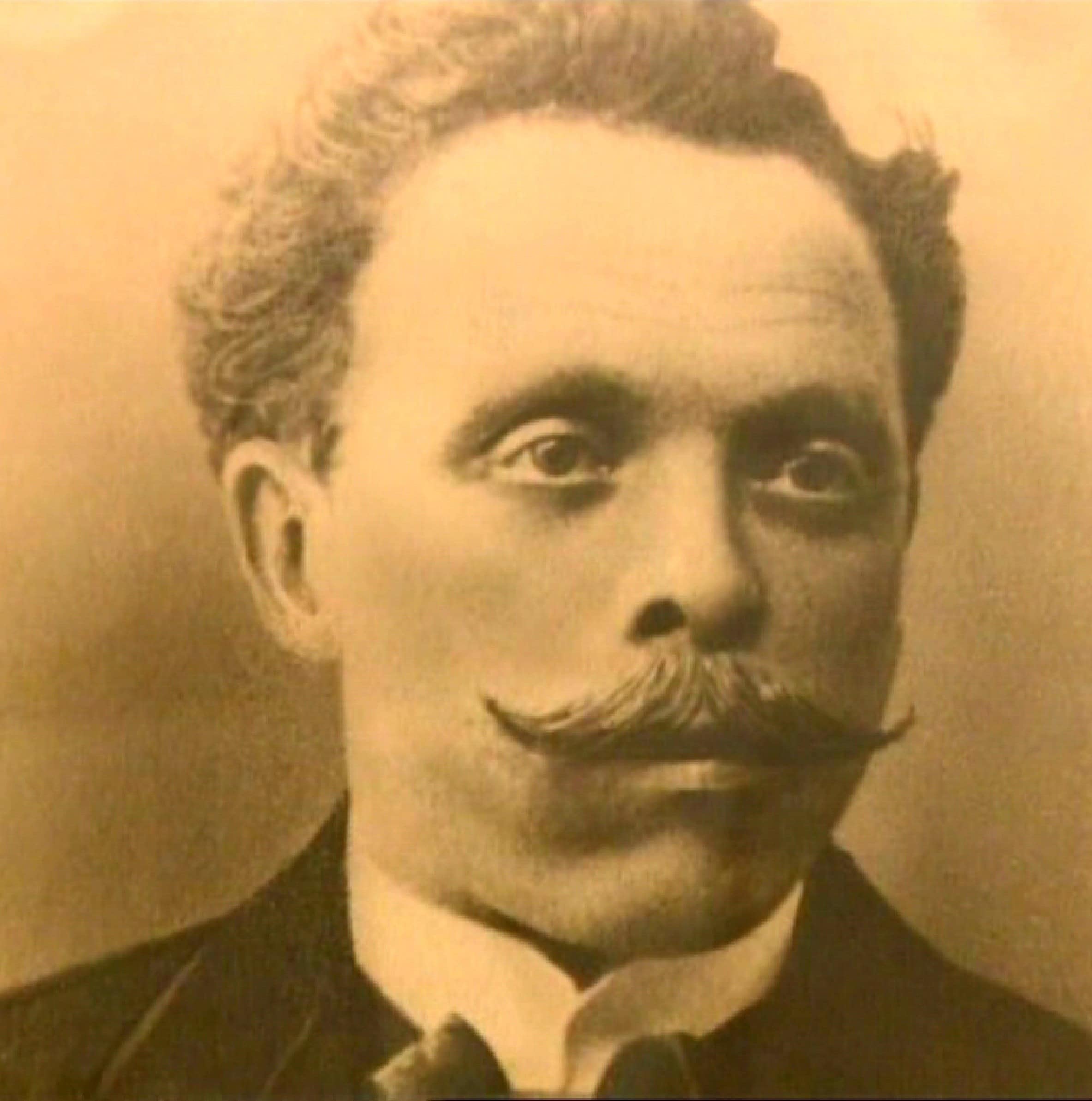
Copyright details unavailable.
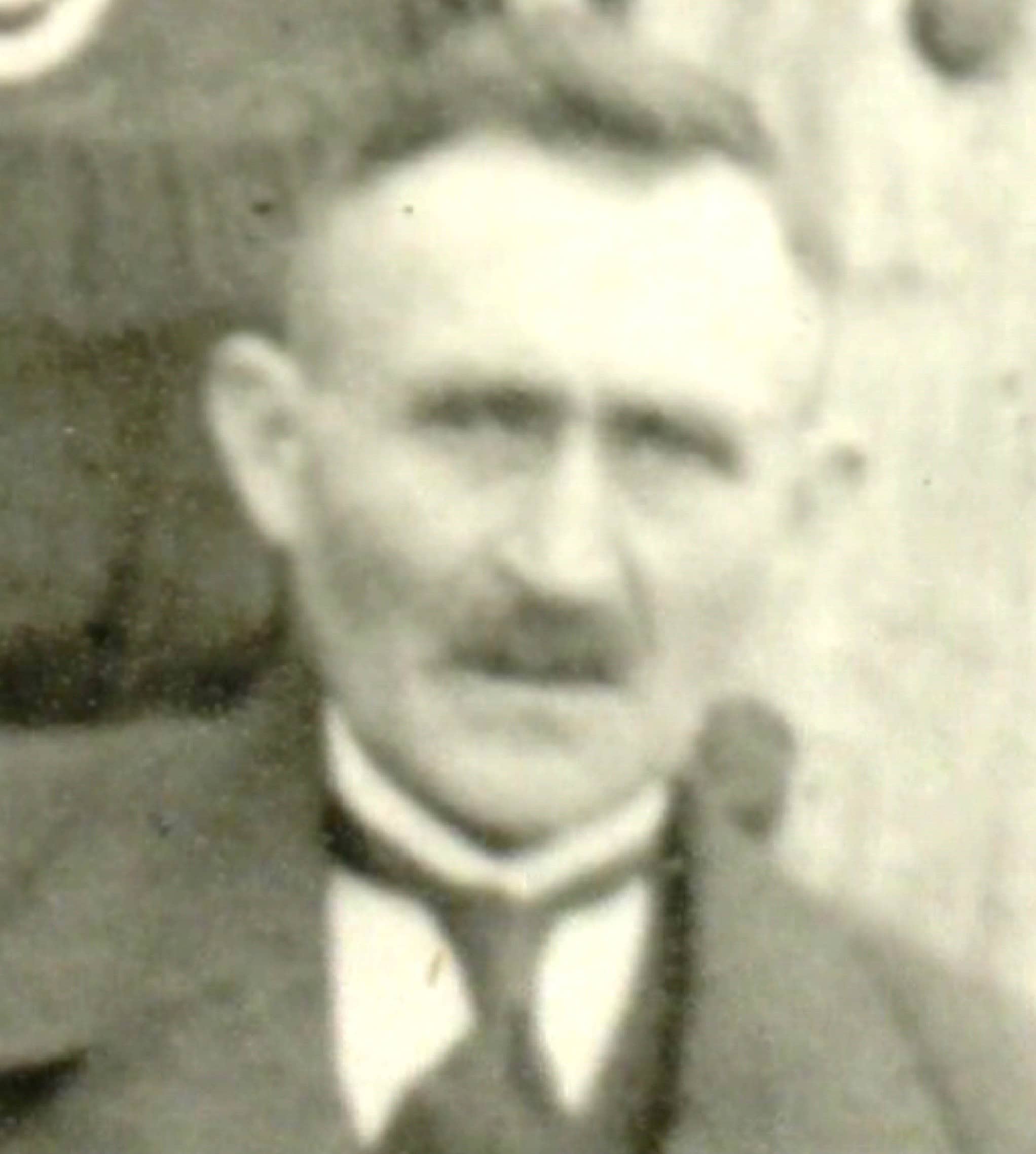
Copyright details unavailable.
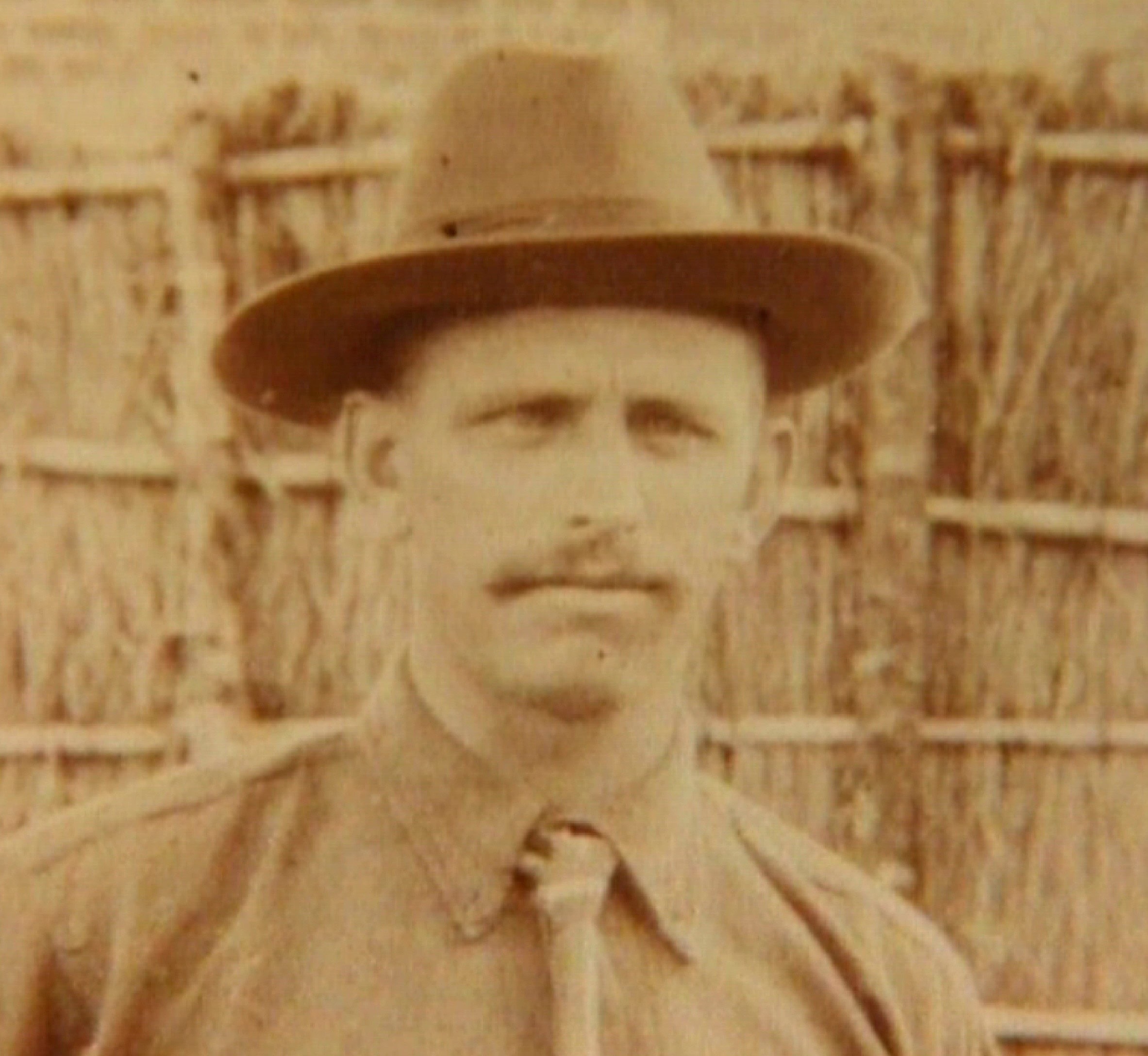
Copyright details unavailable.
The three shipbuilders from Papenburg reached Dar es Salaam on 16 February 1914, also on the steamer WINDHUK.{{ref}} At the same time, construction of the Central Line railway from Dar es Salaam to Kigoma was nearing completion. On the last section of the line, from Tabora to Kigoma, the railhead had already reached Kigoma on the evening of 1 February 1914.{{ref}}
The crates were transported onwards by rail, with a special low loader wagon being brought in for transporting particularly heavy sections.{{ref}} The rail journey was not without incident – a fire in one of the wagons bent one of the two propeller shafts.{{ref}}
It has often been written, that thousands of carriers were used over many months to transport the components of the GOETZEN manually{{ref}}, but this has not been confirmed by any reliable sources up to now. On the contrary, it can be assumed that this situation once was confused and then always incorrectly reproduced. Indeed, a few years before the GOETZEN, the individual parts of two – but significantly smaller – German steamships were carried by hundreds of carriers around 1000 kilometers into the interior: The HEDWIG VON WISSMANN to Lake Tanganyika and the HERMANN VON WISSMANN to Lake Nyasa. The individual parts of those ships were, as far as possible, dimensioned in a way, that they could still be carried. For the heavier parts, however, there were appropriate transport devices.{{ref}}
Also, German naval commander Gustav Zimmer mentions in his report that the components of the GOETZEN arrived at the lake before the outbreak of war, when the railway to Kigoma was finished.{{ref}} This is mentioned by Baltzer in a similar way; the railway was opened to limited public transport on 15 March 1914.{{ref}} The official commissioning of the railway took place later.{{ref}}
Heinrich Schnee, the last governor of the colony German East Africa, also describes the fact that the railway had not been officially opened: In the middle of Lake Tanganyika, the district of Udjidji bordered on it with the Kigoma port facilities, the end point of the central railway. When the war broke out, the last end of this path was still in the process of completion. The opening of the railway should have taken place in August 1914 during the planned national exhibition with the participation of the colonial representatives from home in a solemn manner. The port and railway structures in Kigoma itself were not yet completed, nor was the 600-t steamer “Graf Götzen”, which was the first large Tanganyika steamer to ensure transport on the lake with both the German shore and the Belgian Congo. The route to Kigoma of the central line was completely finished shortly after the start of the war, and work with the port facilities also continued.{{ref}}
Upon their arrival in Kigoma, the OAEG provided the three shipyard workers with 20 Indian employees from the Dar es Salaam railway assembly workshop and several hundred African workers to help in the final assembly of the vessel. They were later joined by additional helpers from the German navy.{{ref}} The assembly was to take more than a year; during that time, World War I broke out.
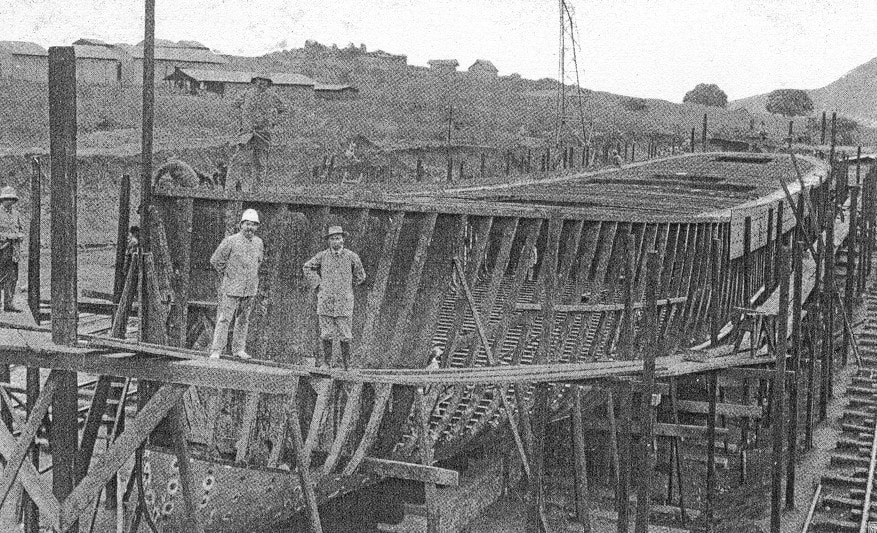
http://www.golf-dornseif.de/uploads/Als%20GRAF%20GOETZEN%20in%20Kisten%20auf%20Safari%20ging.pdf (accessed 22 February 2015).
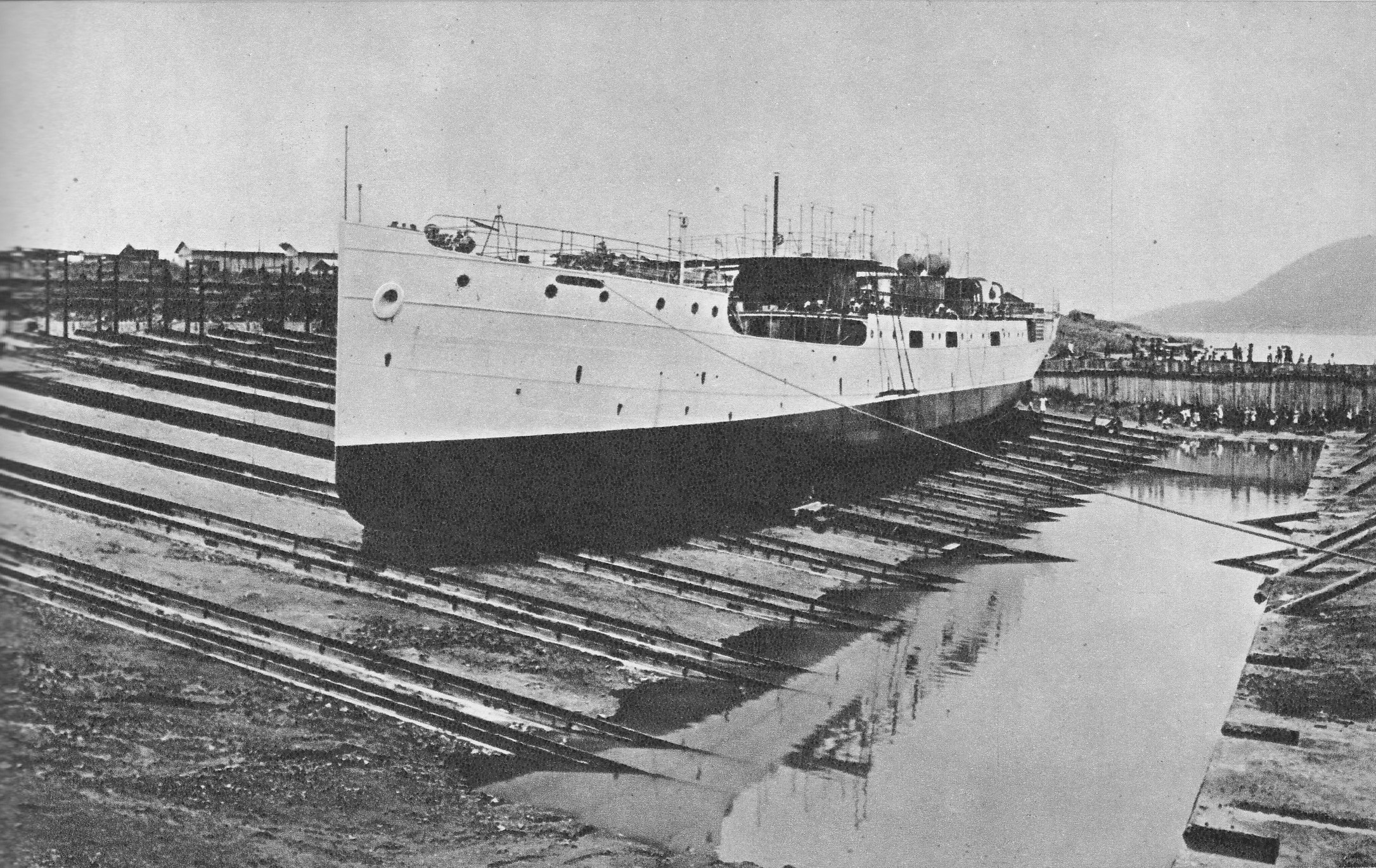
Mervyn F. Hill: Permanent Way, Vol. 2. Page 202.
During this time Master Rüter wrote letters to Franz Joseph Meyer which highlight the situation facing the three shipbuilders in Africa:
Apart from the missing cover plate for the foredeck, everything that was shipped is now in Kigoma, except for two crates with deck screws, which are apparently somewhere in Dar es Salaam … The rigging was rendered totally unusable by a fire on the open wagon during the railway journey … We have now been building for three weeks […] we can hope to be ready to launch by August. The central electric unit, which I had to build myself, is now ready too; a crane has been in operation for a couple of days now … With the exception of a completely useless carpenter and an electrician, I have had no European help; I employ on average 20 Indians and 150 blacks; when the riveting starts this will presumably increase by about 100 … I had to make the main electrical unit on my own, and the crane has been working smoothly for a few days now. But the fire during the rail journey has bent one of the propeller shafts … Whether we will be finished in August I cannot say at the moment because it depends on the riveting; we will manage the other things. […] Mr Hillenkamp has already asked me whether I want to build a second (steamer). Do you think I should do it? I would like to. […] We are all still well and have not had fever at all up to now. We don’t have enough khaki uniforms and shoes. The work is progressing well; here’s hoping the ship will be watertight … We have been working on the ship for three weeks now and hope to be ready to launch in August…{{ref}}
On April 19th, we started laying the A-plate, the Sunday after Easter, since work is required on Sundays as well. We’ve been working on it for about eight weeks now. We’ve got all the frames up. The deck stringer and shear gangway are also finished, as are all the B-plates and C-plates. We’re still missing two D-plates on each side at the stern. The G-gangway is also in place. We’re currently working on the F-gangway. We’ll do the E-gangway later, as it will make getting into the ship easier.
I’m pleased to report that everything is going very well so far. We’re very happy about that. We’re making good progress with the riveting; the deck stringer and bulkheads will be finished soon. We’ve also driven in a lot of rivets on the bottom. They’re all being riveted with compressed air, and I’m confident the rivets will be tight, as we’ve got people who have experience with compressed air riveting. If we hadn’t had compressed air here, we’d be in trouble, because most of the riveters are very lazy. They’re good up on deck and at stringing. The compressed air riveters are Black guys from around here. They’re very hardworking.
Whether we’ll be finished in August, I can’t tell you yet, because it depends on the riveting. We’ll probably finish the rest.
Mr. Hillenkamp already asked me if I wanted to build the second one too. What do you think about that? Should I do it? I’m tempted. I’ve also written to my wife for permission.
I wrote to you about not riveting the end pieces for the second steamer. I’ve thought about it; it would be better if they were riveted, then they can’t warp anymore. And we have cranes for unloading now, so keep that in mind.
The other things have surely already been sent, since I asked for them to be. I still need to check if the 14 and 12 mm and 3/8 mm tack bolts were included. They weren’t available back then, and there were very few at the shipyard. I don’t have fifty of them here. In the superstructure, including the bridge deck, there are 14s. Please ensure that some are sent. This is very inconvenient for me as well. The plumb line will be done exactly the same way I did it, with angle irons and a small groove. What kind of holes do I need in the floor and also in the bridge deck?
As you wrote to me, my position will be retained, and if I do everything well, I will become a proper master craftsman, for which I express my sincere thanks. And it will be my aim to build the ship so well that everything is watertight. And I will always be faithfully at your side, with all my knowledge and skills. I can inform you that we are all still in good health and haven’t had a fever so far.
Our khaki suits aren’t particularly good. There weren’t enough of them. We’ve already ordered new ones. And we also didn’t get enough shoes. We should have always had four pairs if we were to stay here. Would you be so kind as to send us a few more things? They can be packed in one or two boxes; there’s no need to specify that. It’ll be included. Then we’ll send them to you or my wife. Please let us know if you’d like to do that. Then we can make the necessary arrangements.
For the second ship, we still need all sorts of staples. A thousand 22mm staples, five hundred 20mm staples, a thousand 18mm staples, five thousand five-eighths of a staple, five hundred 14mm staples, five hundred 12mm staples, and five hundred three-eighths of a staple—not less, but rather more, as we had very few. The 22mm staples were a lifesaver.{{ref}}
A telegram to the railway administration in Tabora dated January 1915 announced a planned launch date of 25 January. A letter to them dated 18 May mentioned a date for the ship’s maiden voyage and its handover to a navy detachment of the German colonial armed forces for the following week. Representatives of the railway administration were invited to both events but the damage to the propeller shaft meant it was not possible to keep to these dates.{{ref}}
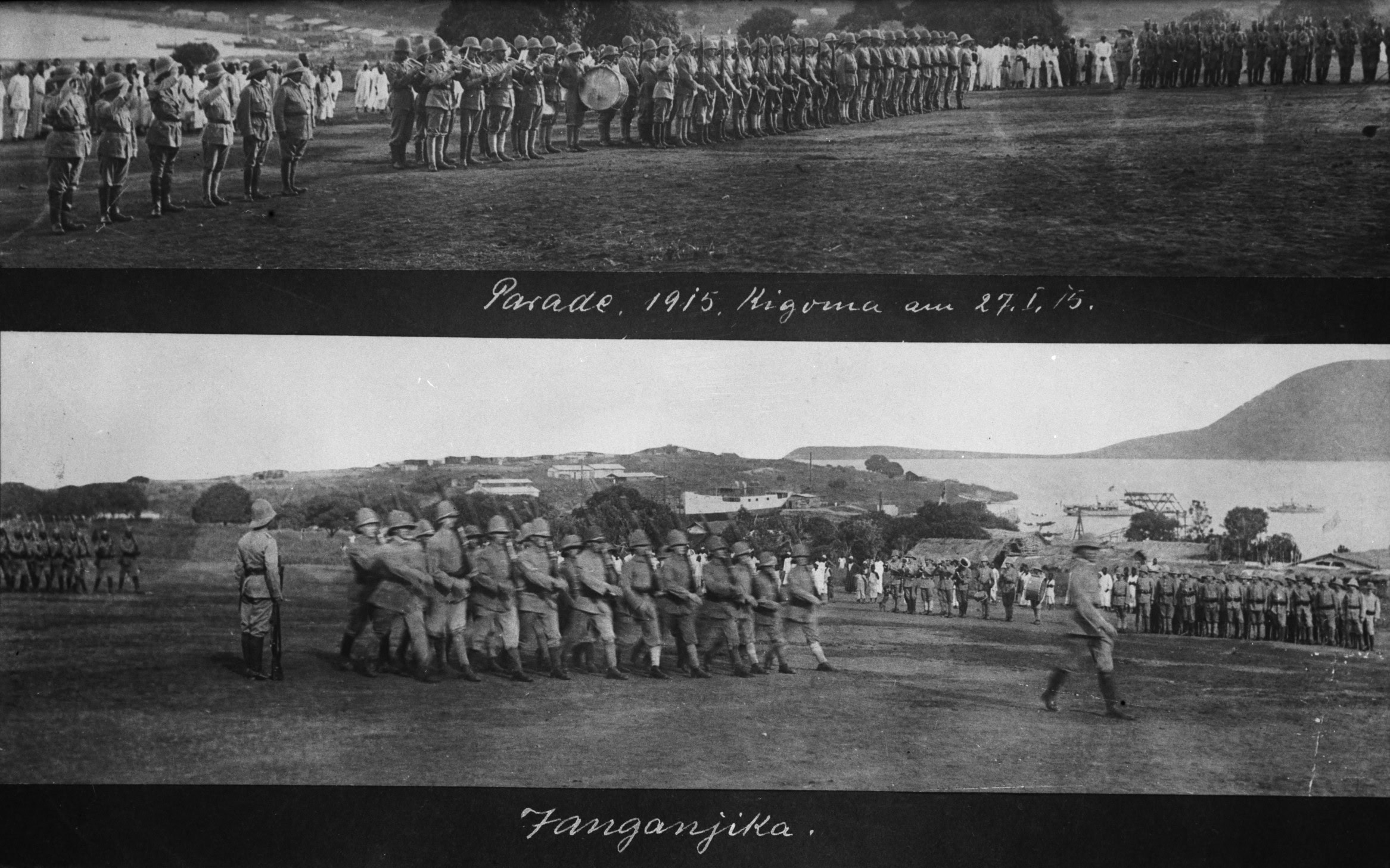
Photo Archive of the German Colonial Society, University Library of Frankfurt am Main, 016-1287-08.
After the outbreak of war, some important components for the ship and its launch could no longer reach Kigoma, so the three Papenburg shipbuilders needed all their ingenuity. With the support of the director of operations at the OAEG, Karl Hillenkamp, and under the leadership of engineer Hübner from the firm Philipp Holzmann, solutions were found for most of these problems.{{ref}}
The shipyard manager Franz Joseph Meyer describes the improvised launch in his account as follows:
The firm Holzmann dug a dock in front of the construction site into which the ship was gradually lowered. Then the dam separating the dock basin from the lake was pierced and dredged away, and the ship floated up.{{ref}}
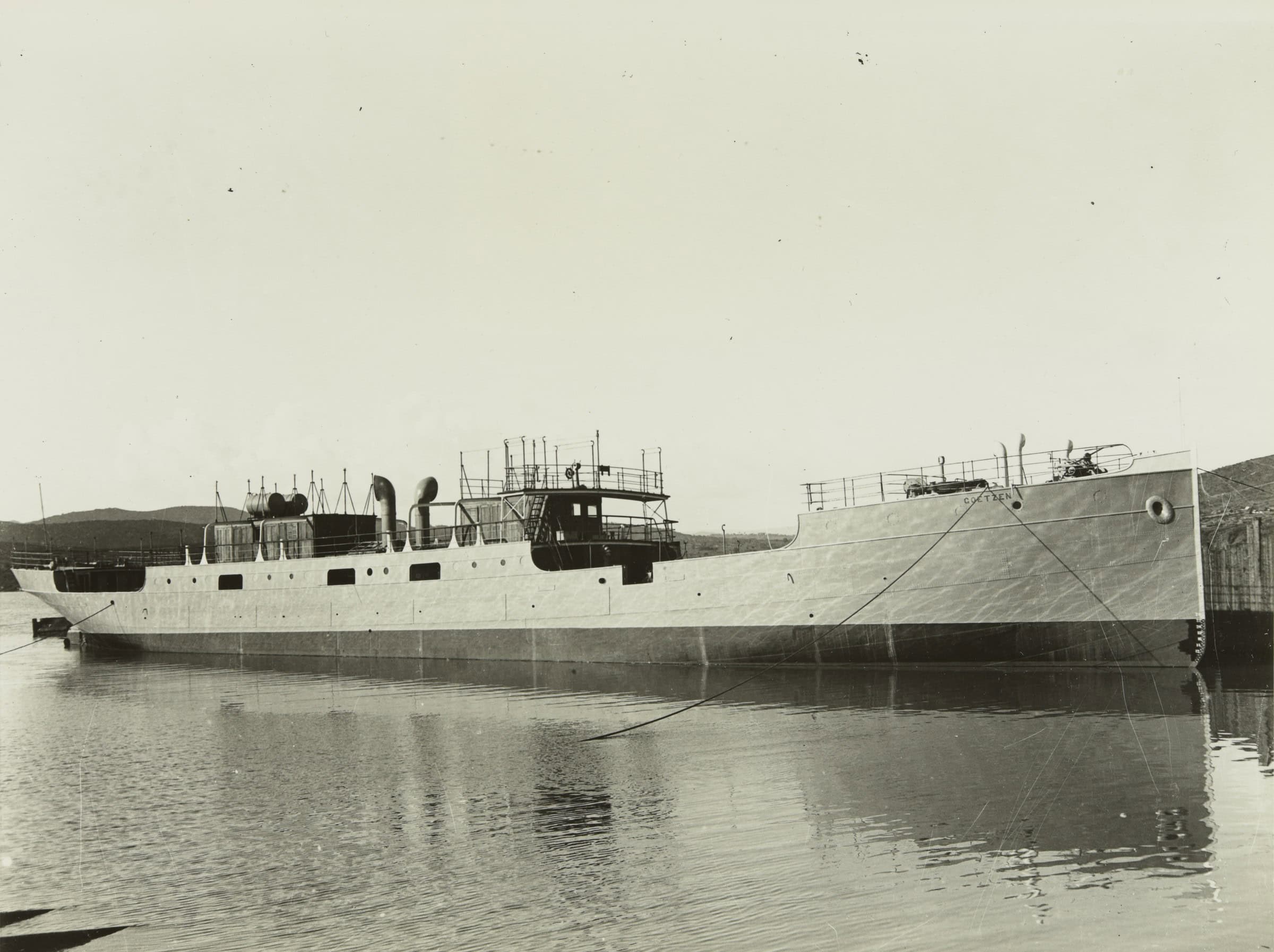
Royal Museum for Central Africa, Tervuren, Belgium. 2017.24.452.
On 5 February 1915 the ship floated on the water for the first time. Then her fitting continued in Kigoma using the land crane (lifting capacity: 25 tons). At the end of May 1915, the work was finally completed.{{ref}} The cost of preliminary assembly, transport and final assembly amounted to around 750,000 Marks.{{ref}}
One morning in the first half of June 1915{{ref}}, the GOETZEN completed her first voyage with 700 members of the German colonial armed forces on board for a transfer of the 24th Field Company to Bismarckburg. The trip had its problems, as evidenced by a report dated 18 June 1915 from Lieutenant Batzner to Governor Schnee. According to this report, the ship was in the Kungwe Bay with a heavy swell and a strong south wind, and was at first not making any headway at all. Between 6 a.m. and 9 a.m. it only managed to cover half a mile. The power of the combined 500 ihp steam engines proved totally inadequate and, on account of the vessel’s insufficient trim, its propellers were constantly coming out of the water. Added to this, at around 8.30 a.m. the mechanical rudder system (a British product) gave up the ghost. The hand-operated steering system also failed, the hatches were not battened down, and the few bulkheads were not very thick, so the GOETZEN found itself in serious difficulty. The proud ship was tossed about by the waves and began to roll heavily, whilst inside everything was thrown around. The rudder system was working again by about 9 a.m., but by 3 a.m. of the following day both the mechanical and the hand-operated rudder systems had failed again. At this point, when the ship was level with Utinta, it went off course and once again began to roll and list. The wind then drove it north towards Kigoma and, at a speed of about three to four knots, it drifted approximately two miles from the shore. Because of the absence of a double bottom and the few bulkheads, the crew again faced the risk of shipwreck. However, at around 4 a.m. they managed to repair the damage and, in quiet waters, the ship reached Bismarckburg at around 7 p.m. The journey from Kigoma had taken 50 hours.
The report did add, however, that the ship sailed perfectly smoothly in calm waters and that travel was then extremely pleasant.{{ref}}
Further trials or acceptance trips took place on 8 and 9 June 1915, travelling south from Kigoma. During the speed trials on the first day, an average speed of just 7 knots was reached with fresh, unstripped wood. When, on the second day, dry debarked wood, which had been loaded in Kalago, was used, the average speed was 8.25 knots. But according to the contract, the speed should have been 9.5 knots. The final report also mentioned that because of missing parts, the refrigeration and lighting systems and the other electrical systems were unable to be put into operation.{{ref}} Additionally, the outbreak of war also meant that the compasses, an anchor and some chains and lamps had failed to reach their destination. Other shortcomings were rectified by the ingenuity of the railway company, who were able to provide four boats, a portable boiler and even an iron cooking stove. The report on the trial runs{{ref}} was signed by the director of operations, Karl Hillenkamp on behalf of the OAEG and Commander Gustav Zimmer.
Lieutenant of the Naval Reserve, Theodor Siebel{{ref}}, became the ship’s Captain and his deputy was First Mate R. Edel, also of the Naval Reserve.{{ref}}
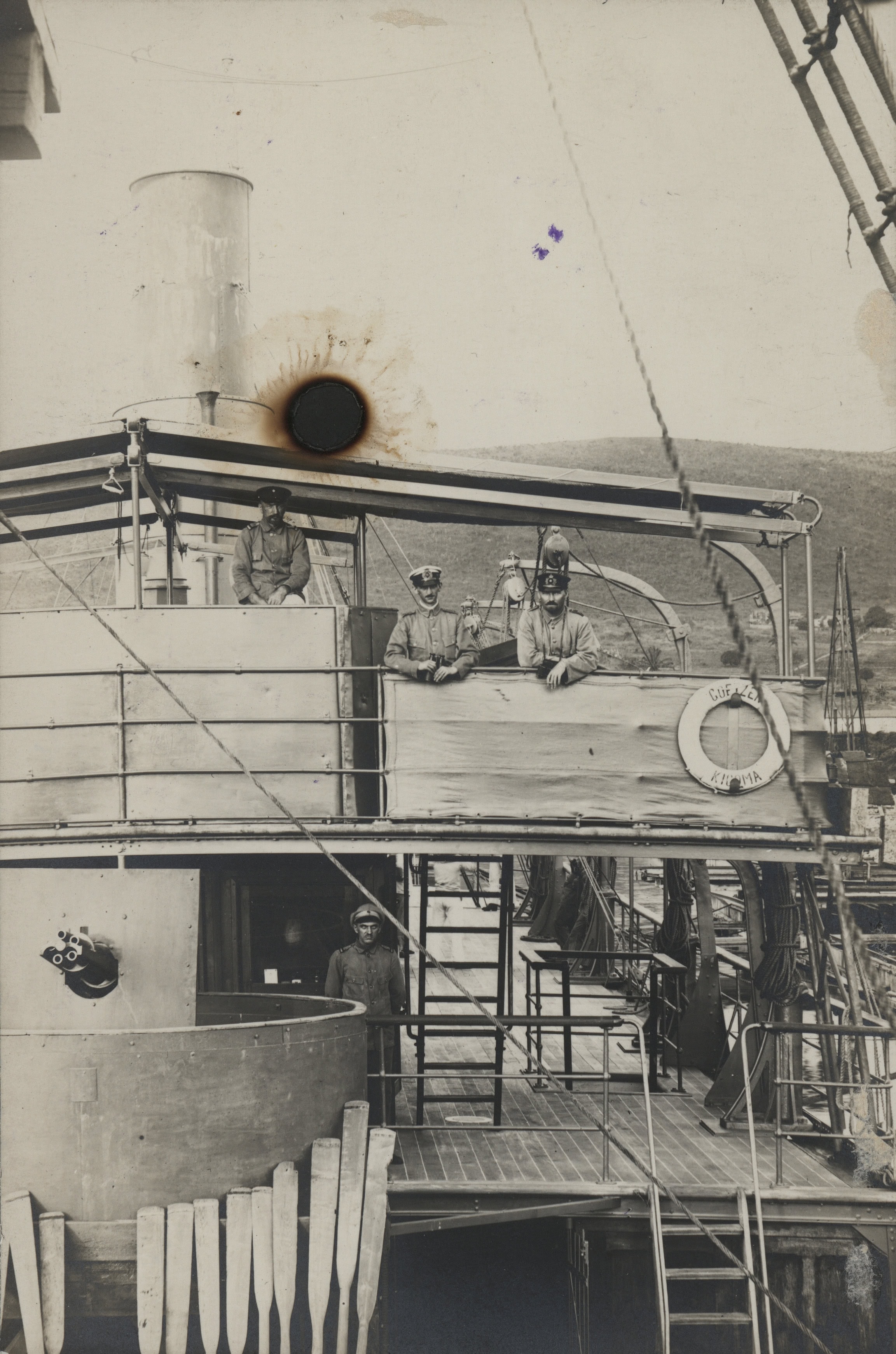
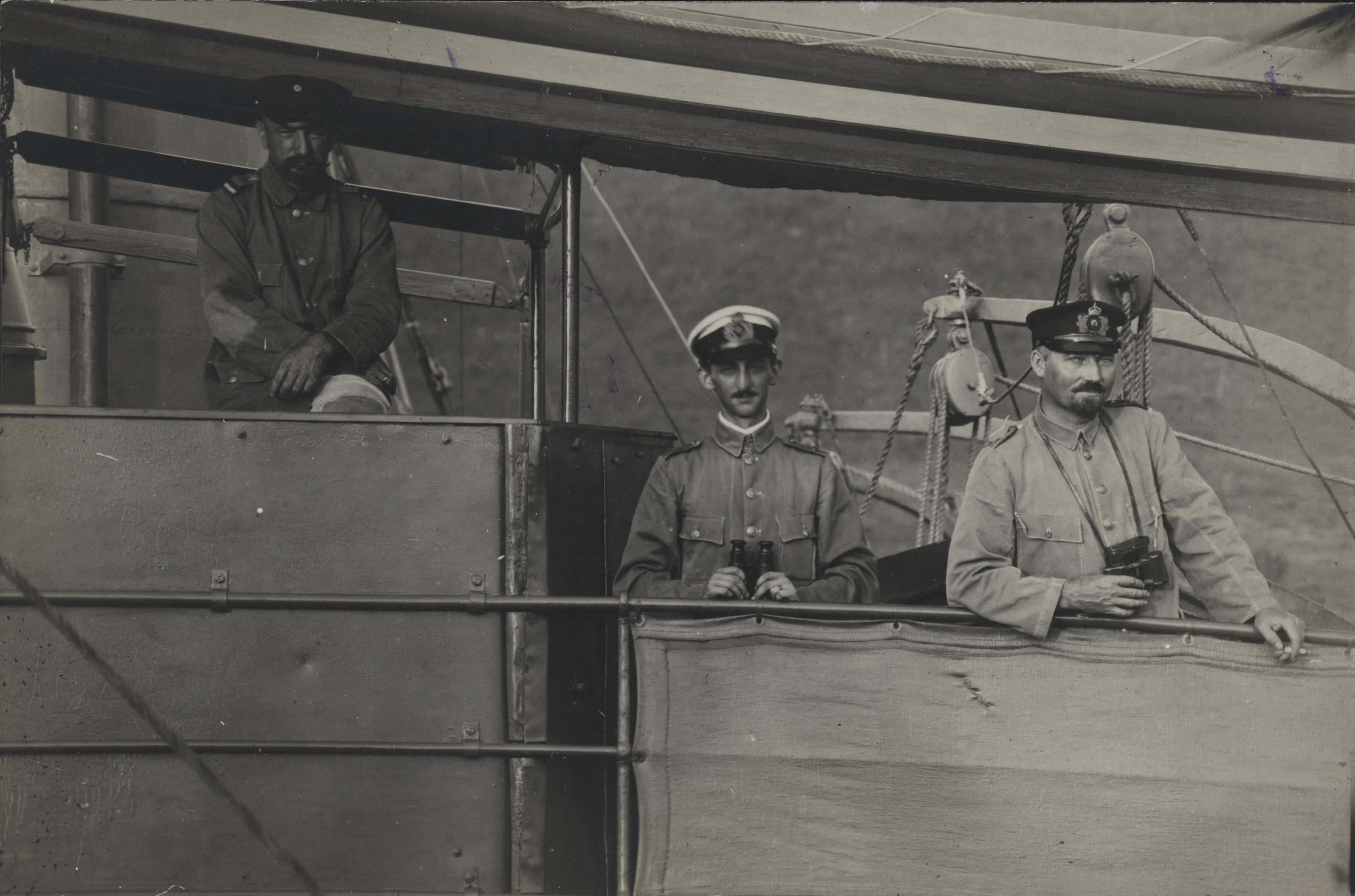
The person on the left is likely to be Reserve Lieutenant Theodor Siebel.
The person in the middle is likely to be Reserve Second Mate R. Edel. His white cap is puzzling; he may have worn it because he was temporarily deployed as commander on the customs cruiser KINGANI in 1915. In another photograph, the gun crews of the GOETZEN are also seen wearing a mixture of blue and white caps. This should not be overinterpreted; it is more likely that, at that time, people simply wore whatever uniforms were still available.
The person on the right is most likely Lieutenant Commander Gustav Zimmer.
Royal Museum for Central Africa, Tervuren, Belgium. HP.1958.40.6, HP.1958.40.4.
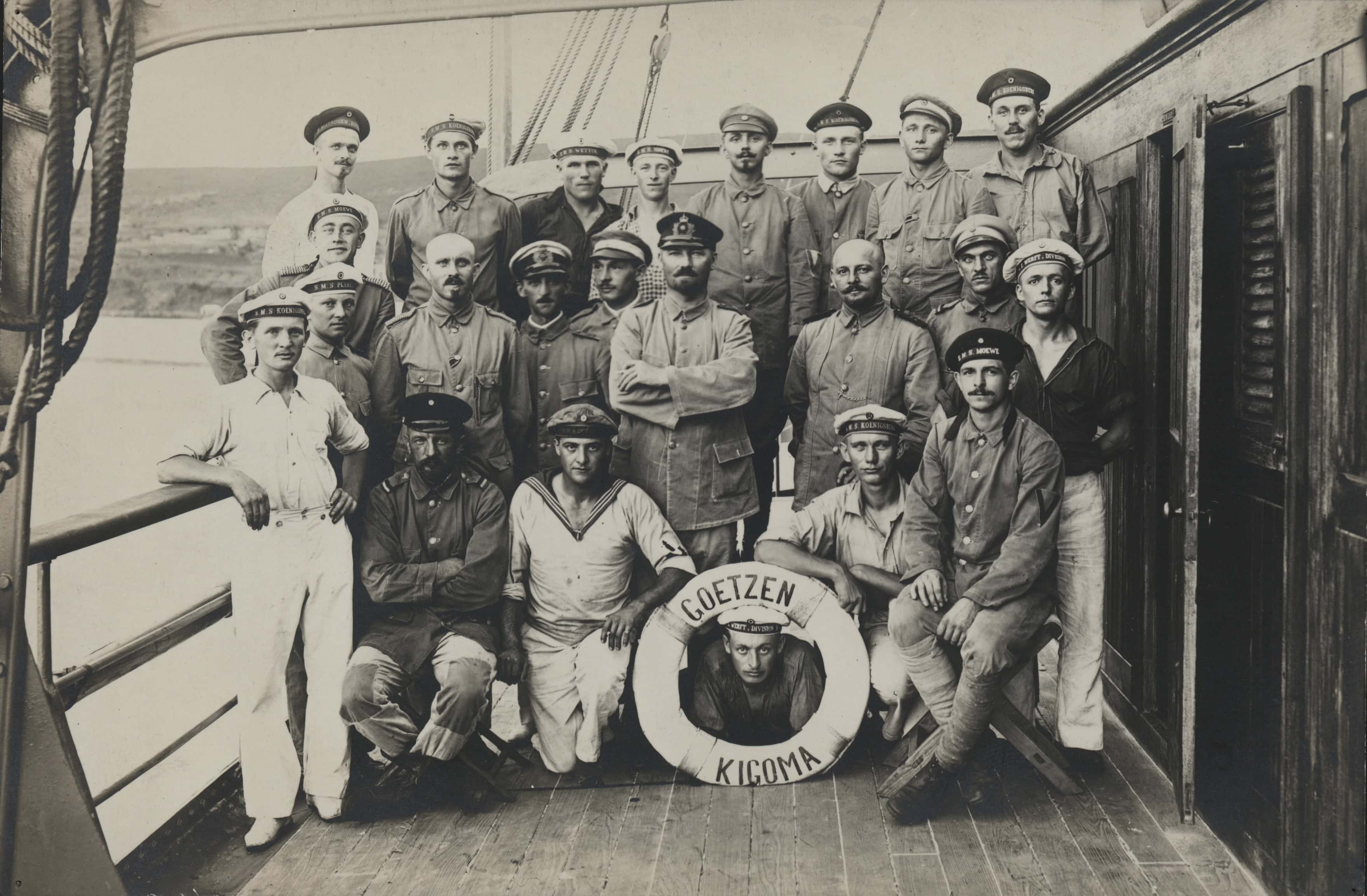
Royal Museum for Central Africa, Tervuren, Belgium. 58.40.5, Boats-G.
Unfortunately, it transpired that the GOETZEN had several construction defects, as Commander Zimmer wrote in a report to Governor Heinrich Schnee, dated 20 August 1915.{{ref}} These consisted of
- an insufficient draught;{{ref}}
- the lack of a double bottom. This meant there was a risk of sinking if the hull should start to leak – as the result of stranding, for example. The subsequent addition of a double bottom should also include trim tanks;
- too few bulkheads, which were also too weak. Particularly the bulkheads in front of the boilers should be strengthened;
- non-partitioned cargo holds: the cargo holds should be compartmentalised to prevent the load from slipping;{{ref}}
- vibration during operation: the ship’s construction should be strengthened in order to prevent the severe vibration at higher speeds;
- insufficient power from the steam engines to enable the ship to make headway against the wind in the storms which occur on Lake Tanganyika;
- a rudder system extremely susceptible to faults;
- too short and too narrow berths, so passengers’ arms and feet came into contact with the mosquito nets. Instead of wooden berths, iron berths should be fitted which were easier to remove and keep clean. The dark wood of the cabins should be painted white;
- too short cargo derricks on the two loading hatches: each derrick should be sufficiently lengthened;
- an unfortunate positioning of the davits and inadequate fastening to the deck: the davits should be moved to the upper deck and be made of tubular steel;
- an inadequate boiler draught: since the boilers were designed primarily for coal firing, the funnel should be extended by two metres to improve the draught with wood burning.{{ref}}
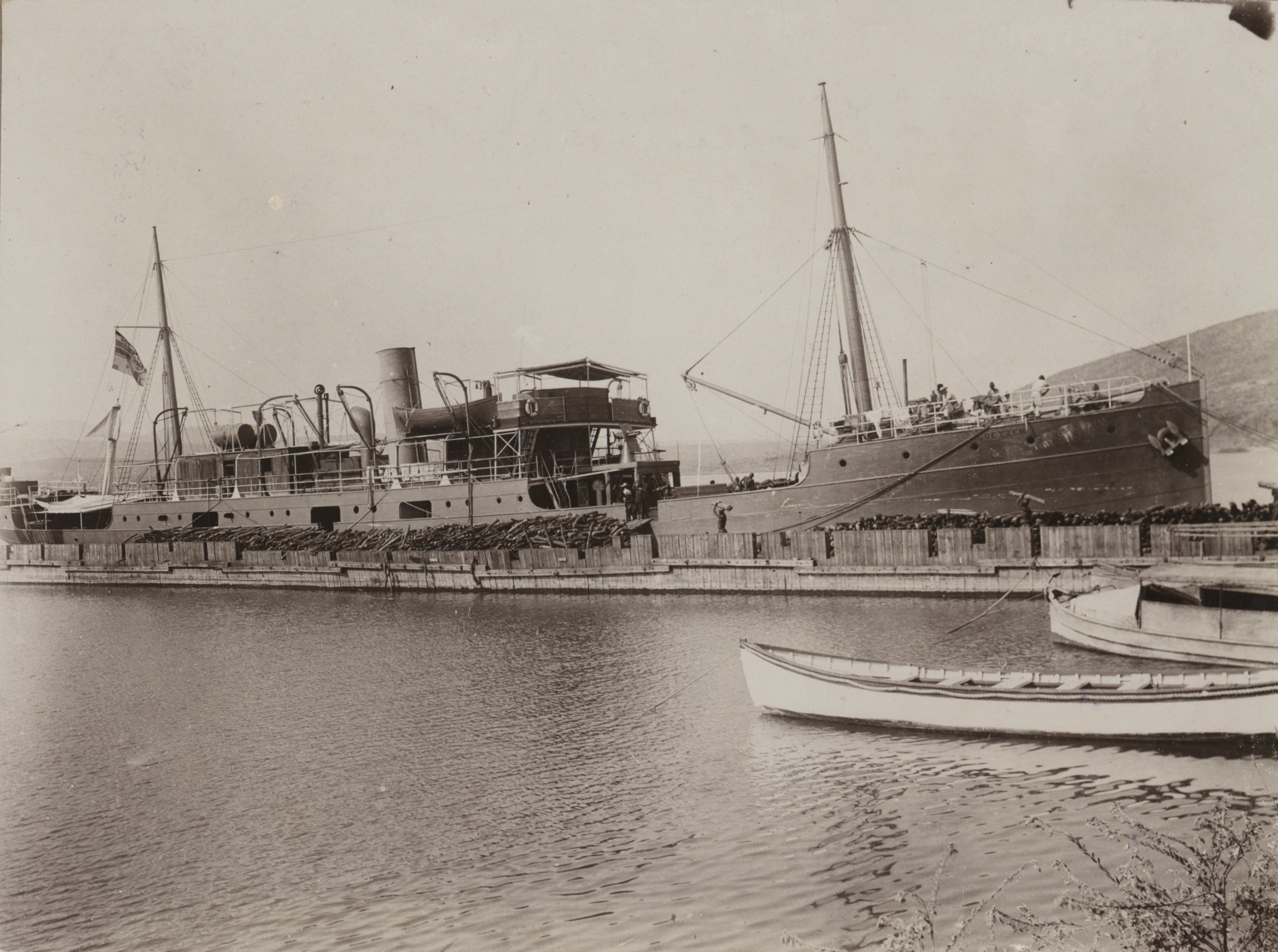
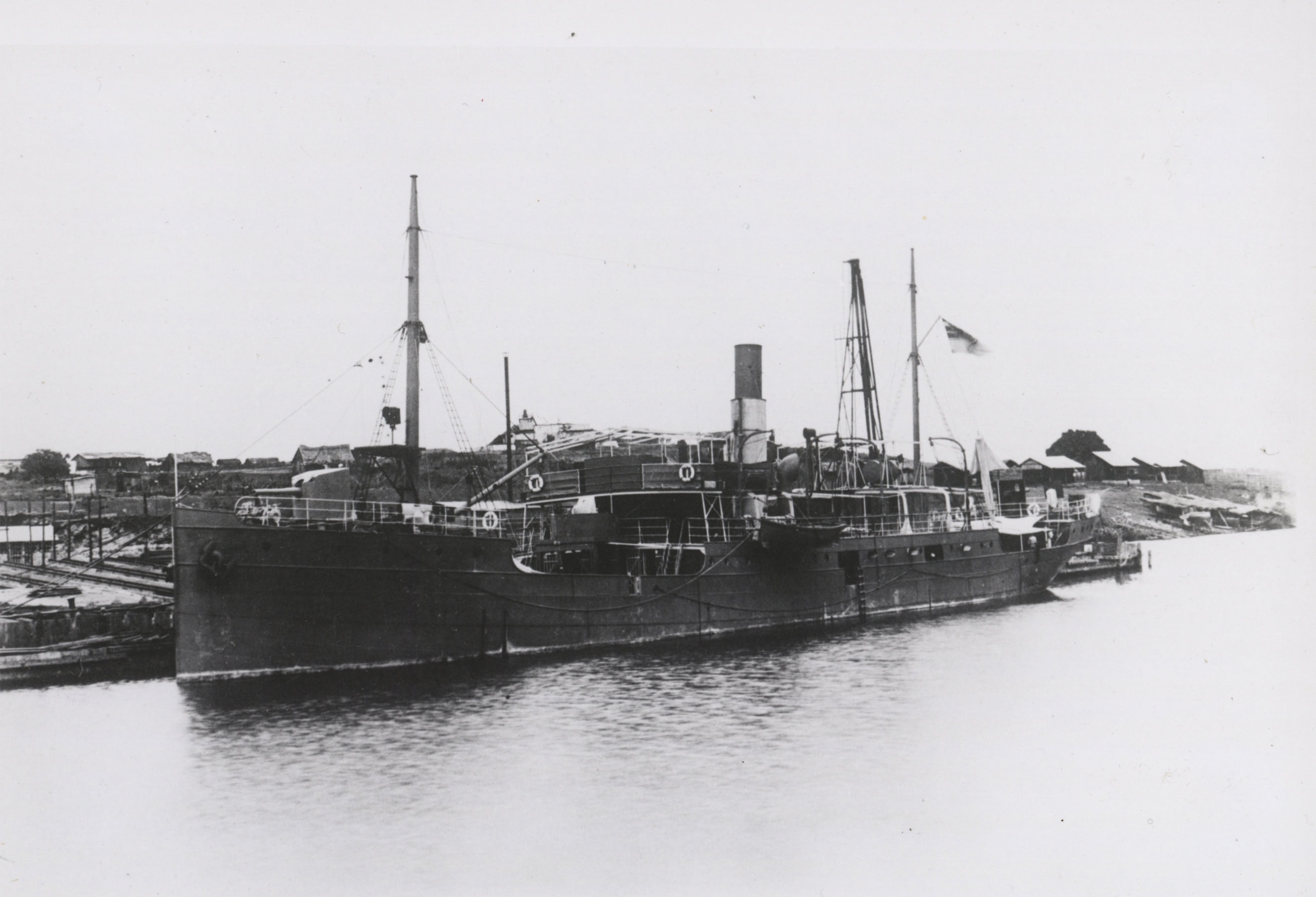
Royal Museum for Central Africa, Tervuren, Belgium. HP.1966.1.1671, HP.2010.8.2572.
The First World War.
As the first battles started on Lake Tanganyika in May 1915, the ship was converted to an auxiliary ship on 9 June and put into service for the German colonial armed forces to protect or defend the long western border of German East Africa against the neighbouring Belgians and British. For these reasons she was appropriately armed. First, she was fitted with an 88-mm rapid-loading gun on the bow, which had previously been given in Dar es Salaam to SMS MÖWE{{ref}} by the light cruiser SMS KÖNIGSBERG, which later had been scuttled by its crew at the mouth of the Rufiji. Then there were the two 37-mm revolver-cannons on the middle and after deck, which also came from SMS MÖWE. In August 1915 a 105-mm rapid-loading gun from SMS KÖNIGSBERG became available. The gun was mounted on the GOETZEN as its new bow gun. The 88-mm gun, which had been mounted on the bow up to then, was moved to the stern and the 37-mm revolver-cannon previously mounted on the stern was added to the one already mounted on the mid deck. In addition, armour plating was fitted for the weapons and the skylights. The navy was obliged to remove this equipment before returning the ship to the OAEG.{{ref}}
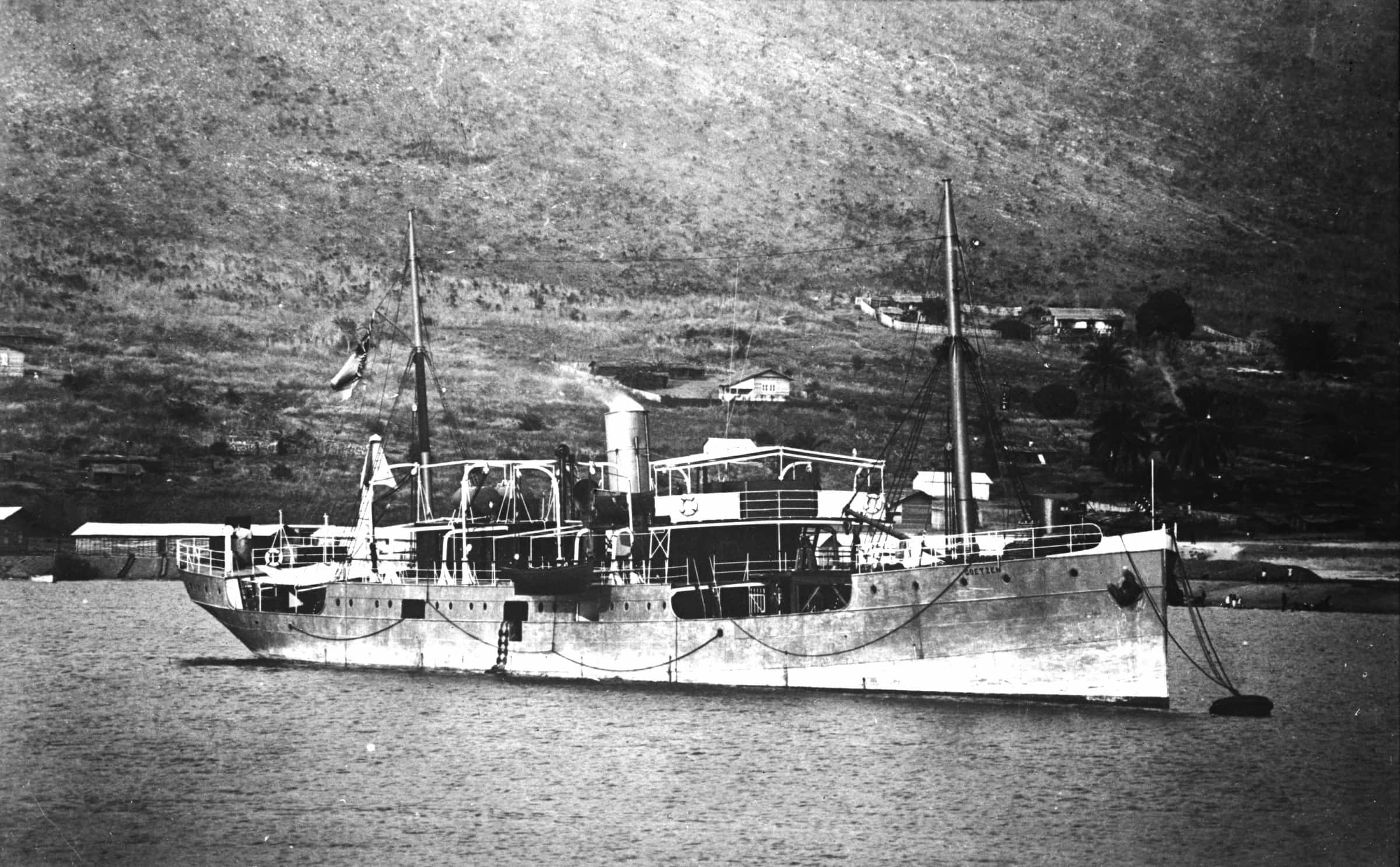
Photo Archive of the German Colonial Society, University Library of Frankfurt am Main, 016-1287-11.
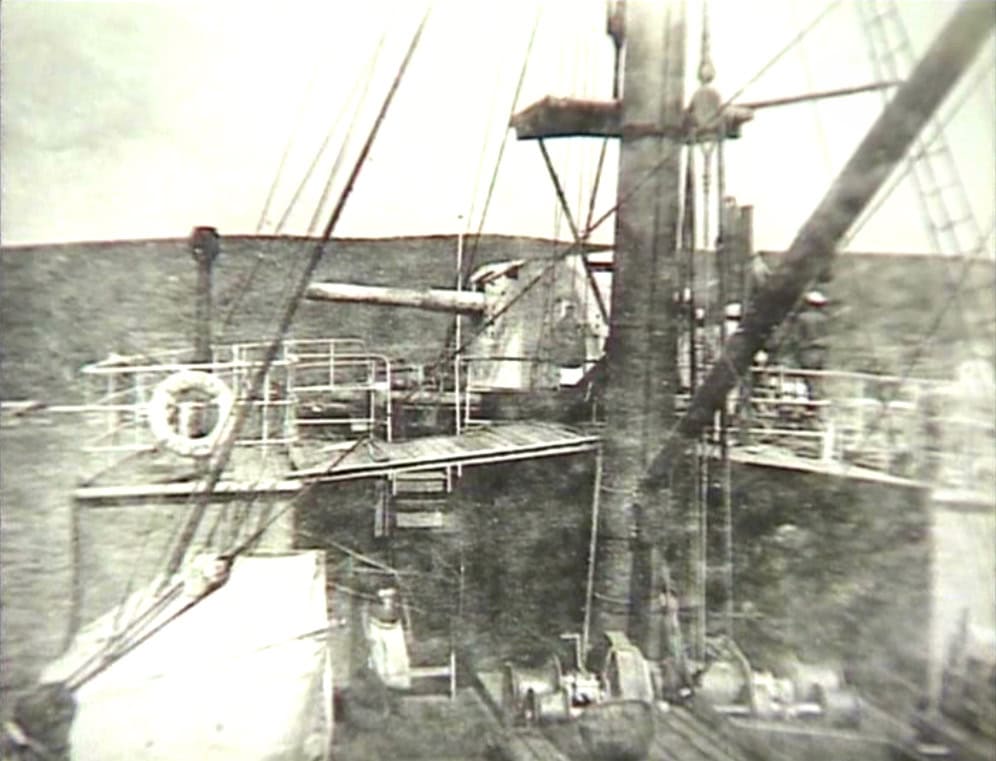
Copyright details unavailable.
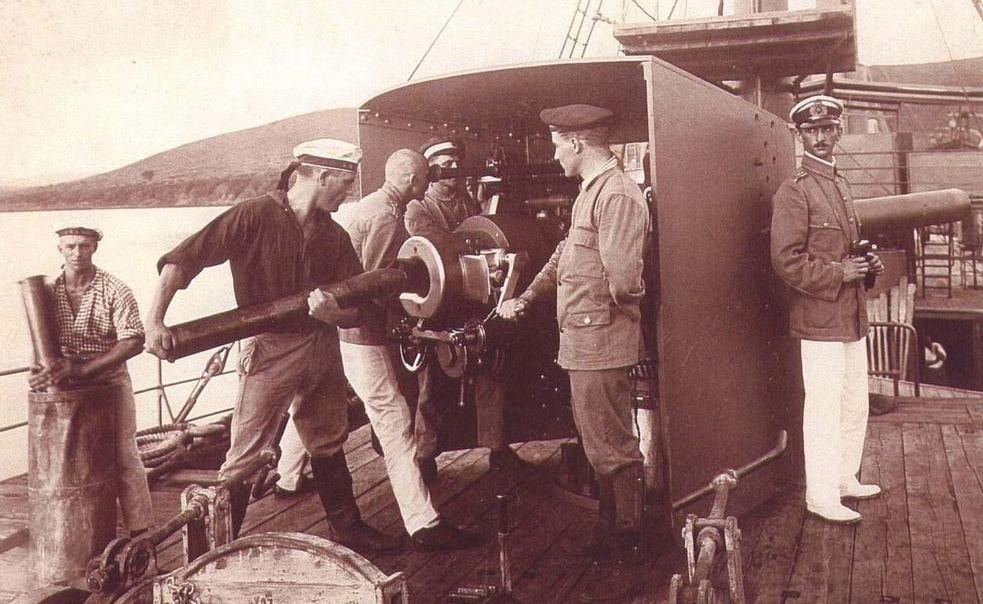
http://www.navweaps.com/Weapons/WNGER_41-40_skc00_pics.htm (accessed 22 February 2015).
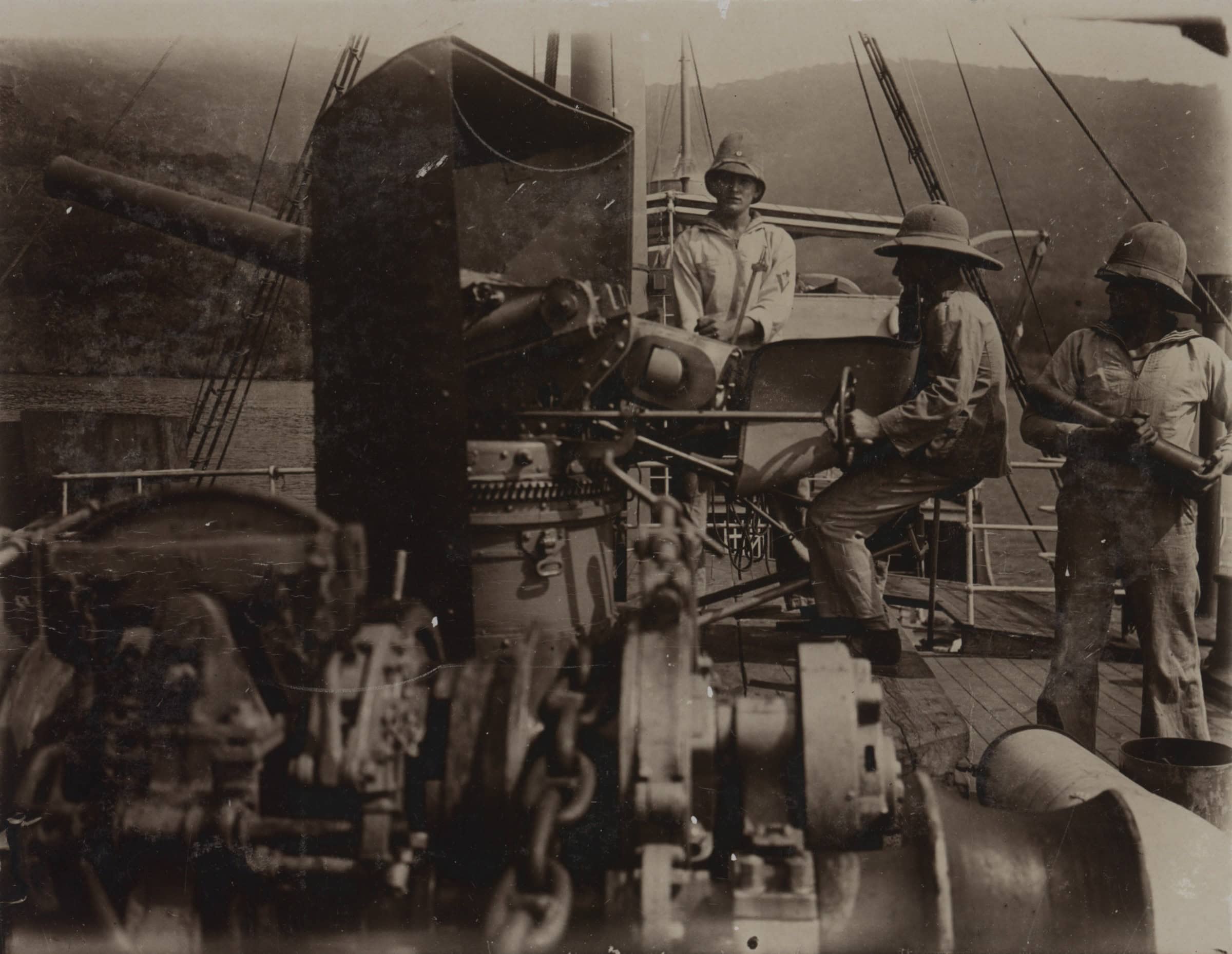
Royal Museum for Central Africa, Tervuren, Belgium. HP.1966.1.1649.
The ship was also used for supply trips between Kigoma and Marienheim at the northern end of the lake (later Usambura; today Bujumbura) and Bismarckburg (now Kasanga) situated at the southern end of the lake. In addition, she could transport up to 900 persons, which was equivalent to the combined capacity of the HEDWIG VON WISSMANN, the KINGANI{{ref}} and three to four dhows towed by a steamer. Compared to dhows towed by a steamer, the GOETZEN was also more than twice as fast and four times faster than dhows under sail.{{ref}}
The fortress Bismarckburg of the German colonial armed forces, whose ruins can still be seen today, was situated on a peninsula stretching out into the lake on the southern border between German East Africa and British Rhodesia. The fortress was thus of particular strategic significance and it played a key role in the successful operations of the commander of the German colonial armed forces, Colonel von Lettow-Vorbeck, who had ordered that the German colony be defended against its opponents, who had considerably superior numbers. General Wahle was stationed in Bismarckburg with the 29th Field Company under his command, who were supplied by the GOETZEN with all the goods they needed from Kigoma. Since in this area bitter fighting raged between the Germans on the one hand and the Belgians and British on the other hand, the ship also supported the fortress with its onboard weaponry from positions on the lake. On 28 June 1915, General Wahle, with the support of the 24th Field Company from Dar es Salaam, succeeded in driving the British far back into their own territory and maintained the front for a whole year.
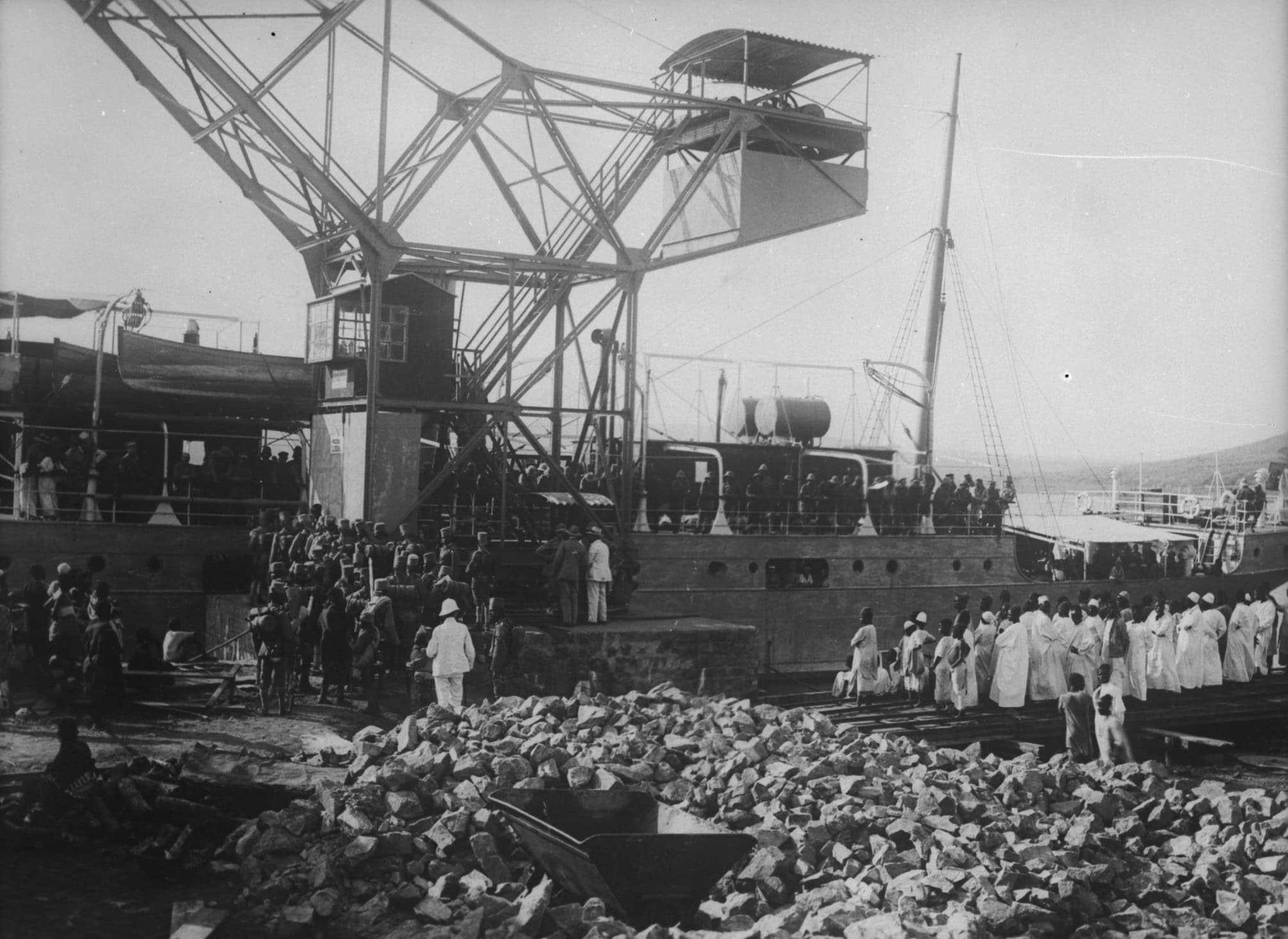
Photo Archive of the German Colonial Society, University Library of Frankfurt am Main, 041-0239-26.
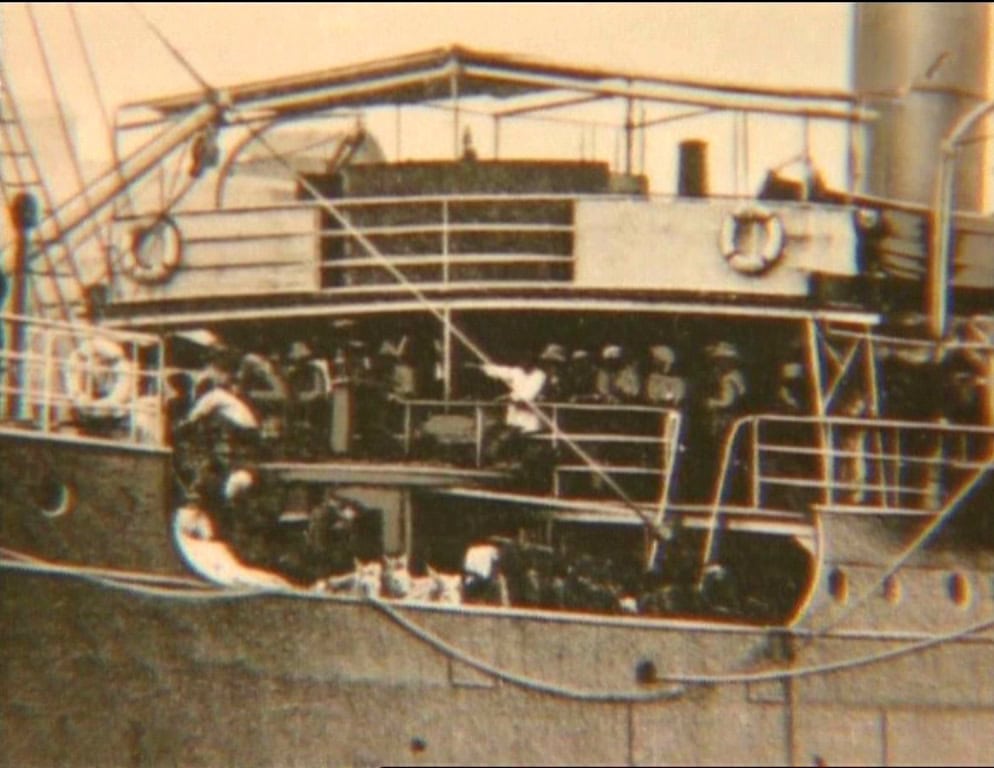
Copyright details unavailable.
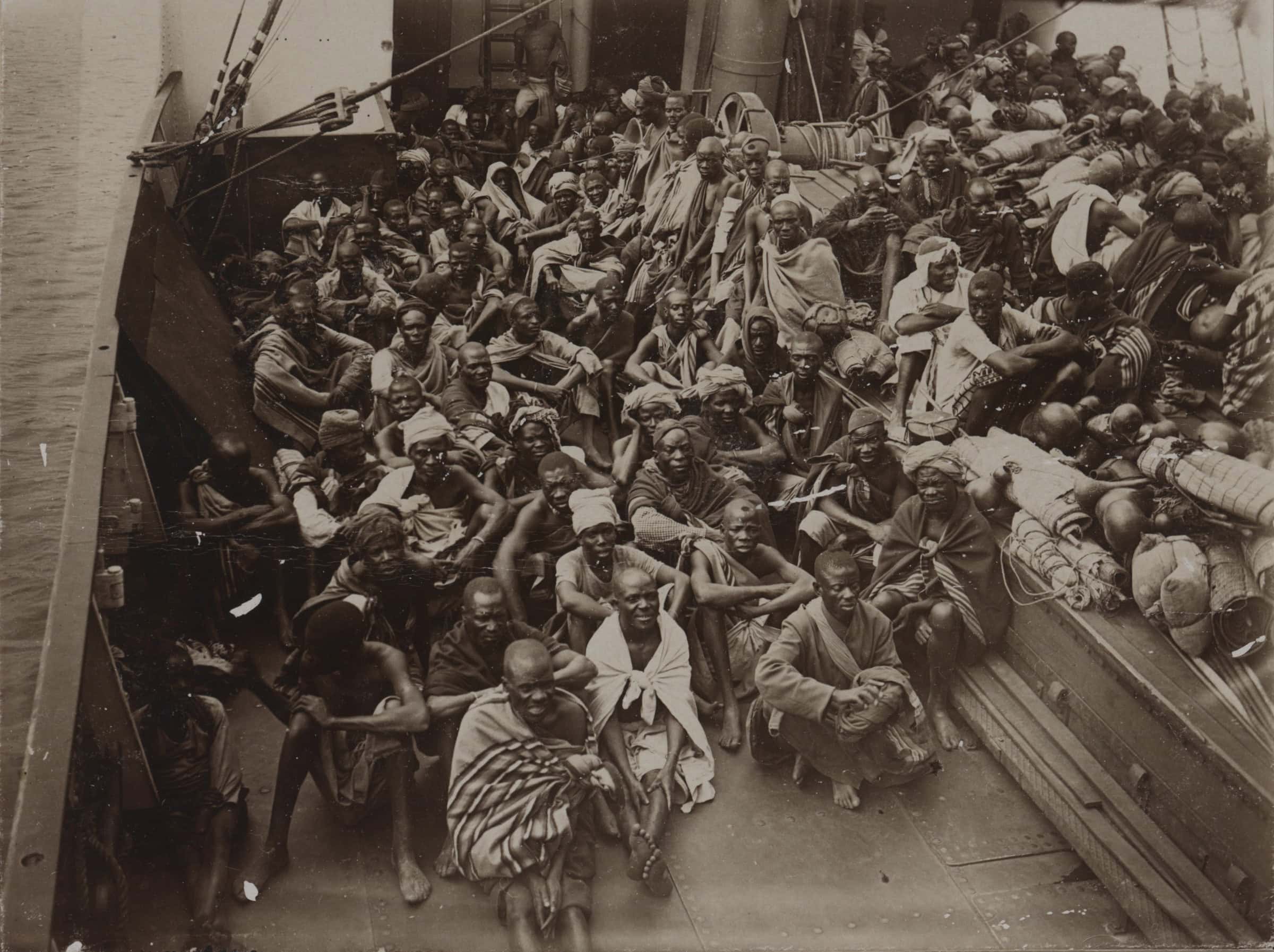
Royal Museum for Central Africa, Tervuren, Belgium. HP.1966.1.118.
Besides such supply trips, the GOETZEN also continually undertook reconnaissance trips on the west bank of the Belgian Congo.
The GOETZEN’s{{ref}} only “act of aggression” took place shortly after it was taken into service at the beginning of July 1915, when it towed the British steamer CECIL RHODES from its position in Kassakalave at the southern end of Lake Tanganyika and sunk it in deep water.{{ref}}
The twin-propeller steamer, which had been driven ashore by a storm, had a similar displacement to the HEDWIG VON WISSMANN and had already been the target of an expedition under the leadership of Lieutenant Commander Kendrick on 19/20 November 1914. Whilst on that occasion a steamer, no longer serviceable and laid up nearby, and two steel boats were destroyed, consideration was being given to the idea of provisionally restoring the well-preserved CECIL RHODES and towing it away after building a launchway. However, a surprise attack by the enemy on 20 November forced the expedition to destroy the steamer and retreat.{{ref}}
The GOETZEN dominated the lake, and in this situation the Royal Navy, under Commander Geoffrey Spicer-Simson, formed the ambitious plan to get by ship, rail, river and road two armed motor boats MIMI and TOUTOU from England to Albertville (today: Kalemie) on the western bank of Lake Tanganyika. These boats had a length of just 12 metres and a displacement of 4.5 tonnes and were each equipped with one fairly small (12 pounder) gun.{{ref}} On 26 December 1915 they forced the German steamer KINGANI (17.75 metres long, displacement of 45 tonnes) to surrender and towed it to Albertville, where it was put back into service as HMS FIFI after repair. On 9 February 1916, MIMI and FIFI attacked the HEDWIG VON WISSMANN (20 metres long, 60 tonnes displacement) and sank her.{{ref}} On this day the GOETZEN was supposed to be serving as a screen ship, but was unable to intervene since she was too far away.{{ref}}
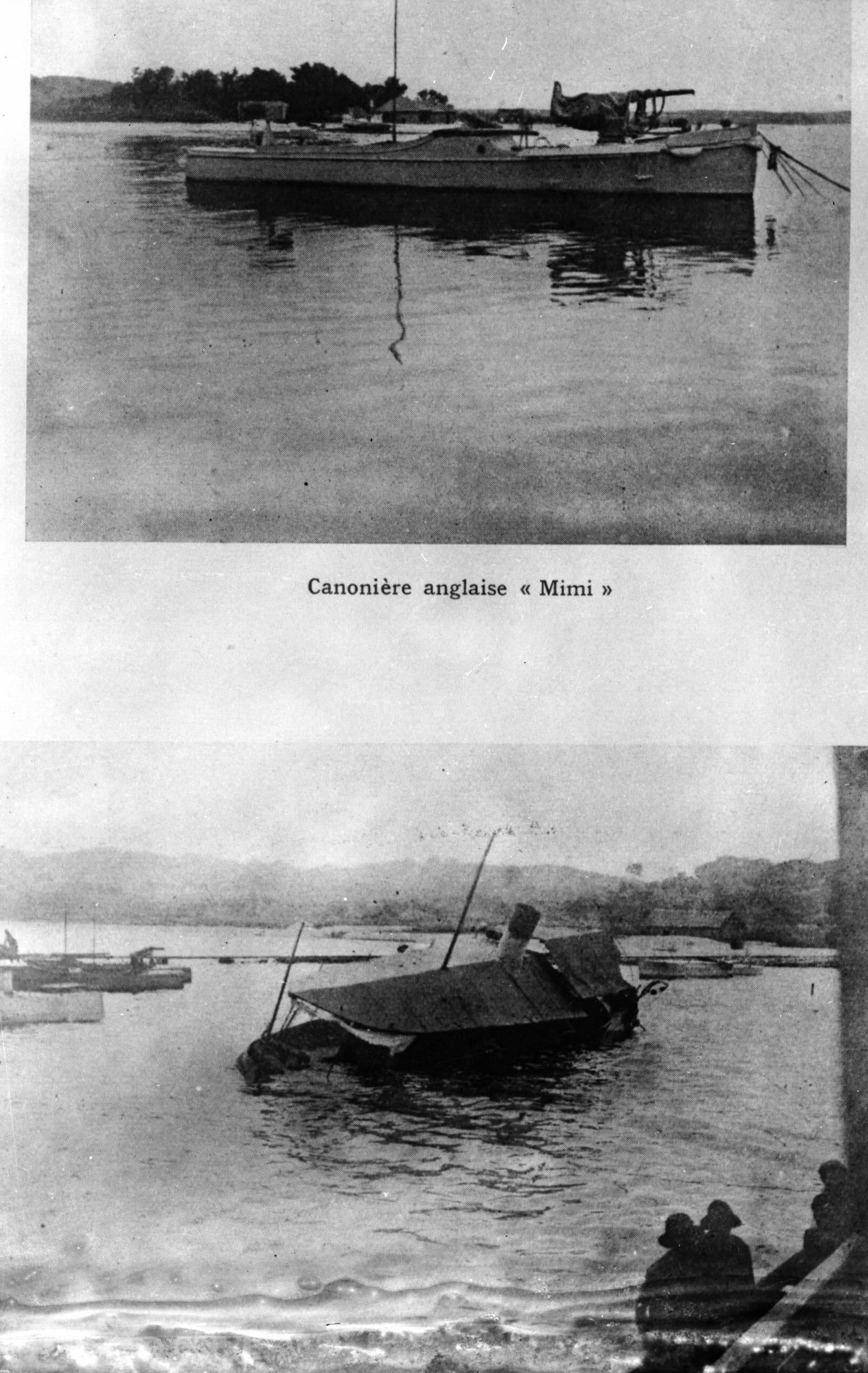
Photo Archive of the German Colonial Society, Frankfurt am Main University Library, 016-1285-03.
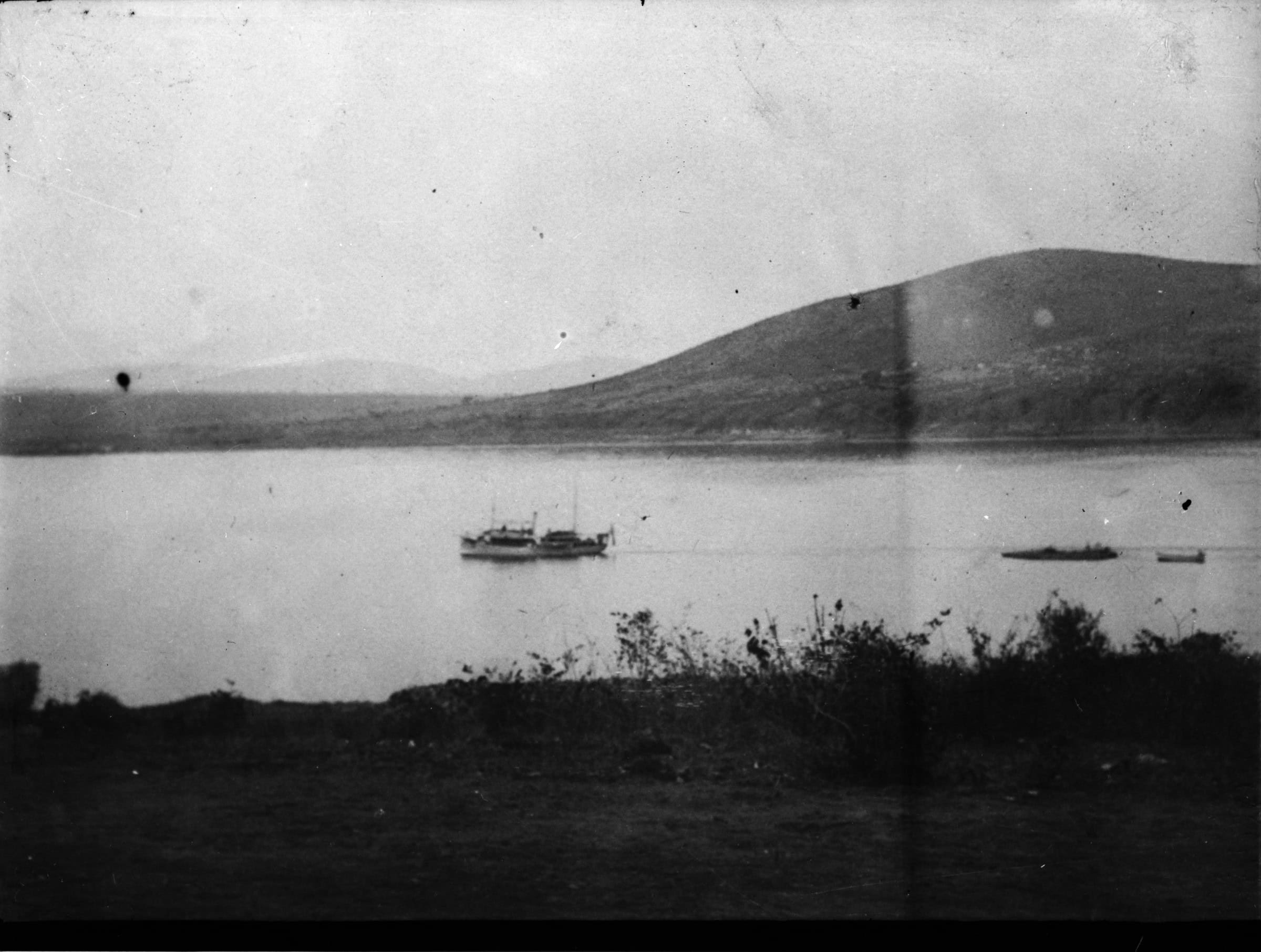
Photo Archive of the German Colonial Society, Frankfurt am Main University Library, 016-1285-11.
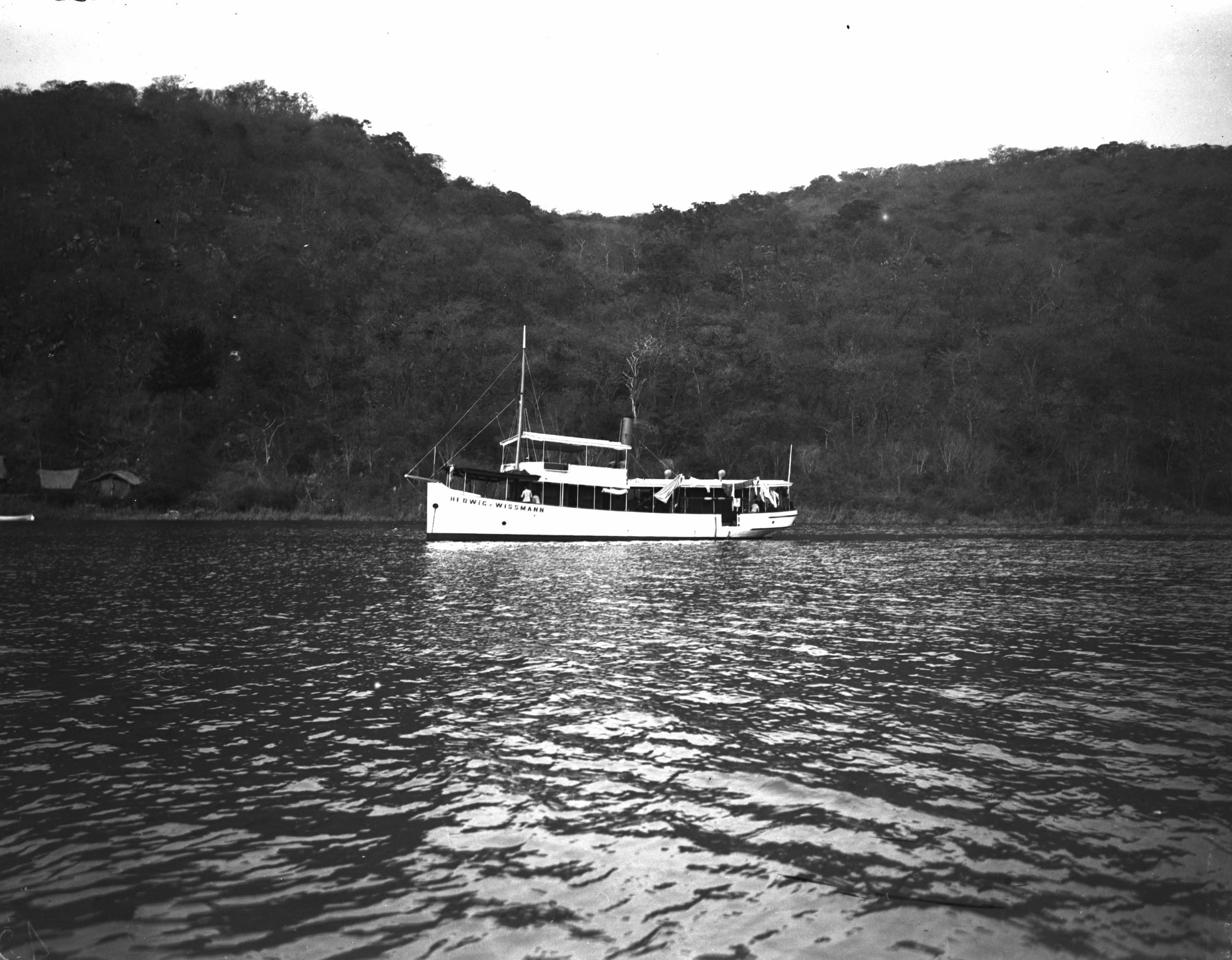
Photo Archive of the German Colonial Society, Frankfurt am Main University Library, 002-1020-12.
Because of these losses, the WAMI, a sister ship of the KINGANI, was brought to Kigoma in February 1916{{ref}}, together with the steamer MWANZA, which had been disassembled on Lake Victoria, brought to Kigoma and been reassembled there.{{ref}} The tug boat ADJUTANT (35.4 metres long, 231 tonnes displacement) also made it to Lake Tanganyika after it was disassembled in Dar es Salaam. However, it could no longer be taken into service.{{ref}}
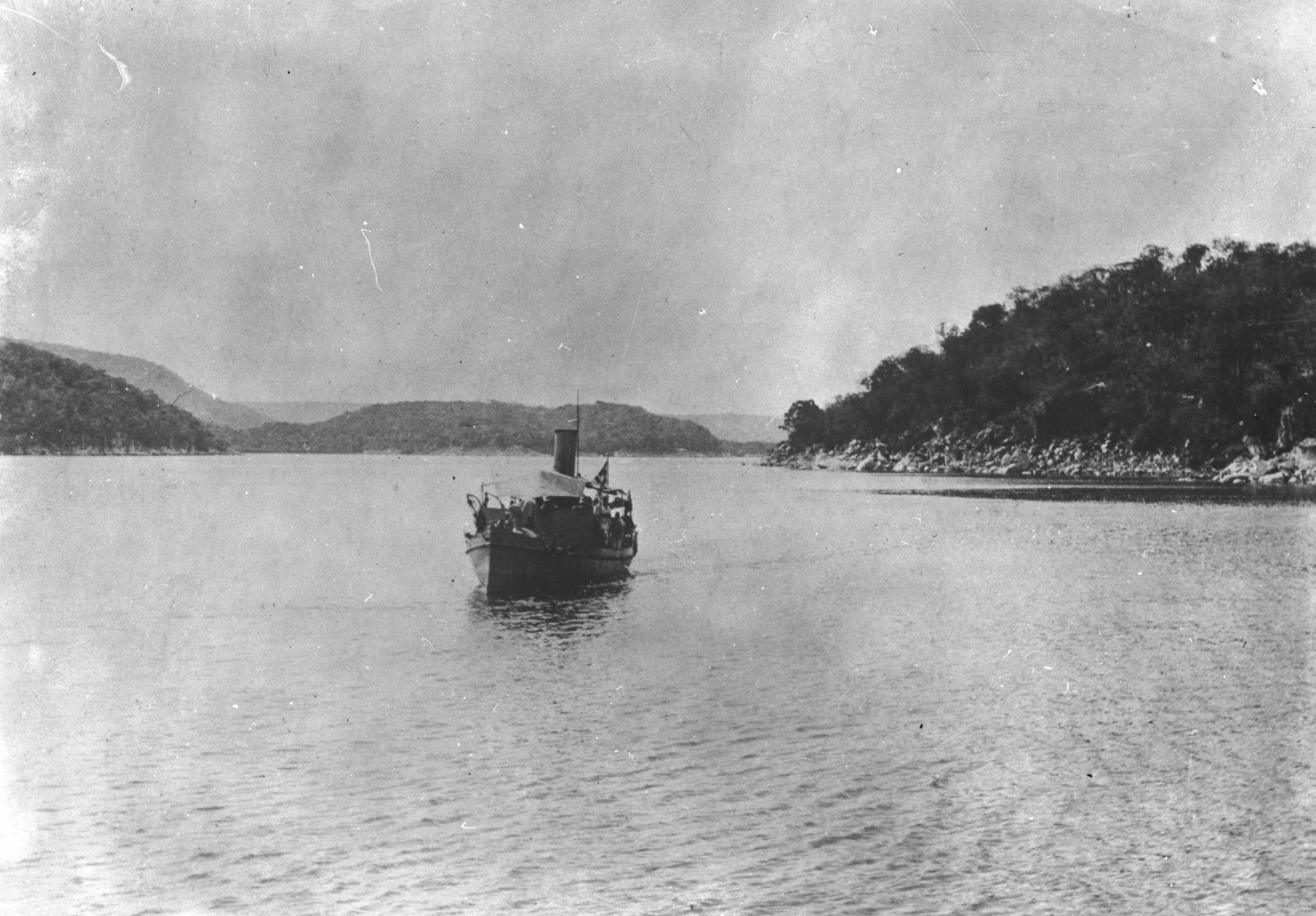
Photo Archive of the German Colonial Society, University Library of Frankfurt am Main, 004-1084-06.
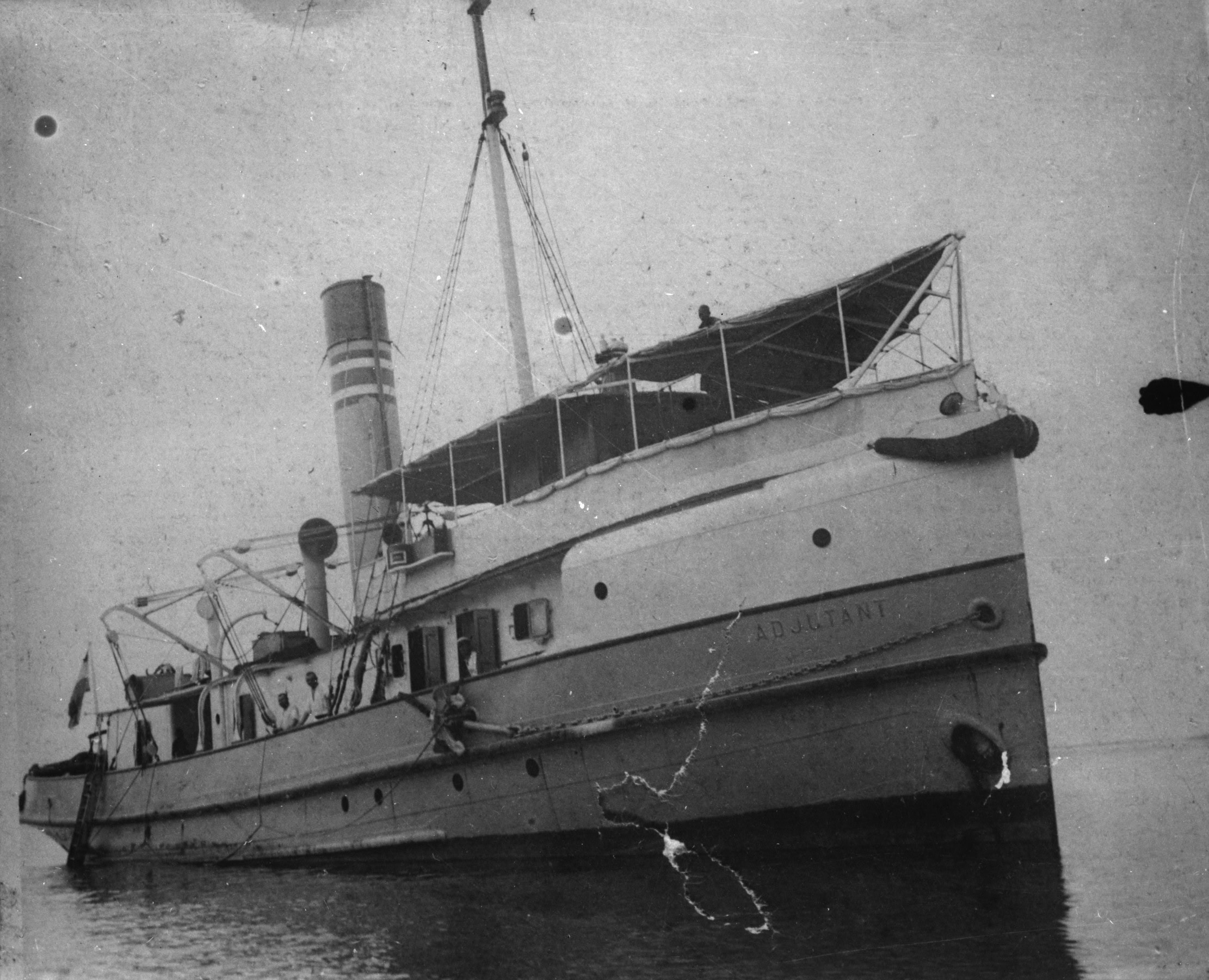
Photo Archive of the German Colonial Society, University Library of Frankfurt am Main, 016-1287-15.
The Belgians too, in the course of the war, brought several boats and ships to Lake Tanganyika, including the gun boat NETTA (18 metres long with a displacement of 16 tonnes). They also had the steamer ALEXANDRE DELCOMMUNE (presumably 90 tons displacement), that, however, was shot incapable of driving by HEDWIG VON WISSMANN during several patrols from August 22, 1915. During the war, the Belgians also started building a slipway in Lukuga for the significantly larger steamer BARON DHANIS (contradicting information; probably 700 tons displacement). The main construction works of the ship respectively its completion took place after the German supremacy on the lake was broken.{{ref}}
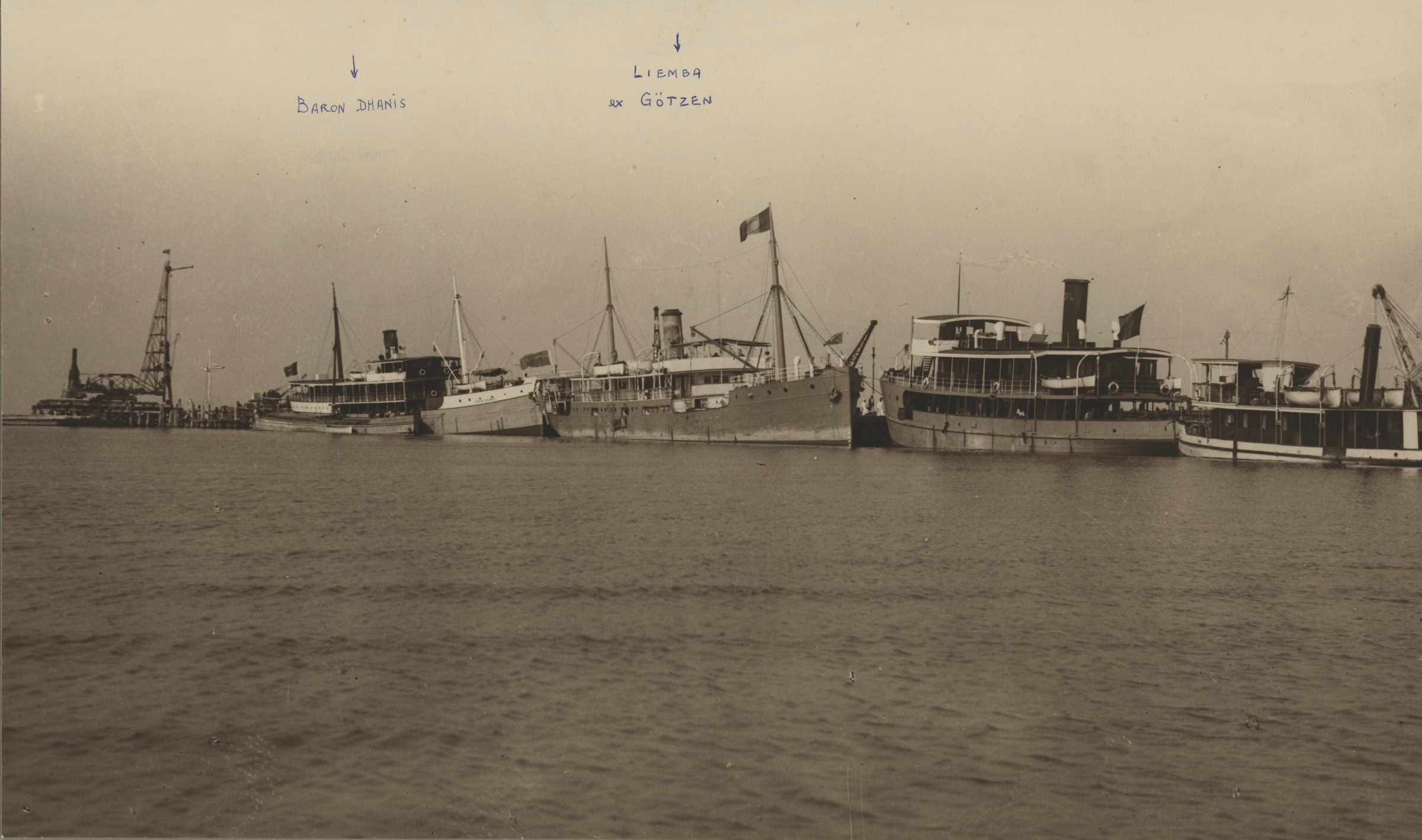
Royal Museum for Central Africa, Tervuren, Belgium. HP.2010.8.2640.
Wilhelm Arning, who first came to German East Africa in 1892 as a medical officer of the German Colonial Force, described the increasingly negative development for the Germans in 1916 at Lake Tanganyika as follows:
In any case, our previously undisputed supremacy on the lake came to an end, because the “Graf Götzen”, which was not built for war purposes and, due to insufficient knowledge of the shipping conditions on the lake, was not very practical, was not allowed to be exposed to greater dangers, because after its possible loss we would no longer have been able to move troops with the desired speed; in any case, even in this regard, every conceivable caution had to be taken.
The fact that a sister ship of the “Kingani”, the “Wami” was rushed to the lake by train, did not change this problem too much. It would have helped more, if the approximately 600-ton zambezi-steamer “Adjutant” of the D. -O. -A-company, a heavily built, extremely seaworthy ship could have been brought in and repaired in good time. The attempt to do so was made after a bold night drive under the leadership of Lieutenant d. Sw. Herm had broken the blockade at the mouth of the Rufidji and reached Daressalaam.
It had to be completely dismantled for transport and reassembled in Kigoma, which was no small matter given the venerable age of the iron parts and the few resources available. But engineer Hübner also managed to achieve this. If one had been able to make up their minds, as soon as the necessity arose and to start the dismantling in Daressalaam, this capable man would have succeeded, despite all the difficulties, in setting a new steamer on the Tanganyika in time, capable of carrying a powerful gun and maybe we could have gained influence again.
So the ship did not get ready, although the construction was progressing much faster than expected and the readiness for August 1, 1916 was in prospect. But until then, it took the enemy no longer to fear German invasions. The troops that had previously had to secure the opposing coasts were released for other use.{{ref}}
The GOETZEN continued to be used for supply trips until April of 1916, and there is a detailed description of one of these trips:
On 18 February 1916 the steamship “Götzen”, built in Kigoma during the war, and our auxiliary cruiser on the Tanganyika, equipped with 105- and 88-millimetre-weapons from the cruiser “Königsberg”, itself destroyed by gunfire, sailed into Usumbura. […]
Full of pride, he [editor’s note: commanding officer Siebel] showed me his lovely new ship, whose modern fittings, roomy cabins, pristine white beds and bright electric lighting was in sharp contrast to my primitive domesticity in Mutschija.
The trip started in the afternoon. Siebel, First Mate Edel and I enjoyed an evening meal together, then stretched out on our loungers on deck. The moon rose behind the high border hills as a large yellow disk and bathed Lake Tanganyika in glittering silver, with the stark silhouette of the mountains on the horizon.
An unusually beautiful tropical night. We sat on the bulwark and enjoyed the splendid view. The steamer was travelling close to the shore, past countless villages and settlements of the Warundi, whose lights winked at us from the banks of the lake and the mountains. At five o’clock in the morning we reached Niansa.{{ref}}
The last documented supply trip by the GOETZEN was to Marienheim on 18 April 1916.{{ref}} When, in spring 1916, the German colonial armed forces came under more and more military pressure, from 18 May the two larger guns were removed for use on the land front.{{ref}} The artillery guns on the ship were replaced by dummies to fool enemy spies.{{ref}} Since the GOETZEN could now no longer protect itself sufficiently from attacks by enemy ships, it stayed moored in the harbour of Kigoma.{{ref}}
Since the British and Belgian ships were not a match for the GOETZEN until that, the Belgian government had already decided in summer 1915 to transfer airplanes to Lake Tanganyika to attack the GOETZEN from the air. For this purpose, four “Short Admiralty 827” seaplanes were brought to Albertville (now Kalemi) via the Congo River. 32 kilometres north of there, on the small lake Tongwe, near the town of M’Toa (also written as Toa), a base was set up.{{ref}}
The first enemy plane appeared over Kigoma on 6 June 1916; its target was obviously the GOETZEN. The attack is described by Assmann as follows:
During the first attack on Kigoma, the Belgian plane only dropped one bomb on the “Götzen” from a low altitude, and then flew back to Lukuga. The bomb hit the water right next to the stern of the “Götzen” and some debris pierced her side above the water, slightly wounding one European and one Black crew member. The damage to the “Götzen” was slight and was repaired in the next few days.
From 10 July 1916 enemy seaplanes appeared over Kigoma almost daily. The target of their bombs was probably only the steamer “Götzen”, which was at anchor in deep water in the middle of the harbour. Despite 16 consecutive air attacks, the “Götzen” was not hit.{{ref}}
On 10 June pilot Aimé Behaeghe and his observer/bomber Leon Collignon attacked the GOETZEN in Kigoma harbour with two bombs each weighing about 31 kg. Directly after the attack there was talk of two direct hits, which had caused severe damage to the ship.{{ref}} On another occasion the Belgians claimed one direct hit and one near miss to the stern.{{ref}} The direct hit was disputed by the Germans.{{ref}} When British salvage workers raised the ship in 1924, they found only indications of splinter damage to the stern on the starboard side.{{ref}} In the following weeks until Kigoma was abandoned, the Belgian airplanes bombarded Kigoma – as mentioned above by Assmann – and the surrounding area over and over again. And the GOETZEN was also sighted{{ref}} and attacked, but she did not suffer any further damage.{{ref}}
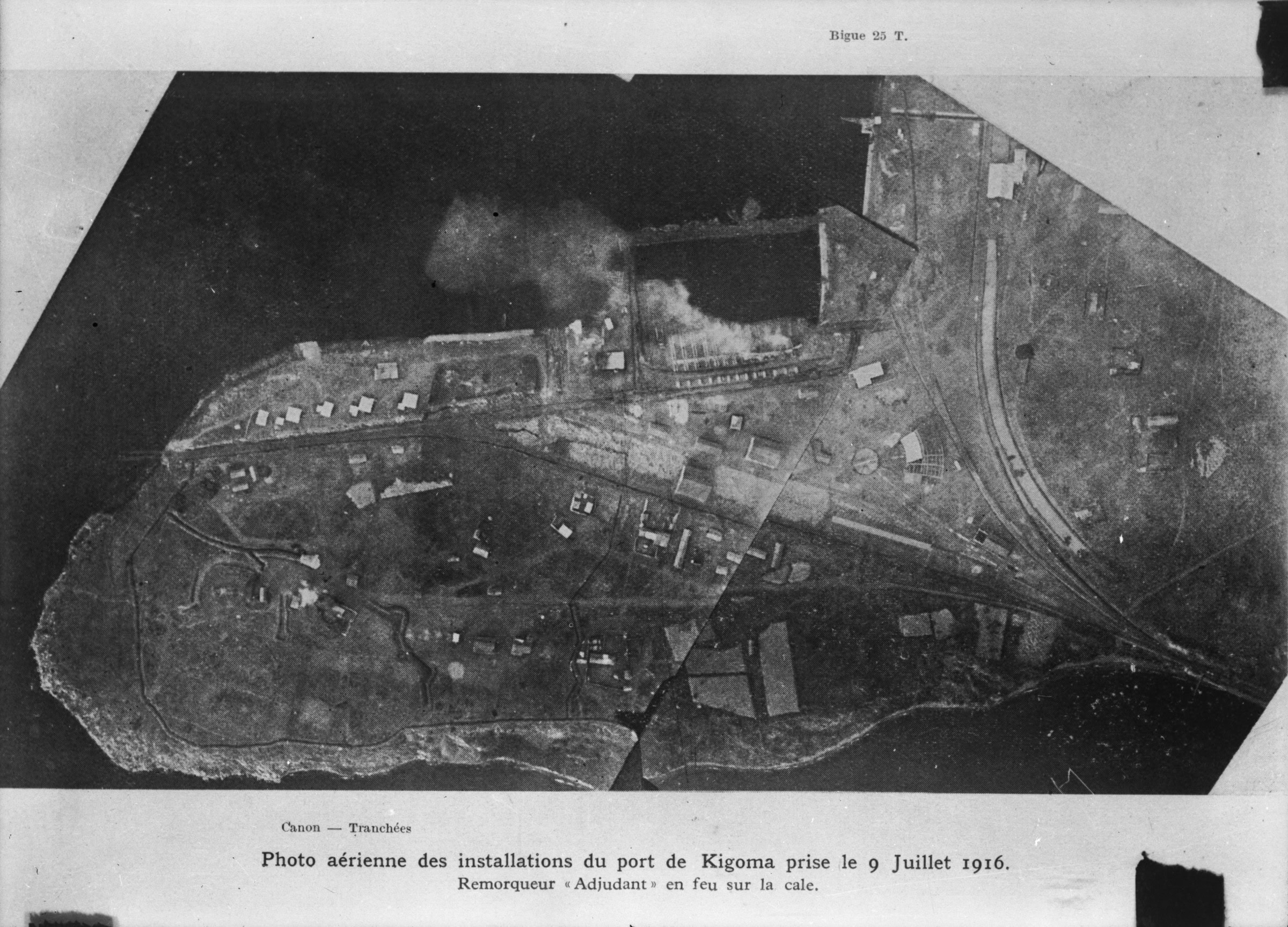
Photo Archive of the German Colonial Society, University Library of Frankfurt am Main, 016-1285-01.
When, in spring 1916, the Belgians advanced to the Central Line railway, the commander of the western troops, General Wahle, first decided to defend Kigoma against the Belgians. For this reason, extensive fortifications were established on Karamtwaye Hill (German name: Kigomaberg; Belgian name: Kabondo) between Kigoma and Bangwe Point.{{ref}} Its troops were detailed to hold up the Belgians for as long as possible. The GOETZEN was also anchored in the bay under the hill.
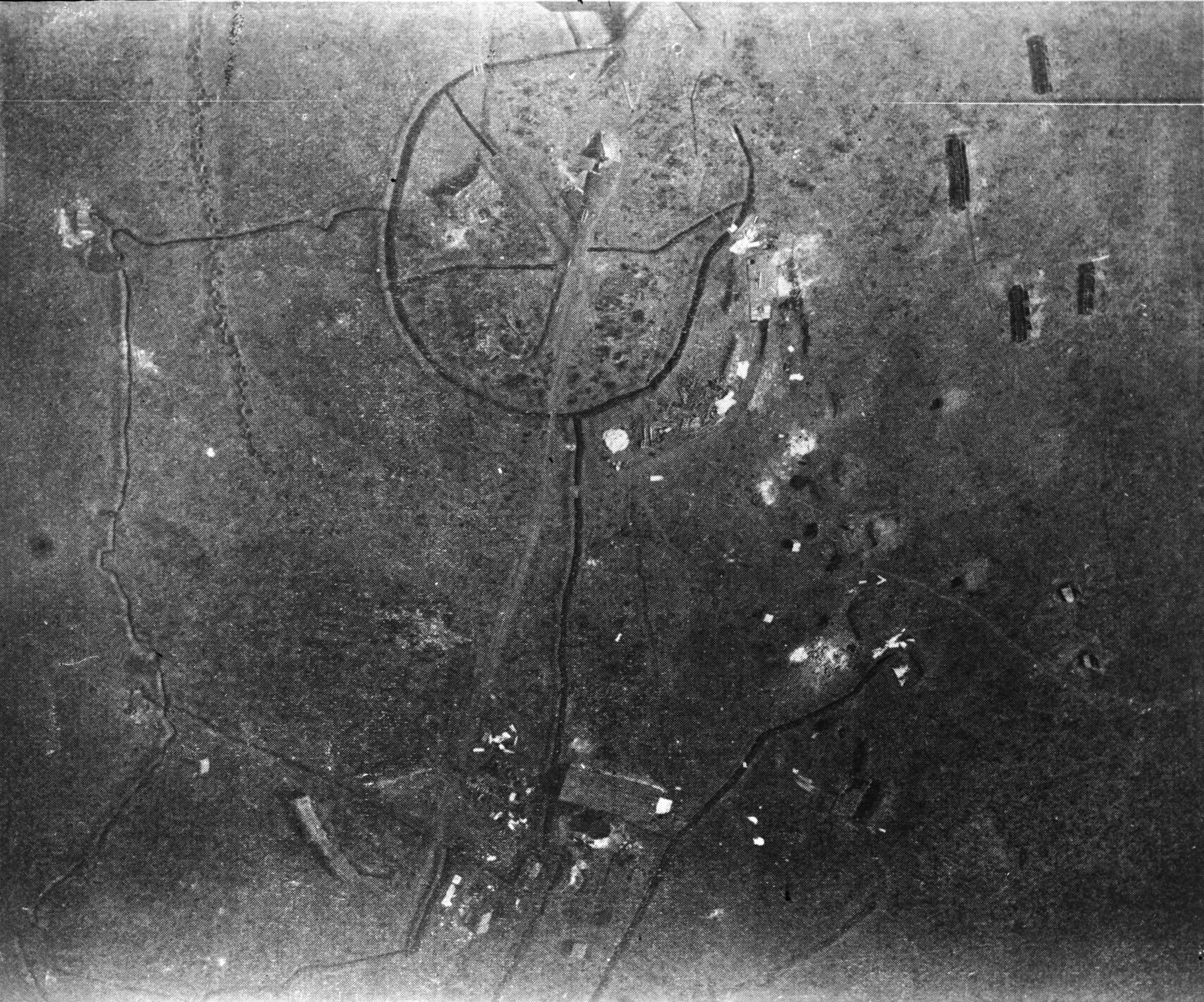
Photo Archive of the German Colonial Society, University Library of Frankfurt am Main, 016-1285-02.
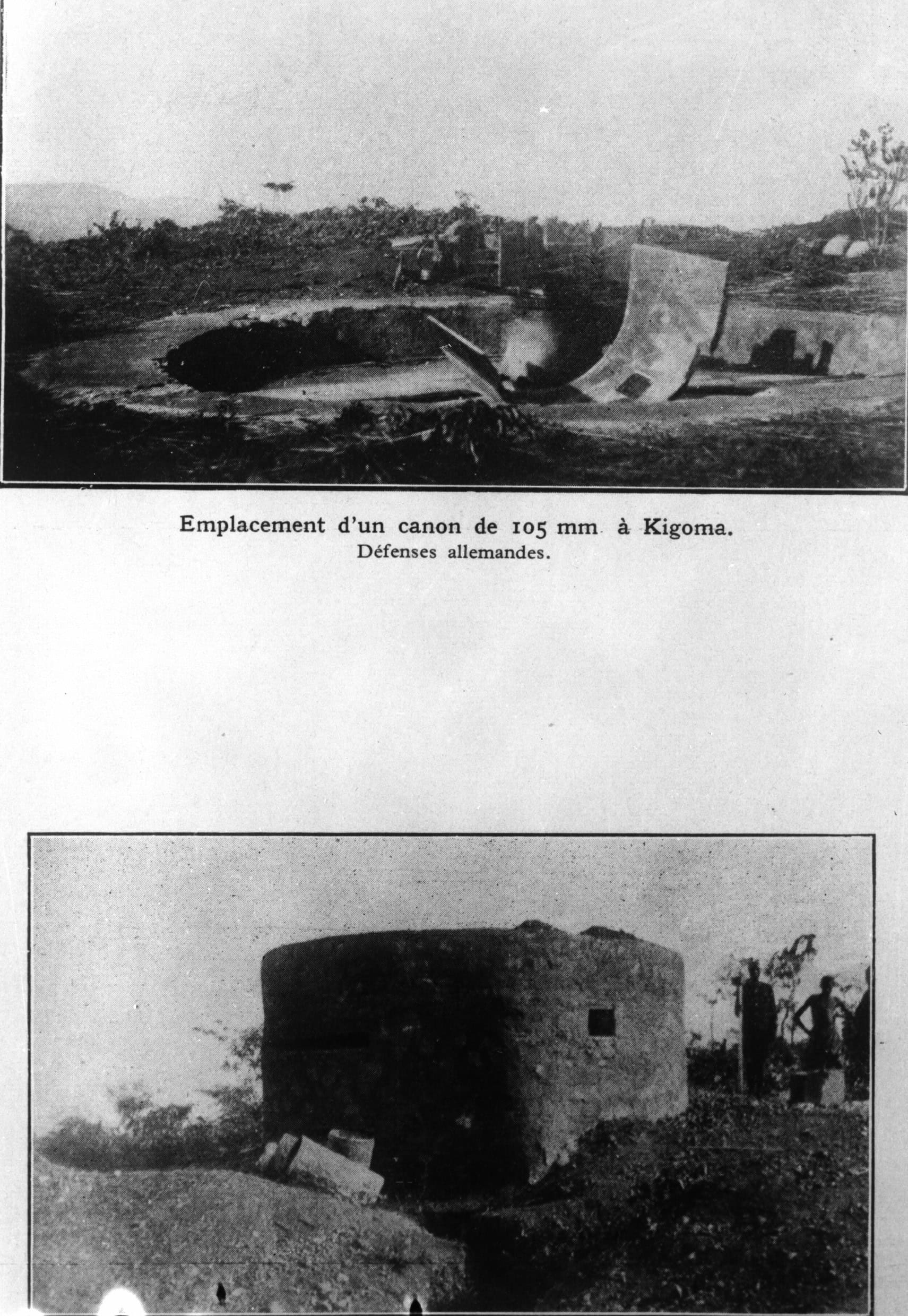
Photo Archive of the German Colonial Society, Frankfurt am Main University Library, 016-1285-07.
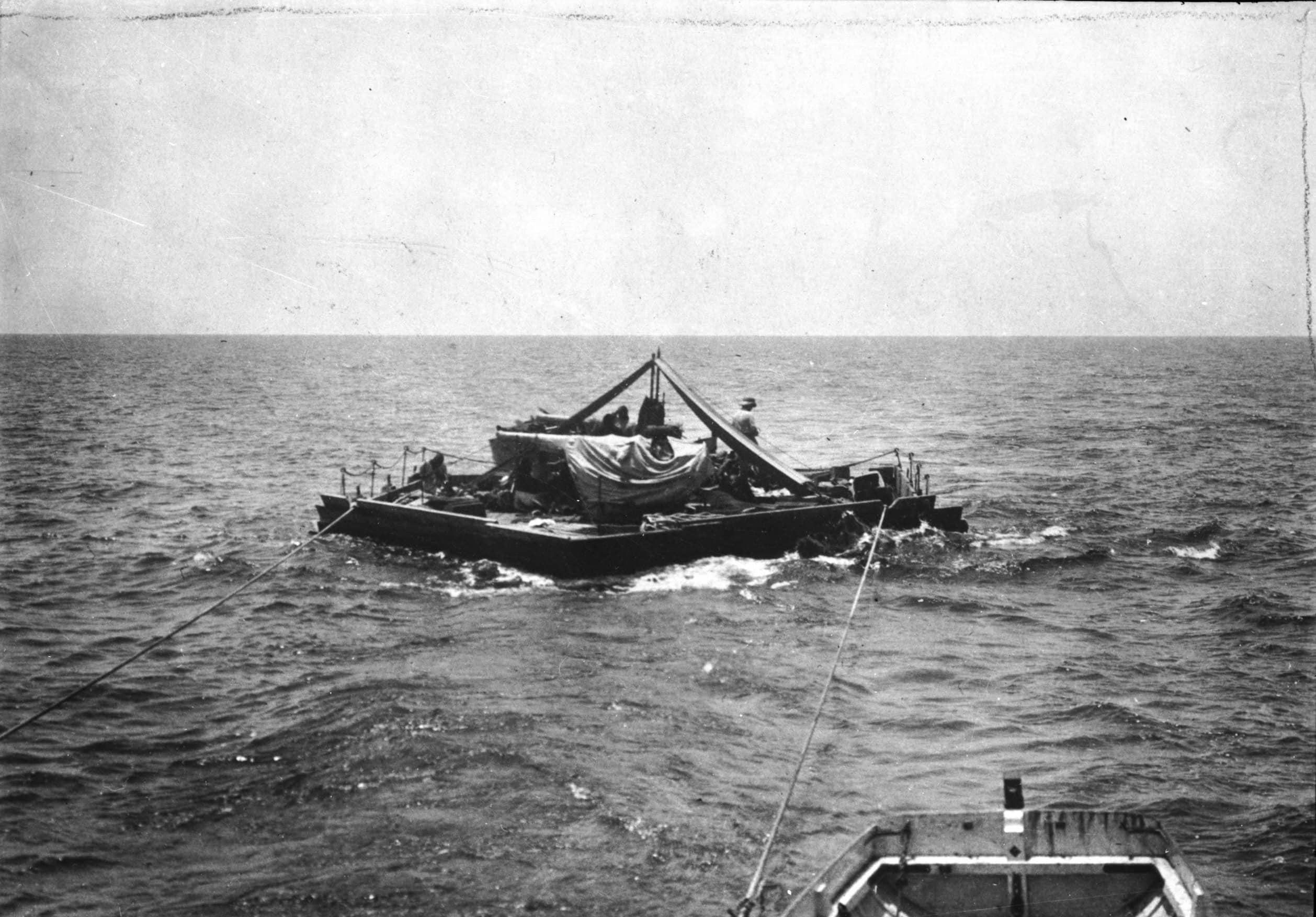
Photo Archive of the German Colonial Society, University Library of Frankfurt am Main, 016-1287-12.
Self-sinking during the German retreat.
A few days before the Belgians reached Kigoma, Commander Zimmer decided in an agreement with General Wahle and Colonel von Lettow-Vorbeck, to abandon Kigoma.{{ref}} On 21 July most of the troops therefore left Kigoma by train, led by Commander Zimmer. Before this, the harbour and railway facilities were blown up. There remained just a small unit (around 40 men) under the command of Lieutenant Commander Forstmann of the Naval Reserve, who were to stay until the Belgians arrived in Kigoma, to blow up then the remaining facilities – also the GOETZEN was destined to be blown up – and setting off towards Kassaua resp. the Malagarassi River on the WAMI, where this last remaining ship should be sunk too.{{ref}}
But those involved decided otherwise. All the ship’s important mechanical parts were greased thoroughly to protect them from corrosion; important parts may also have been removed and hidden on land.{{ref}} Then the cargo holds were loaded with pieces of iron and stone. On 26 July 1916 the ship was sunk south of Kigoma in Katabe Bay (Belgian name: Baie de l’elephant; British name: Bangwe Bay) in a water depth of 11 fathoms (about 20 metres), at coordinates 04° 54’ 05” S; 029° 36’ 12” E.{{ref}} The reason for this sinking presumably was the intention to raise the ship again without major problems after an anticipated positive outcome of the war.
According to sources, the ship is said to have been sunk on an alluvial shallow, as however the port side of its stern shall have hidden hard on the bottom of the lake. The propeller, the propeller shaft and the shaft bracket on that side are said to have been destroyed and some plates of the hull are also said to have been dented.{{ref}}
At a time the LIEMBA was in Kigoma on the slipway in late September, early October 2020, it was possible to carry out an own inspection. However, this did not provide any confirmation of the damage mentioned. In particular, on the shaft bracket and the hull structure, no indications for subsequent repairs could be seen.{{ref}}
It is repeatedly claimed that the GOETZEN was sunk in the mouth of the Malagarasi River.{{ref}} This claim can be traced back to an incorrect account of a battle dated 28 July 1916 by the commander of the Belgian gunboat NETTA, Lt. Wauthier, who was firing on the WAMI{{ref}} just in front of the mouth of the Malagarasi River and thought it was the GOETZEN.{{ref}} This led to a press release by the Belgian government, which was then distributed. It was not until after the war that the Belgians admitted their error.{{ref}}
Once the GOETZEN was at the bottom of the lake, Rüter, Tellmann and Wendt faced their next adventure: the getaway. Since they had heard rumours of cannibalism among the black auxiliary troops in the Congo, they decided to surrender to the English rather than the Belgians. Together with 100 Askaris, who loyally accompanied them, they thus became prisoners of war – firstly in the British colony of Nyasaland in South-East Africa{{ref}}, later in Egypt. After they had spent several months there, they and the other prisoners dug a tunnel out of the camp and tried to escape by swimming through the Nile. This attempt was not successful. Rüter, Tellmann and Wendt did not get back to Papenburg until 1919 – finding a country changed dramatically by poverty and political instability. The wages for which they had worked so hard were worth almost nothing due to inflation. Even worse was the fact that the health of the men had suffered due to malaria. It is known that Anton Rüter died on 20 July 1955 at the age of 78.
The AFRICAN QUEEN.
The often-cited claim that the LIEMBA is also a film star and had a role in the film “African Queen”{{ref}} is not correct. The German gunboat in the film, KÖNIGIN LUISE was the British steam tug BUGANDA, which operated on Lake Victoria. Today the ship is at anchor in the port of Mwanza. But how did this misconception come about, and what exactly is the story behind it?
The original version of the “African Queen” – written by C. S. Forester and first published in 1934 in the British newspaper News Chronicle, then later as a book – differs considerably from the story of the film. Thus, the German gunboat in the newspaper version was called DORTMUND and the story ended with the two protagonists Charlie and Rose ramming the DORTMUND at full speed with their steamboat AFRICAN QUEEN and blowing themselves up.{{ref}}
In the subsequently published book, however, the gunboat was called KÖNIGIN LUISE.{{ref}} The AFRICAN QUEEN is sunk in a storm. The two protagonists are separated and captured by the Germans the following day. The captain of the KÖNIGIN LUISE does not have them executed but instead hands them over to the British troops, who later sink the KÖNIGIN LUISE. Charlie and Rose are sent to the coast where they are married by the British Consul.
Finally, the film classic “The African Queen” was made in 1951, directed by John Houston, and starred Humphrey Bogart (as Charlie Allnutt) and Katherine Hepburn (as Rose Sayer). In the film, the two plan a daring journey down the river in their little steamboat AFRICAN QUEEN with home-made torpedoes to attack the considerably larger German gunboat KÖNIGIN LUISE, what finally is successful.
The plot shows clear parallels with the German cruiser SMS KÖNIGSBERG, which was sunk in the mouth of the Rufiji river, and also with the battle action on Lake Tanganyika. Also incorporated into the action are the efforts of the Royal Navy, to get the two armed motorboats MIMI and TOUTOU through the jungle to Lake Tanganyika.{{ref}} Nevertheless, the events related in the newspaper, book and film are entirely fictitious.
Salvaging by the Belgians and the British.
Until the end of the First World War, the territory on the eastern bank of Lake Tanganyika had almost come entirely in Belgian hands. Since the two masts of the sunken GOETZEN still protruded some one and a half metres out of the water in Katabe Bay, the Belgians soon managed to find the ship.
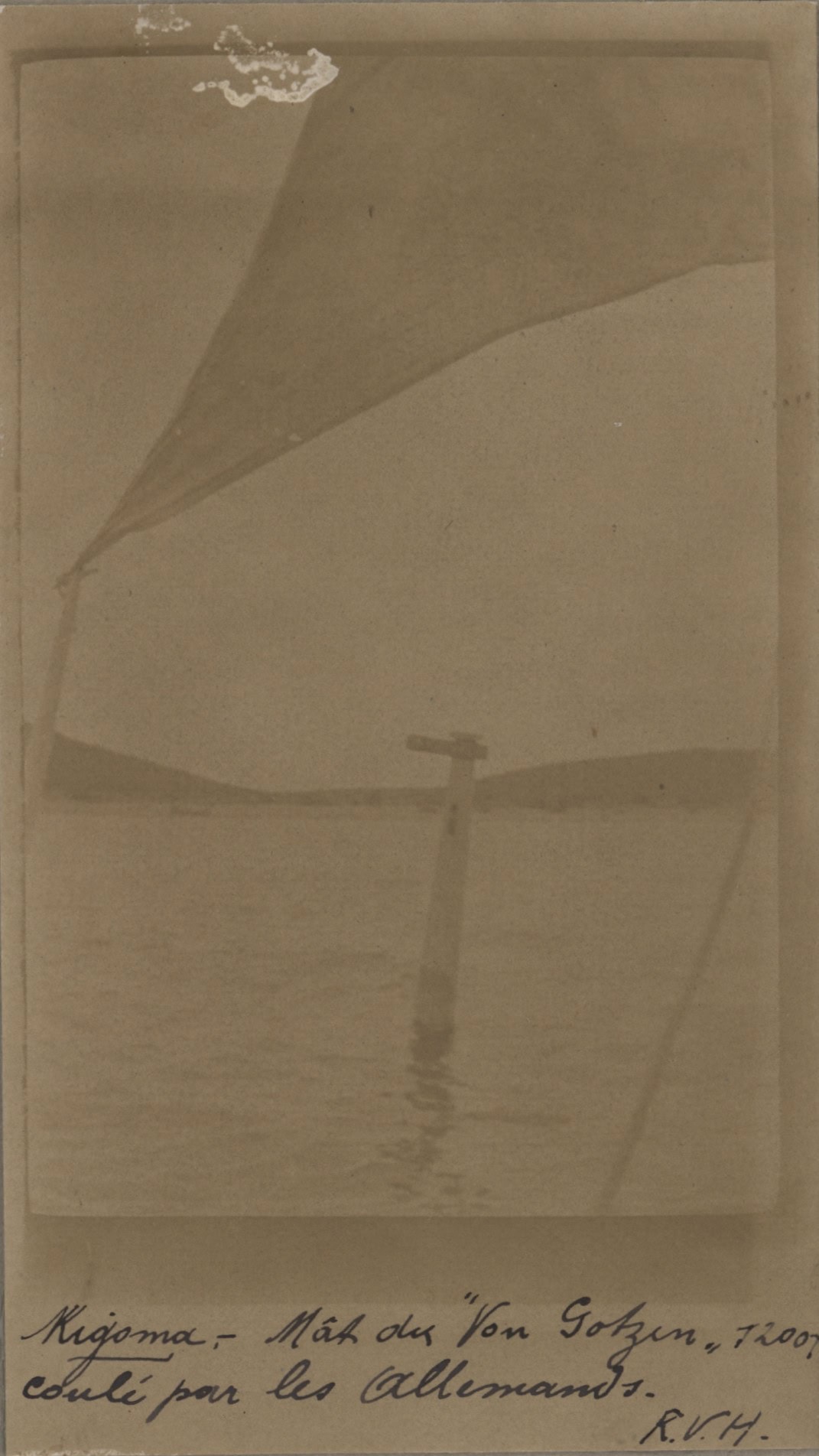
Royal Museum for Central Africa, Tervuren, Belgium. HP.1966.1.119.
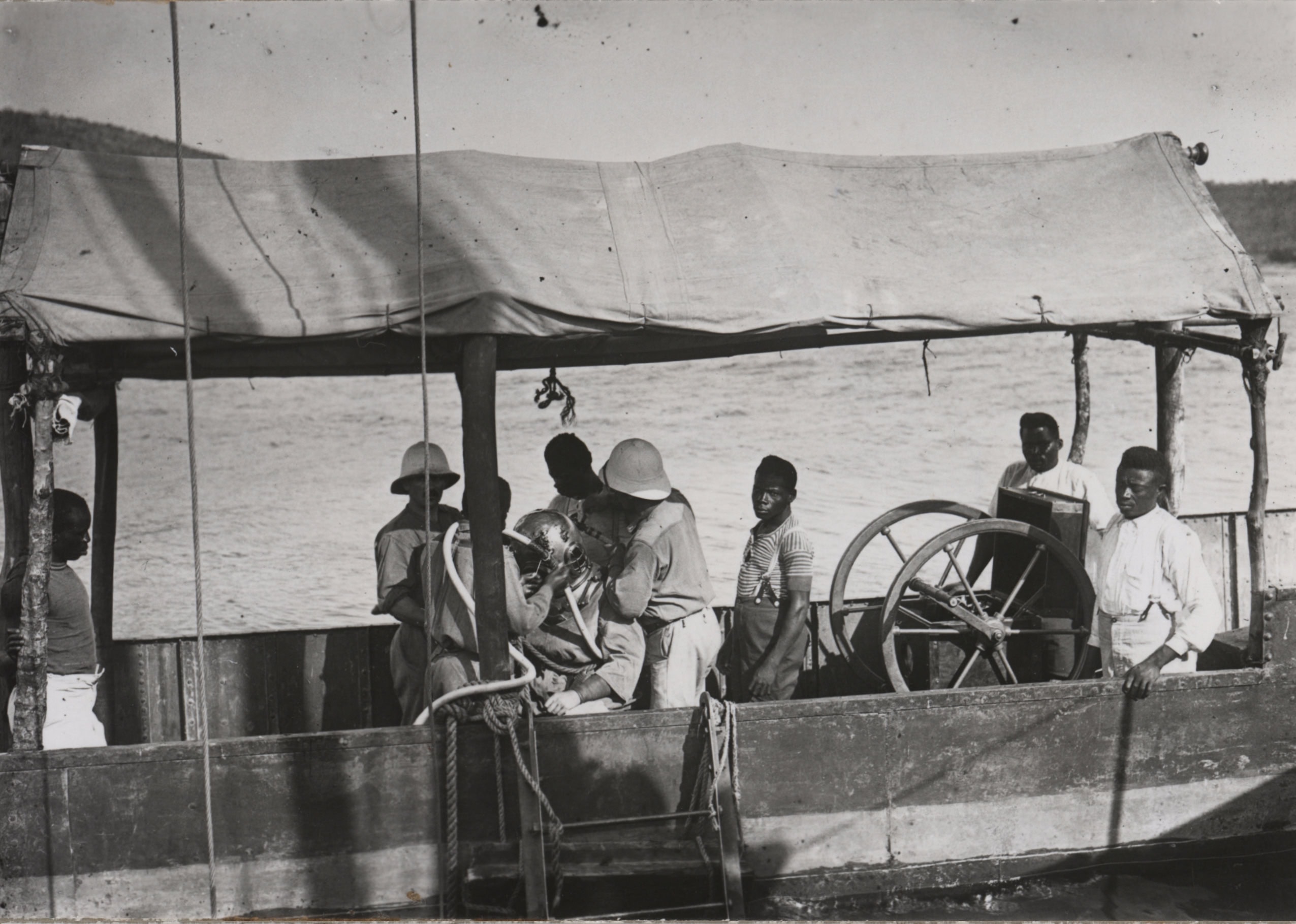
Royal Museum for Central Africa, Tervuren, Belgium. HP.1966.1.120, HP.1966.1.124, HP.1966.1.128, HP.1966.1.123.
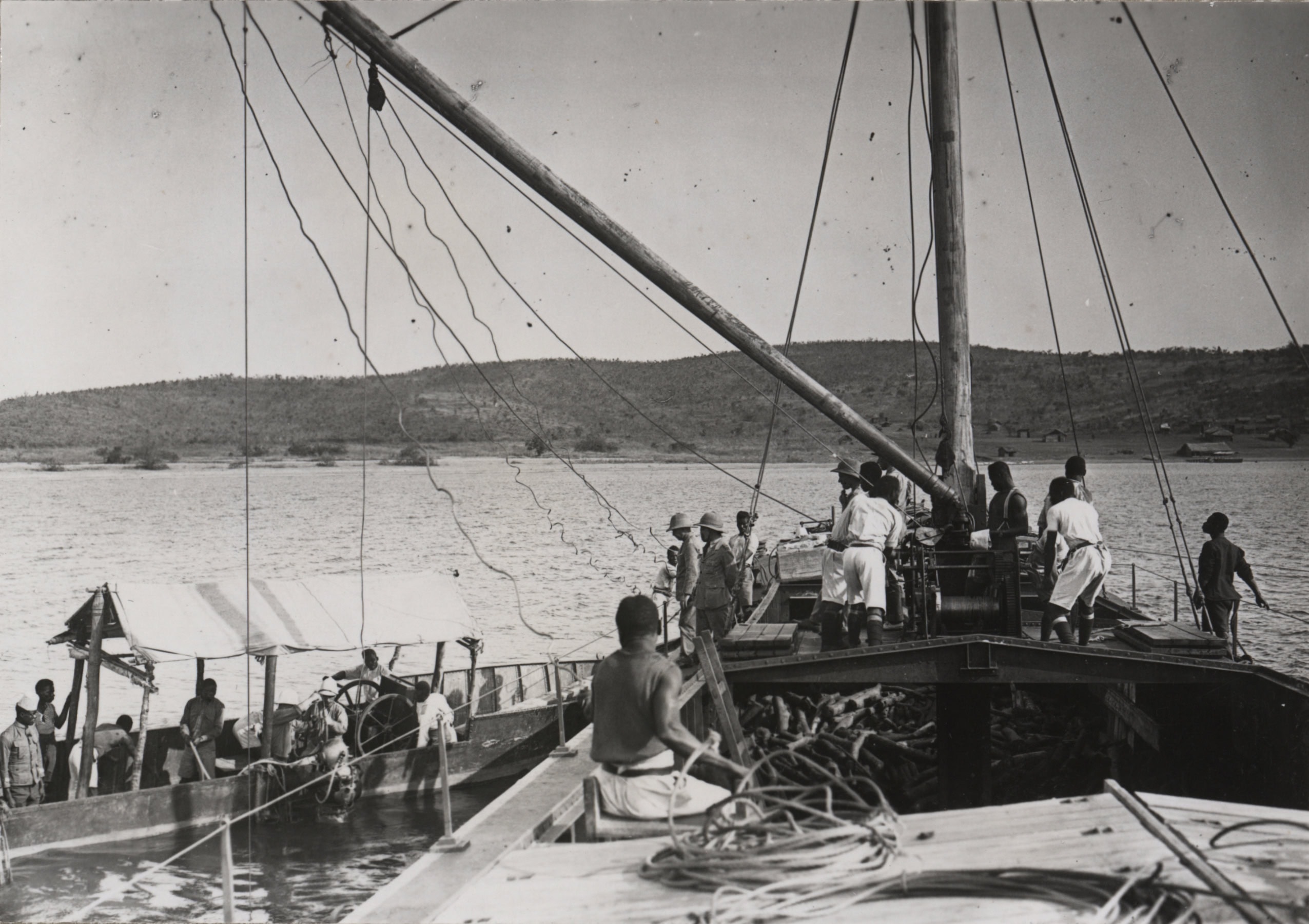
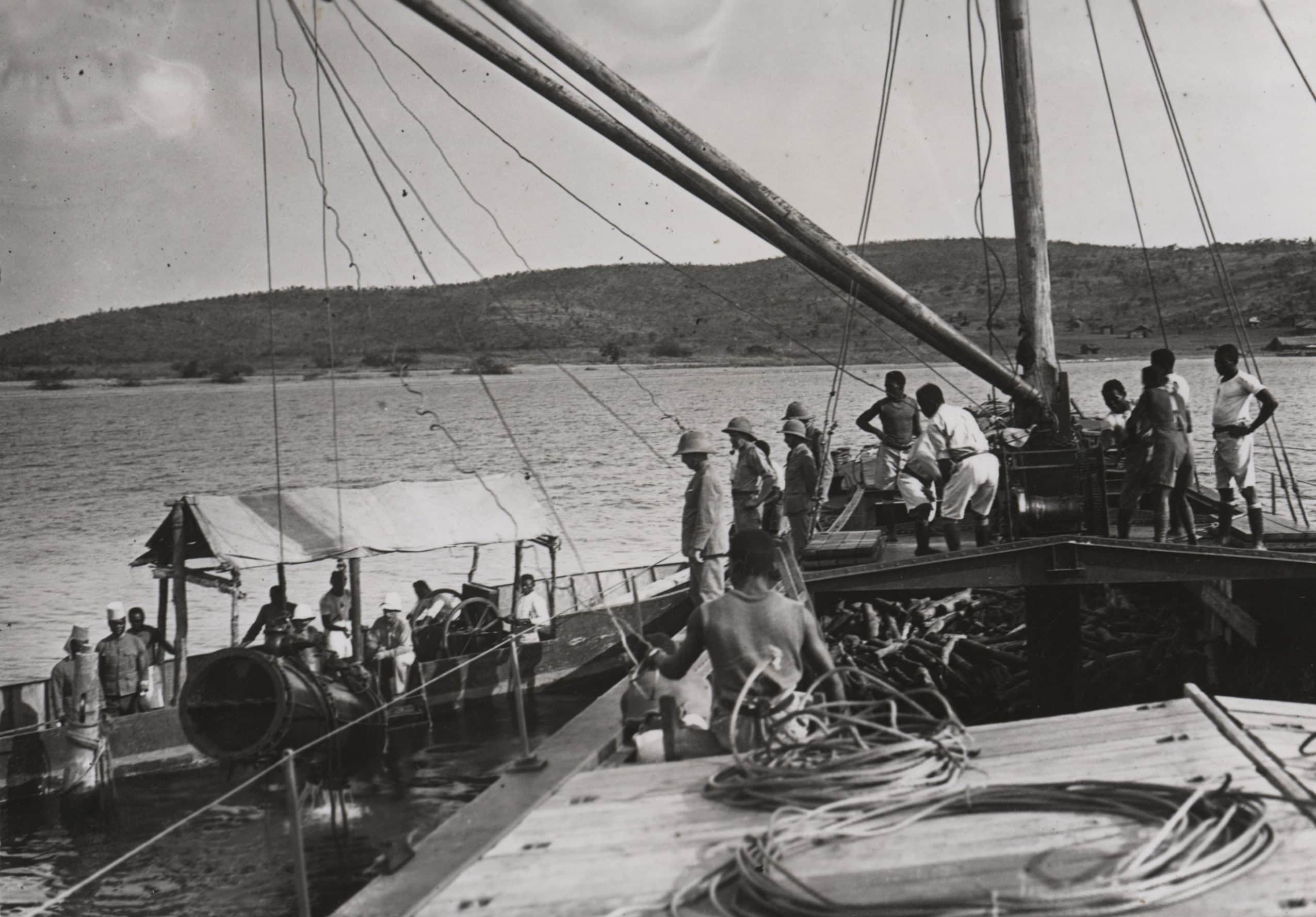
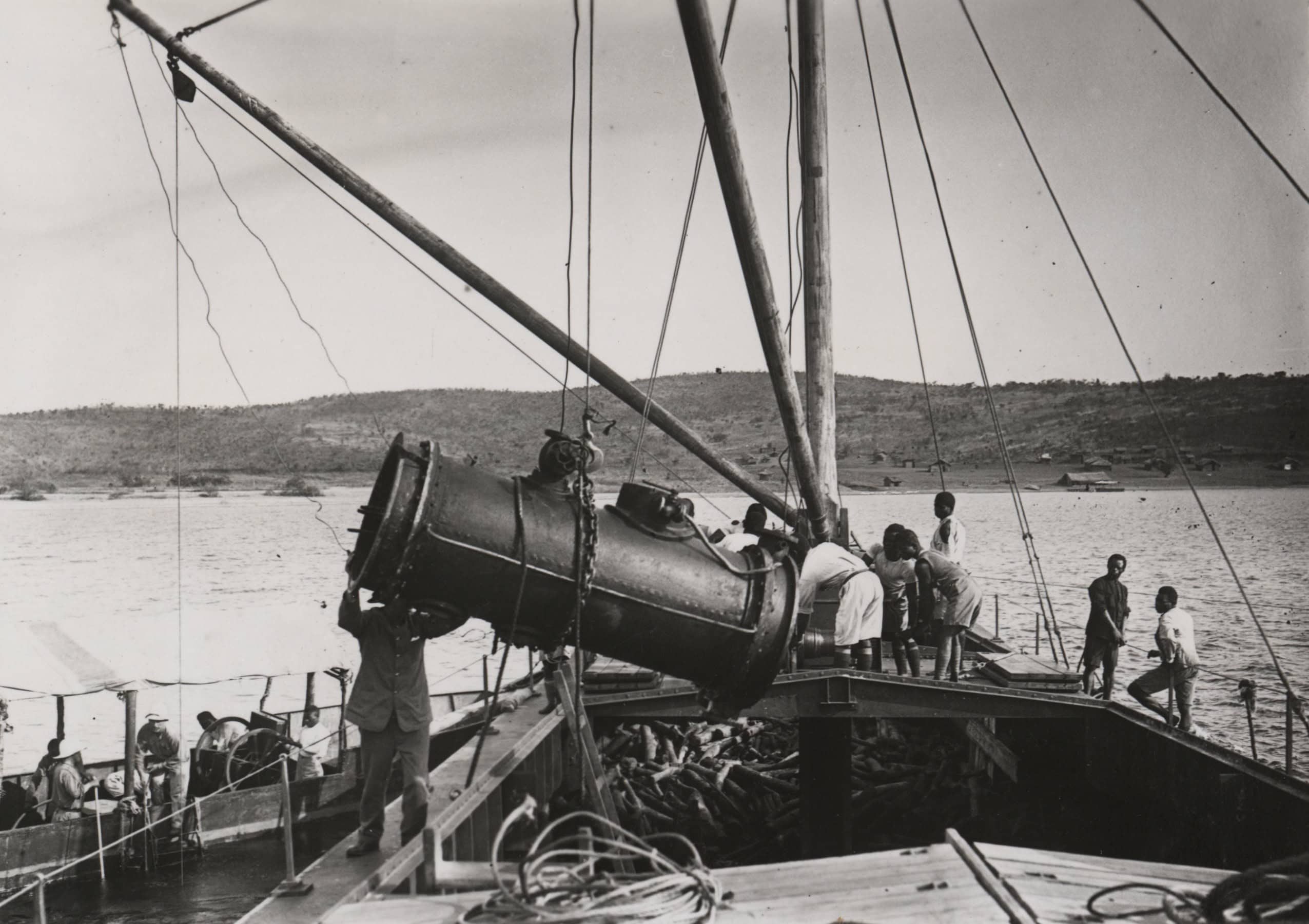
Musée royal de l'Afrique centrale, Tervuren, Belgien. HP.1966.1.120, HP.1966.1.124, HP.1966.1.128, HP.1966.1.123.
They were able to lift it just clear of the bottom, and in this half-salvaged state, and by using barges they towed it back in front of the harbour of Kigoma in a water depth of six to seven meters. There, the GOETZEN unfortunately sank again.{{ref}}
For the frequently reproduced assertion, that the GOETZEN tore herself away spectacularly during a storm in early 1920{{ref}}, there could not be found any reliable sources until now.
In 1921 the former colony of German East Africa came under British rule in the form of a mandated territory. The future of the Goetzen was also under discussion, and on 5 May 1921 the British Governor of Tanganyika, Sir Horace Archer Byatt, wrote to the Foreign Ministry in London proposing that the ship should be raised and taken over by the British. A response to this suggestion from the British Minister for the Colonies at the time, Winston S. Churchill, was received on 13 October with enclosed copies of correspondence with the Treasury Department on the matter of the proposed salvage and acquisition of the steamship GOETZEN by the government of the colony of Tanganyika. One of the enclosed copies dated from 27 September 1921. This stated that Churchill agreed wholeheartedly with the opinion of the Governor and therefore was trying to issue authorisation for the planned action, whose cost at this time was estimated at £7,500. A further copy from 5 October 1921 states that the British Treasury Department would issue an authorisation for the estimated cost of £7,500 under various conditions. For instance, it had to be ensured that the sum would cover the total cost of the project and that, as regards the ownership of the salvaged ship, there should be no disagreements with the neighbouring Belgians.{{ref}}
In fact, the salvage proved a much more protracted and complicated undertaking than was foreseen and the total cost in the end – including the Belgians’ failed salvage attempt – was £20,400, almost three times the originally budgeted £7,500.{{ref}} Work on the planned salvage using pressurised air began in December 1922 under the command of Lieutenant-Commander T. Kerr of the Royal Navy with one diver and five shipbuilders. But it soon transpired that two more divers and three more men would be needed. A diver earned £75 per month, a shipbuilder £40, each with free travel costs, free accommodation in Kigoma and the necessary equipment.{{ref}}
After Tanganyika Railways & Ports Services (TR&P) also became responsible for the shipping traffic on Lake Tanganyika on 1 June 1923, they took over the salvage work. Despite that, there was little of value to take over: The tug MWANZA was still out of service due to a serious accident to the boiler; and the FIFI was laid up in a bad state of repair. As the salvage and re-equipping of the GOETZEN would obviously be a long job, the only hope of starting a service on the lake in the near future was to use either MWANZA or FIFI. In 1924 a Board of Survey decided that FIFI could not be repaired, so she was stripped of all equipment and the hull sunk in the lake. The heavy repairs to the MWANZA’s boilers took a long time and the ship did not run its trials until 19 January 1924. They were successful, and the Mwanza went into service and ran 15,000 miles during the remaining eleven months of the year. Unfortunately, the reconditioned boiler did not stand up to the work and had to be condemned. A new boiler was ordered from Great Britain, but delivery took time, so that MWANZA was out of commission until the middle of 1926. During this time the vessel was reconditioned and provided with one three-berth cabin for first-class passengers, deck space for 30 passengers and cargo space for 30 tons.{{ref}}
A very descriptive report of the GOETZEN’s salvage provides the shipbuilder and diver C. F. Laver, who was engaged in this matter:
In early December, 1922, a small salvage party assembled at Kigoma to get it afloat. In charge of the operation was Commader Kerr, late Royal Navy, and his deputy and paymaster was Commander Sharp, late Royal Navy – both then domiciled in Kenya Colony. The technical adviser was Mr. J. Shepherd, who had held the same office during operations on the sunken dock at Dar es Salaam. The European section of the party was completed by the addition of a ship’s carpenter, a marine engineer – both ex Royal Navy – and four shipwright-divers.
[…] Nevertheless, a plan was prepared embodying the deceptively easy-looking method of raising by compressed air. To retain the air within the holds of the ship it was planned to extend the coamings of the hatches downwards. There was nothing very difficult likely to be met with in accomplishing this work; the difficulty in compressed-air salvage comes with the first movement of the ship – the imprisoned air rushes to whichever end or side starts to rise first, and makes it rise faster and faster, whilst the other end or side stays put. If the initial rise can be controlled by some counter measure, and limited to a rise of a few feet, the end or side which lags behind can receive an increased lift […]; then the ship can be moved into shallower water and the process repeated.
The rise can be checked in two different ways. In the first, weights can be attached to the ship by wires slack enough to allow a fixed amount of rise, after which the weight attached to the rising end would be added to the deadweight of that end of the ship and dragged up the beach with her. In the second, and the one Mr. Shepherd adopted, lifting pontoons are attached to each end, submerged at such a distance that when the end rises to the required height the pontoon emerges and thus reduces the lift. Two Vicker’s collapsible pontoons were included in the equipment for this service, each designed to lift 50 tons.
The equipment at Kigoma included two specially constructed diving boats – rectangular box-like vessels with tapered ends – each rigged with a diving pump and gear for two divers shallow water, or one diver in depths over 33 feet up to 100 feet. There was also a motor-boat to act as tender to the diving boats and for kindred purposes. Ashore there was a steam-driven air-compressor linked to the wreck position by a two-inch main; and in reserve there was a six-inch motor-driven centrifugal salvage pump.
Within a week of arrival at Kigoma diving operations commenced on the wreck with a survey. The decks were found to be littered with the heavy wire hawsers used in the original attempt; and the mainmast had been bent down almost at right angles to clear the lifting lighter used. The hatch coamings were examined, and it was found to be a simple proposition to remove the coping-irons from their lower edges and to use the rivet holes for bolting on the extension plating […].
Diving routine was arranged so that in each diving boat one diver would be underwater three hours whilst the other acted as attendant; then without a break the first diver became the attendant whilst the other dived and endeavoured to complete the day’s programme. The depth was great enough to require controlled decompression at the end of each dive – a short pause at 20 feet and a long one at 10 feet to avoid trouble from nitrogen bubbles in the blood and tissues; these stops were cut by the divers themselves to about half the times […] The reason for the cuts was initially the possibility that crocodiles might be tempted […] but it also gave another 15 minutes on the bottom […].
The wire hawsers took up little diving time to clear, but the removal of the mainmast was a tougher proposition; its heel not only penetrated the deck, it also went down through the top of the twin shaft tunnel and was stepped on the vertical keel. The mast wedges in the deck were not at all so troublesome to extract as was anticipated; borers had been busy on them for a considerable time, honeycombing them with horizontal tunnels, and closely behind them followed ferocious-looking little fishes which ripped away the weakened wood to expose the borers. Some of the wedges had completely disappeared.
In the holds were a large number of empty oil drums, and some of these were secured to the mast, bungholes downwards, and compressed air fed into them until enough lift was built up to yank the mast from its housing.
After a few weeks the extension plates were completed and the air-compressor was started up to test the airtightness of the steel decks. The result was alarming; the decks, it appeared, had never been caulked, watertightness had been achieved by caulking the covering of teak decking. Like the mast wedges, these teak decks were partly destroyed by the combined operations of borer and fish; the air leaked up through them in numerous places. It was useless trying to stop the leaks from above the decks; they had to be stopped at source – on the underside of the steel deck plating – a most formidable prospect, and a very sticky problem for the technical adviser.
The first experiment at checking the leaks with tallow failed, due to the heat of the newly compressed air in the hold, the air escaped before it had time to cool down to the temperature of the surrounding water, which itself was about 80 degrees Fahrenheit, and the tallow fell away from the plating almost immediately. Ultimately, beeswax was found to be just the right substance for the purpose, and the divers had little difficulty in applying it to the laps of plating in the total darkness which prevailed in the holds. But another difficulty immediately arose; they had no means of knowing where exactly the laps were leaking. The bubbles from a leak ran along between the steel deck and the covering wood deck, maybe appearing many yards away from the leak in the plating, and it was obviously impracticable for them to deal systematically with every joint in the decks whether leaking or not.
Eventually a solution was found which was both simple and effective: by running the compressor at top speed an airlock of about 8 in. could be maintained under the highest part of the deck; wax candles and a box of matches were taken down in a watertight box which was fitted with a valve to equalize the pressure for the purpose of opening the cover in the air lock, and after many abortive attempts, a candle was at last lighted, and from it others. They provided light and a ready means of locating leaks; the flame of a candle run along a lap would be sucked out through the first leak it met with, after which it was a matter of a minute or so to seal the leak with a pencil of beeswax.
The progressive reduction of leakage enabled a deeper airlock to be maintained without punishing the air-compressor so much, and there came a day when the holds were pronounced to be sufficiently airtight for requirements. The next business was the attachment of the two flexible pontoons, another straightforward job; but when the air was run into them, they leaked as badly as the decks had done, and instead of taking their full lifts of 50 tons each, it was difficult to pump them up to half capacity.
Very little could be done about them; but it meant the acceptance of a heavy reduction of the checking forces when the ship began to lift. A trial lift was staged, and without hesitation the bow rose right to the surface, and as it did so the ship turned over on to her starboard side, with the bluff of her port bow steaming in the sun. After a while she was allowed to sink again to the bottom, and later was righted.
It was then decided to borrow water tanks from the Railway and to use them inverted as pontoons to make up for some of the deficiency resulting from the failure of the flexible pontoons. The technical adviser also recommended that the centre of lift should be shifted further aft by making the bunkers airtight. About this time two of the divers became anxious to return to England, and were released from their contracts, after which Mr. Shepherd himself attended to the task of making the bunkers airtight, the ship’s carpenter acting as his attendant.
When the substitute pontoons were all attached, the bunkers and the two boilers were blown, and another lift attempted. The result was little different to the first one. The root of the trouble probably lay in the heavy suction which had to be broken between the flat bottom of the ship and the clinging sand; by the time the ship was buoyant enough to break the suction she was too buoyant to be checked by the emergence of the pontoons. A bold decision was then taken to construct two cylindrical pontoons of steel, each with a lifting capacity of 70 tons.
Plates and angles were obtained from Dar es Salaam, and from them the two pontoons were built in the open air […]. The plant consisted of the salvage pneumatic drills and pistols; and a 6-in. hand-operated shearing machine and a charcoal-burning rivet-forge borrowed from the Railway. The plates and angles were bent cold to a radius of 5 ft. 7½ in. on an improvised press made up from a pair of wagon-lifting screw-jacks. The pontoons were properly riveted and caulked, and incorporated in the design two heavily proportioned sling-plates.
These pontoons were attached to the ship, but the suction forces were too great even for these giants, and the ship assumed her now too familiar posture with the bows seven or eight feet above water and the foremast horizontal and submerged. An endeavour was then made to float her on her side; air was pumped into the after hold until it began to escape through the shaft tunnel into the engine room. Pontoons were transferred to the stern, and use was made of every ounce of buoyancy that could be provided, but the stern stubbornly remained down in 11 fathoms. There was no question of suction in this position; it was simply the shift of the centre of lift due to the trim of the ship – the effect which defeats so many promising attempts in submarine salvage operations.
Anxious discussion of the situation brought out the fact that unless more buoyancy could be obtained from the after hold, the salvage would have to be abandoned; and the only way to increase that buoyancy was to close the shaft-tunnel door to attempt to deepen the airlock in the after hold. Commander Kerr was most reluctant to allow a diver to enter the engine room with the ship in that condition, but eventually yielded to persuasion and the tunnel door proved sufficiently airtight to hold in the extra air. The air compressor ashore was driven as never before; but for an hour there was no visible response from the ship. The anxious watchers had one thing to cheer them; air was rushing into the ship and not much of it coming out again – the lifting forces were gathering strength. Then suddenly a shout went up from the crowd of spectators ashore, and with the water cascading from her port side she surfaced like a submarine, surrounded by a widening ring of foam from the air gushing from holds and pontoons. It was Sunday, 16th March, 1924.
There was no time lost in hauling the ship into shallower water where she was finally righted and floated. Most of the water trapped in her was pumped from her by the 6-in. salvage-pump – running towards the end on a magneto off a motor-cycle – but the last few hundred tons were pumped out by the ship’s own donkey pump, running on compressed air. She was then berthed once again in the little basin containing the slipway, from which she bad been launched, battered but a long way from beaten; she was destined to sail the waters of Lake Tanganyika for many long years under her new name – LIEMBA.
The reconditioning had to be carried out entirely afloat, and is believed to be unique in that respect, the ship having to be fitted with new shaft-brackets and new outer-bottom plating.{{ref}}
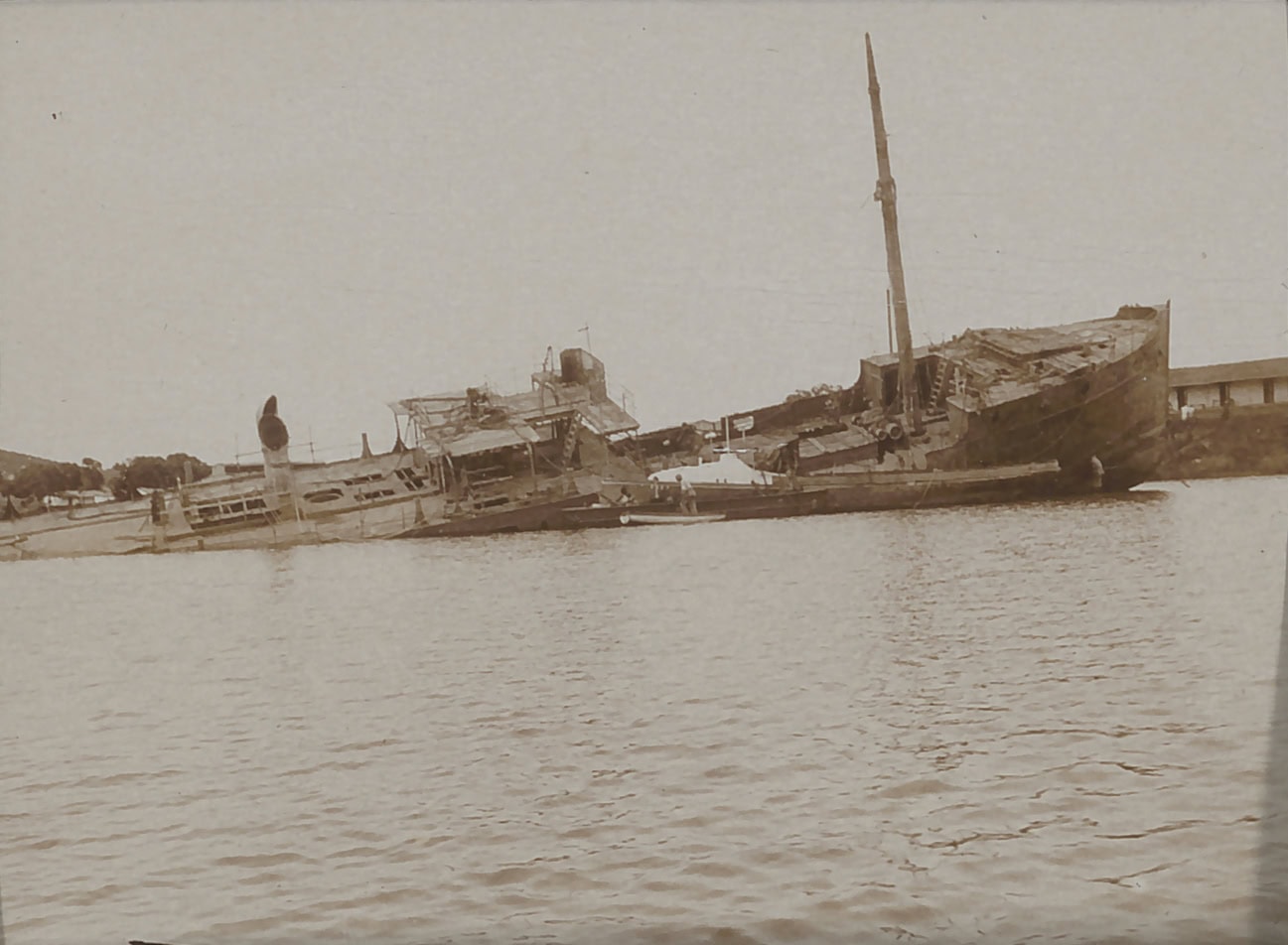
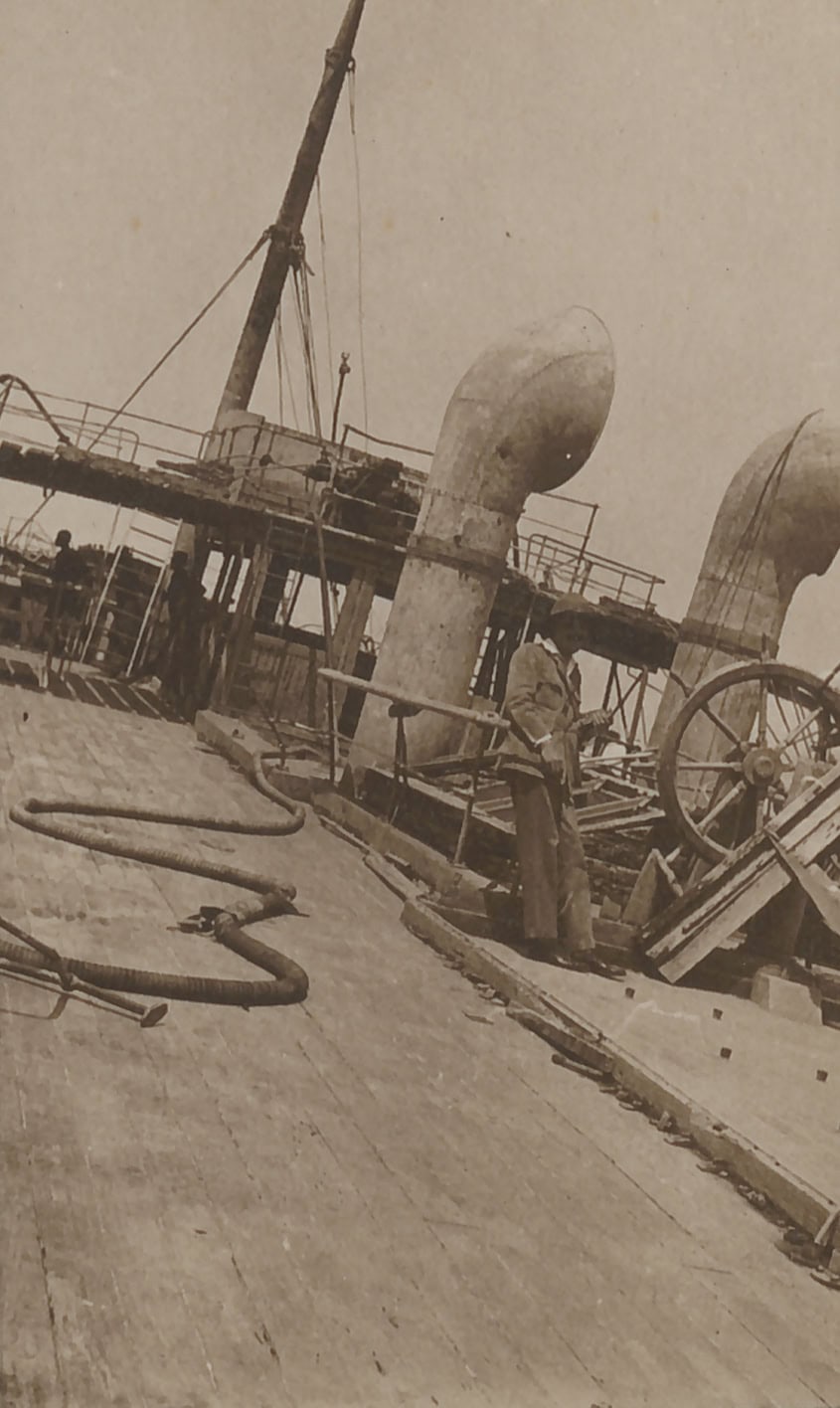
Royal Museum for Central Africa, Tervuren, Belgium. 2018.10.348-15, 2018.10.349-15.
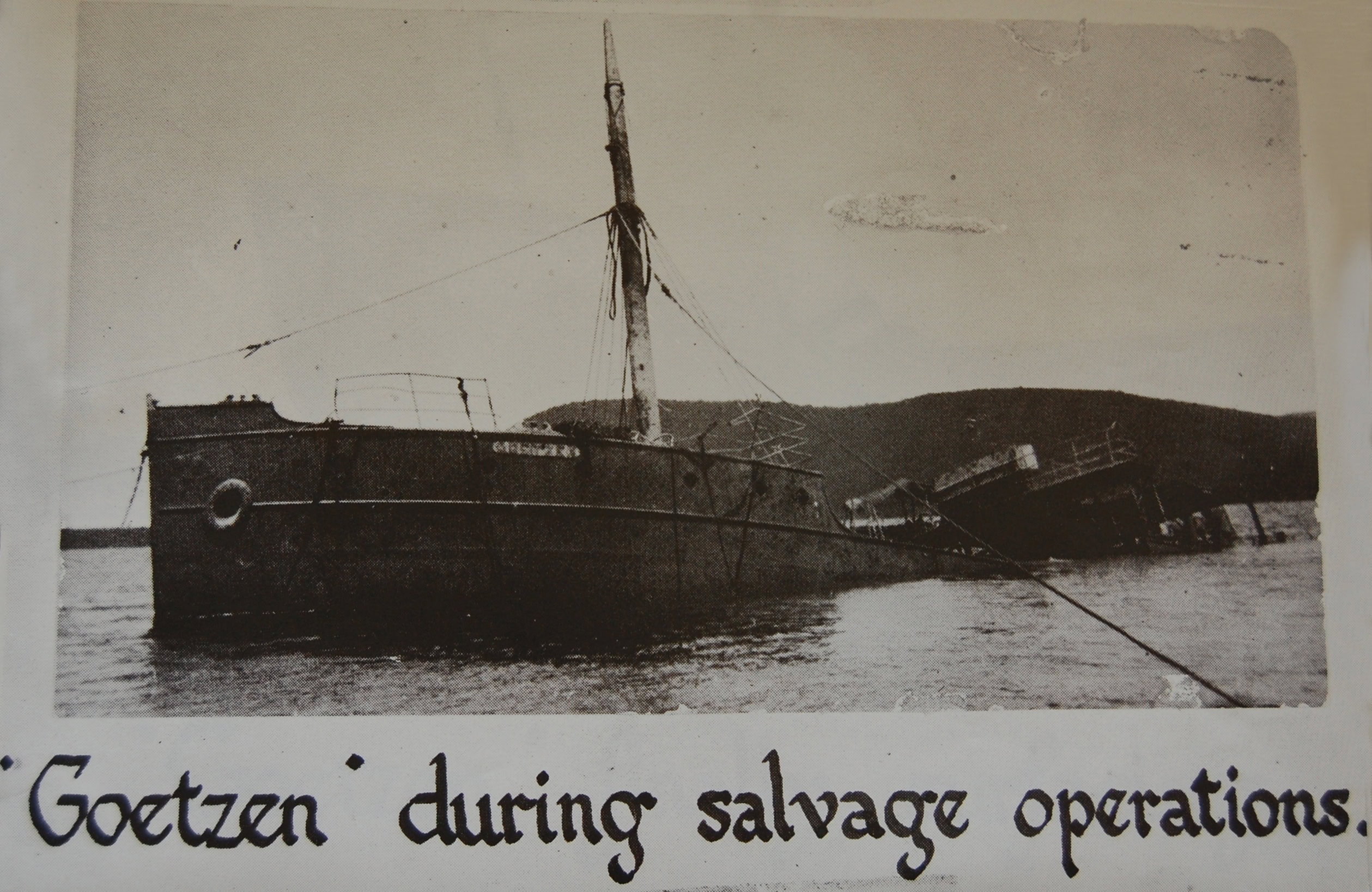
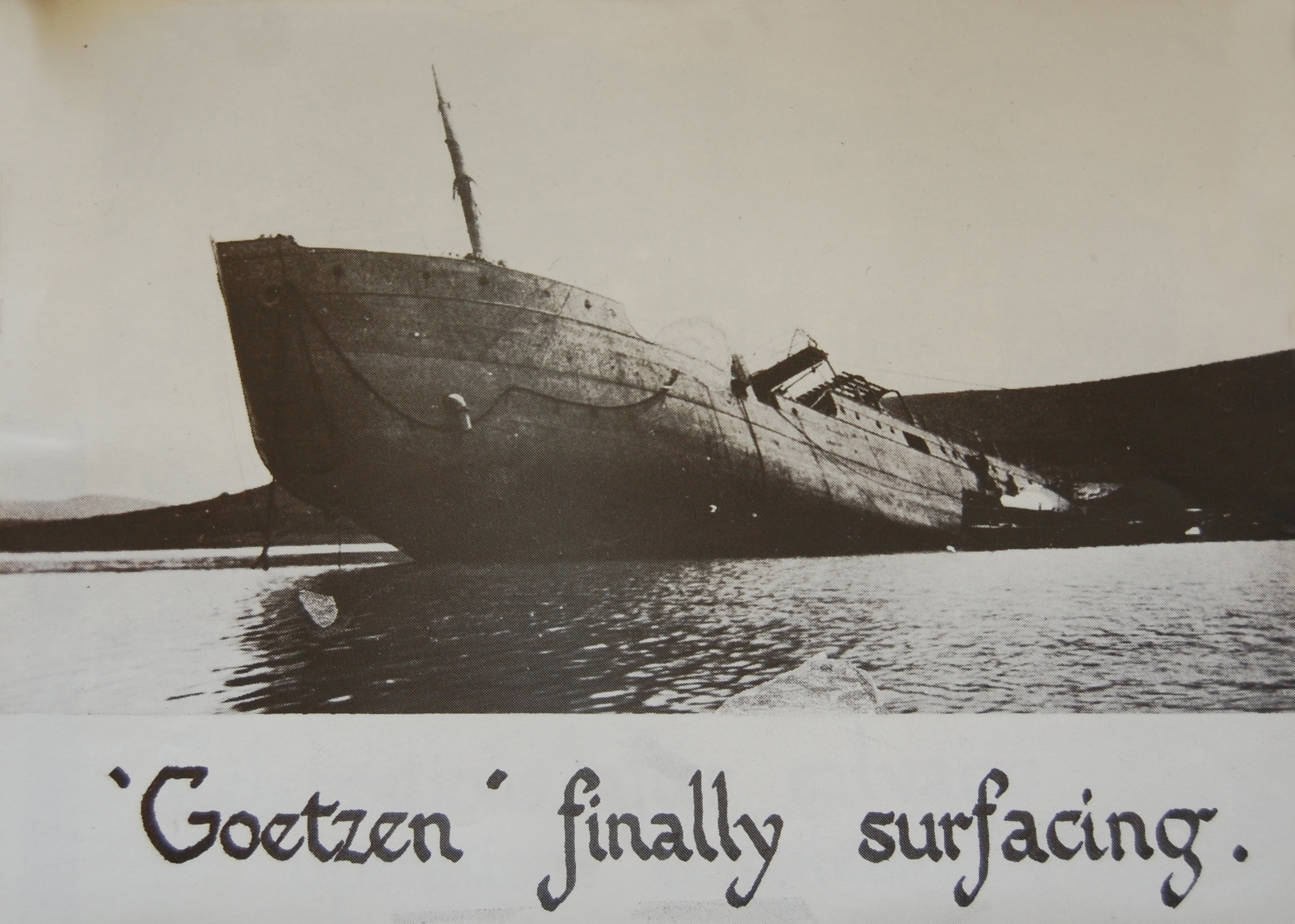
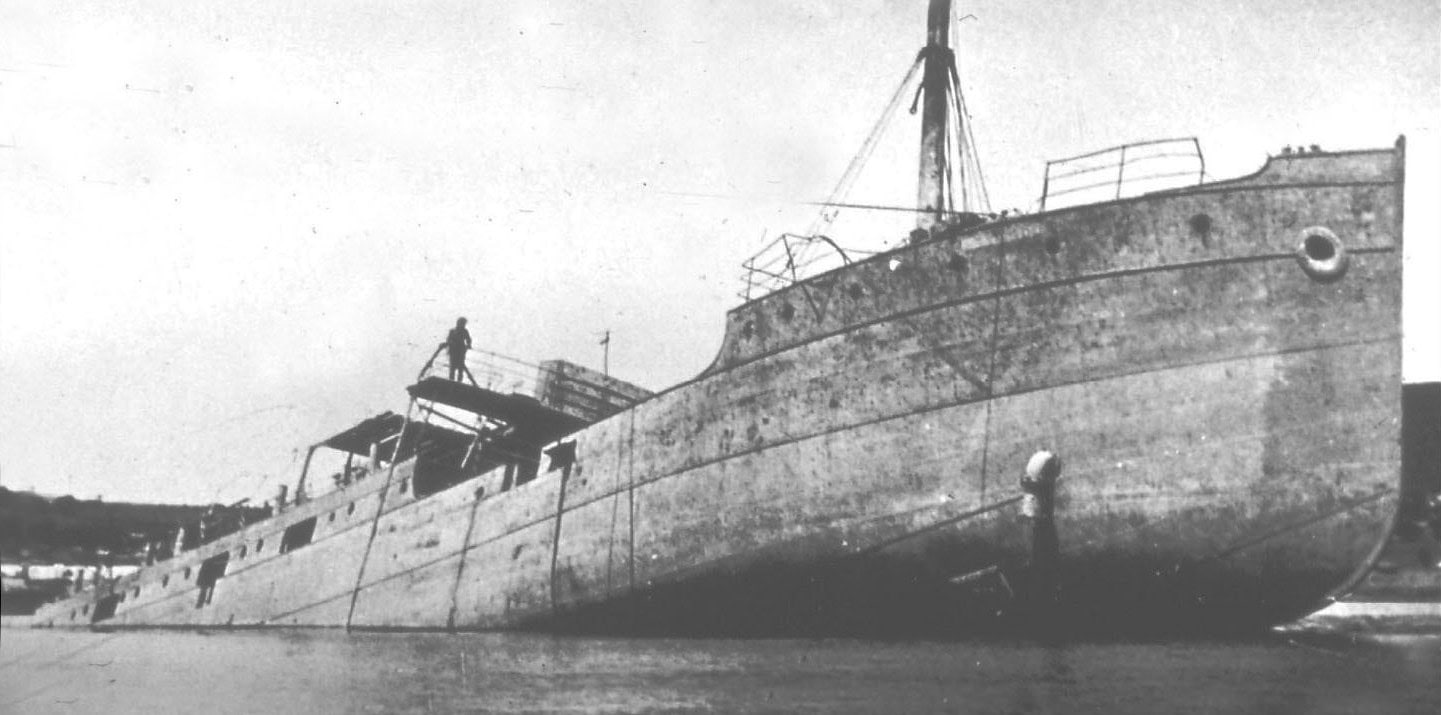
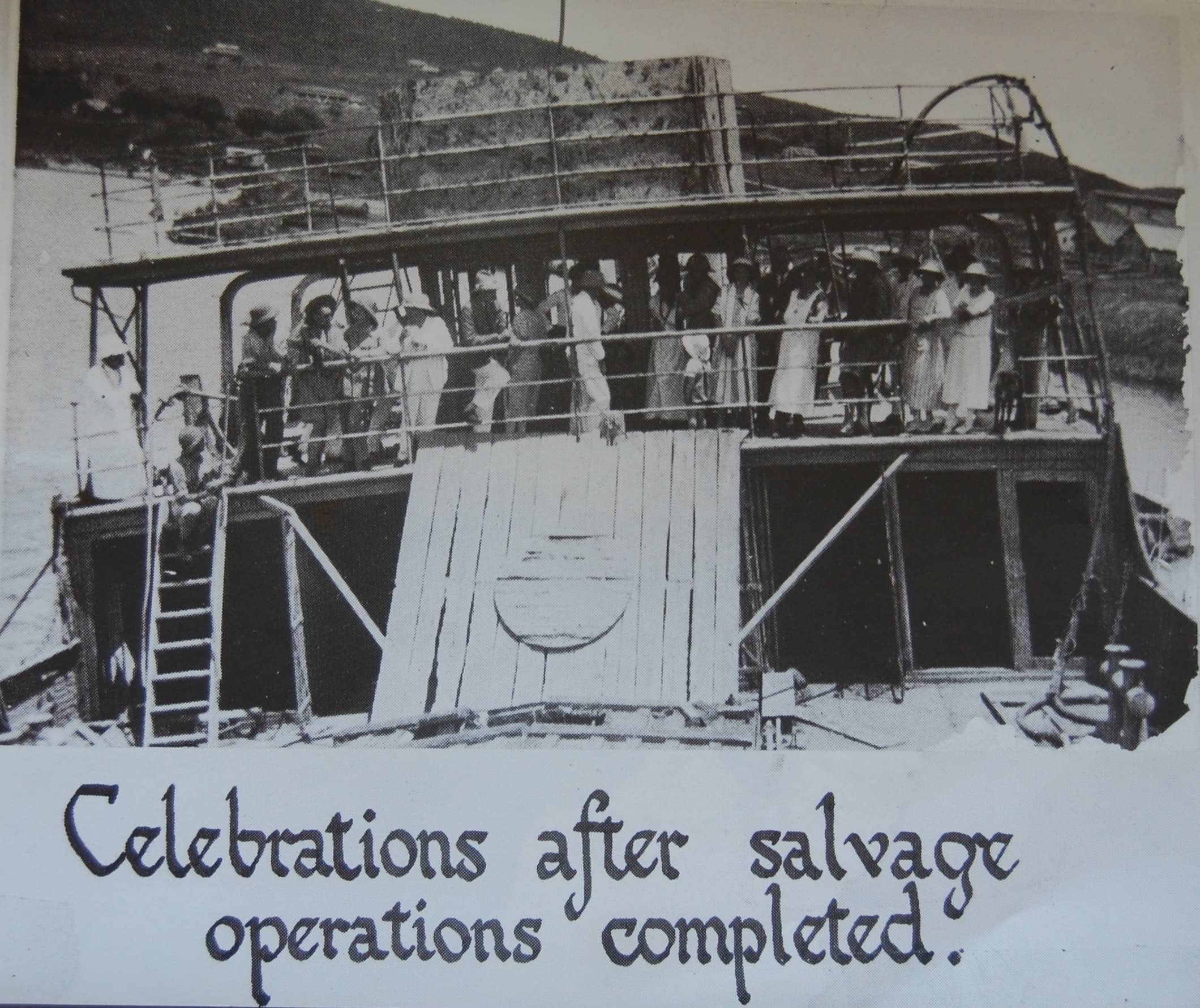
Lizzie Webster (1 and 2), Meyer Shipyard Papenburg (3), Bjarne Henneberg Sørensen (4).
After almost eight years under water, upon initial inspection the ship proved to be in an unexpectedly good condition. On 29 March 1924, the General Manager of the TR&P, Colonel G. A. P. Maxwell, wrote: The ship’s engines are obviously in excellent condition. […] Commander Kerr tells me that there is absolutely no reason why the GOETZEN should not sail with complete safety and fully loaded.{{ref}}
Major repairs by the British.
After the salvage of the GOETZEN, however, discussion began about possible further action. Would developments on Lake Tanganyika justify the vast cost of completely overhauling the steamer and establishing regular shipping operations – which Churchill was in favour of – or would it not be better to try to sell the ship as it was to the Belgians at a profit if possible? Confidently, G. A. P. Maxwell wrote on 17 July 1924 on this matter: Of course, we should not become dependent on the Belgians as regards the shipping transport in our southern ports and those in North East Rhodesia, but rather we should compete with them.{{ref}}
On 17 September 1924 the British Foreign Ministry declared in a letter to the Governor that it was fundamentally in favour of overhauling the ship for service on Lake Tanganyika and requested a complete list of the estimated costs.{{ref}}
A detailed estimate of the costs was thus prepared in May by chief mechanic K. C. Strahan. In order to render the ship seaworthy, Strahan estimated a sum of £12,422 for the hull, fittings, decks, etc.; for technical components such as the steam engines, boiler and other systems, on the other hand, £7,481. Overall, then, a total cost of £19,903 was to be expected. But it was not possible to keep to this estimate either, since in the course of the subsequent three-year refitting phase, various other work proved necessary. In the end the costs amounted to a total of £29,296. If this is added to the cost of salvage carried out by the Belgians and British, amounting to £20,400, the total cost comes to £49,696. According to a letter by the General Manager dated 6 August 1926, there were additional amounts for restoration of the shipyard (£15,000), the slipway (£10,000) and construction of a crane (£3,000). Moreover, marine signage and beacons had to be installed on the eastern and southern banks of the lake.{{ref}}
In order to appreciate the scale of these costs, it is important to bear in mind that previously the German costs of preliminary assembly of the ship in Papenburg, transport to Lake Tanganyika and final assembly there had been 750,000 Marks, which is equivalent to £36,765.{{ref}}
In the course of the repair work, the original ship superstructure was largely retained. Only a new funnel top and fixed sunshade roofs were added, as well as one of the two water tanks on the first-class-lounge was removed. The cabins now offered accommodation for 10 first class, 12 second class and 150 third class passengers.{{ref}} At the stern, a small extension was added with a surround gallery.
Despite the years underwater, the propulsion system was in a remarkably good condition, so it was put back into service after a thorough overhaul.{{ref}}
From GOETZEN to LIEMBA.
Towards the end of the restoration work, the persons responsible started to think about renaming the GOETZEN. Because of the ship’s connections to the region, one of the names under discussion was that of the famous British explorer of Africa LIVINGSTONE; also the name KANGAROO, which in the language of the natives of what was then Rhodesia and Nyasaland meant “man with a little dog” and also referred to Livingstone. A third suggestion was MNYAKA. This name incorporated the Swahili word “nyaka”, which means “catch”, “pick up” or “steal”. Or – in seaman’s terms – “commandeer” or “capture”.
But in the end, all these names were rejected and on 8 January 1926, Governor Sir Donald Cameron wrote to the Foreign Ministry:
With regard to your letter No. 331 dated 18 June concerning the renaming of steamship GOETZEN, I request that the necessary measures be taken to register the ship under the name LIEMBA, the name the natives used for Lake Tanganyika when Dr. Livingstone first reached its shores.{{ref}}
Strictly speaking, it is the language of the Fipa tribe resident in the Rukwa region – in the southern part of the lake – and means “the place where is water”.{{ref}}
On 9 and 10 May 1927 the test runs were undertaken. This was done under the supervision of Chief Mechanic C. F. Strahan, who later noted in his report that the results were satisfactory and that the average speed achieved was 8.5 knots.
Finally, cards were printed for the ceremonial event of the recommissioning, to which the railway administration invited guests on the occasion of the official maiden voyage of the T.R.S.{{ref}} LIEMBA and the naming of the ship by Mrs. John Scott{{ref}} in Kigoma on Monday, 16 May 1927. The naming ceremony was followed by a short speech of thanks to the Governor. In addition, Mrs. Scott, as the sponsor, received a gift by which to remember this special day. On behalf of all others involved in the project team, special thanks were offered to Mr. Shepherd for the salvage and Mr. Halliday and Mr. Strahan for the restoration, then generous toasts were drunk to all these persons and the future success of the LIEMBA. The musical accompaniment was provided by forty men commandeered from the Sixth Battalion of the King’s African Rifles of Dar es Salaam. During the subsequent maiden voyage, the celebratory feast was held. The last speakers were the incumbent General Manager of the railway administration and the Governor of Tanganyika, as well as the ship’s captain, G. A. C. Sharpe.{{ref}}
Ibrahim Mbiu Bendera, who began his service on the LIEMBA in 1982 as second navigation officer and became her captain two years later, also did researches concerning the ship’s repairs and renaming:
At that time, the British Imperial Government had earmarked a total of 35,000 Sterling Pounds interest free loan to the Territory Government for the construction of a new steamer capable of carrying passengers and cargo for Lake Tanganyika.
However, Sir Horace Byatt the first British Governor, who named the territory Tanganyika, thought otherwise. His dispatch No. 226 dated November 8, 1923, read in part: “With reference to your telegrams of 23/10 and 26/10, I consider that when VON GOETZEN has been salved and commissioned with (the vessel) MWANZA lake requirements will be met for some time to come and I am not justified in recommending another vessel.”
Thus the Governor wanted the SS VON GOETZEN to be transformed into a merchant ship capable of carrying passengers and cargo.
He went further by suggesting that the money saved from the difference between repairing the ship from the allocated funds for a new ship be utilised for other use, including the improvement of the railway line between Dar es salaam and Morogoro and the Dar es salaam Port.
The colonial secretary accepted this as the cost of repairing the SS GOETZEN was estimated at approximately half of the value of the new steamer.
After several delays, the repairs were finally concluded in 1925. By then the British Governor for Tanganyika was Sir Donald Cameroon. It was thus logical to have the ship registered under the British Registry, but the question was what will be her new name? From the various correspondences available at the National Archives, the government of Tanganyika Territory had not yet come up with a name.
The general manager of Tanganyika Railways in his letter dated March 9, 1925, addressed to the Governor suggested that the ship be named MV LIVINGSTONE, after the great British explorer of African hinterland. It may be said that this was a very popular name in the East and Central African region used for towns, streets and other sites worth colonial aspect.
However, under the British Merchant Shipping Act of 1894 (which was applicable by then) under Section 47 it was mandated for the name of a ship to be accepted there should be a written permission from the Board of Trade.
Thus although the Chief Secretar accepted the general manager’s suggestion, he explained in his memo dated March 31, 1925, that permission from the board must be sought.
Therefore, based on the above, on April 25, 1925, the Governor dispatched a note to Lt. Col. Amery, who had then replaced Sir Winston Churchill as the Secretary of State for the Colonies, informing him of the desire to register the SS VON GOETZEN in the name of LIVINGSTONE.
The reply from Lt. Col. Amery dated June 25, 1925, declined to register the ship in that name. In his own words he said: “I’ve the honour to acknowledge the receipt of your dispatch No. 274 of the 24th of April, regarding the renaming of the SS GOETZEN, and to inform you that the Registrar General of Shipping and Seamen has pointed out that there are already two vessels registered in the name of ‘Livingstone’. Having regard to the regulations made under Section 50 of the Merchant Shipping Act, 1906, this name is not available.”
The Secretary of State went further and requested another name of the ship to be proposed.
After the name LIVINGSTONE failed to pass the test, the Governor told the Chief Secretary to request from all the provincial commissioners in Tanganyika to look out for a local name that the “natives” used to call Dr. Livingstone to be used as the new name of the ship. Answers to this question were received from as far off as Nyasaland (Malawi) where the Chief Secretary in that territory suggested the ship to be called MNYAKA, meaning “the doctor”, the local name that the natives in that area used to call Dr. Livingstone.
Another suggestion in a letter dated November 26, 1925, from the Overtown Institution in Livingstone, Nyasaland proposed the name MONARI, while from Northern Rhodesia came KAGURU meaning “the man with the little dog”, a name they used to call Dr. Livingstone.
Ultimately, the Governor chose the name LIEMBA which was proposed by the Provincial Commissioner for Western Province as the name of the lake that the natives used to call it when Dr. Livingstone first reached those waters. To the Wafipa the lake was, and still is the “Liemba Lya Mfipa”, meaning the sea of the Wafipa.
When the name LIEMBA was suggested to the Secretary of State by the Governor in his dispatch dated January 8, 1926, the Secretary of State Lt Col Amery replied that instead of LIEMBA, the ship be named CAMERON after the Governor himself, since he had extensive career in Africa, from West Africa and then in East Africa. However, the Governor was too modest as he insisted on the name LIEMBA and hence the ship was registered in London as MV LIEMBA. This clearly shows that the LIEMBA (ship) and the “Liemba Lya Mfipa” (lake) are really destined for each other. With a name, the MV LIEMBA by Tanganyika Railways and Port Services was launched on May 16, 1927, by Mrs. Mary Katherine Scott, the wife of Sir John Scott, who was the Chief Secretary and acting governor of Tanganyika.{{ref}}
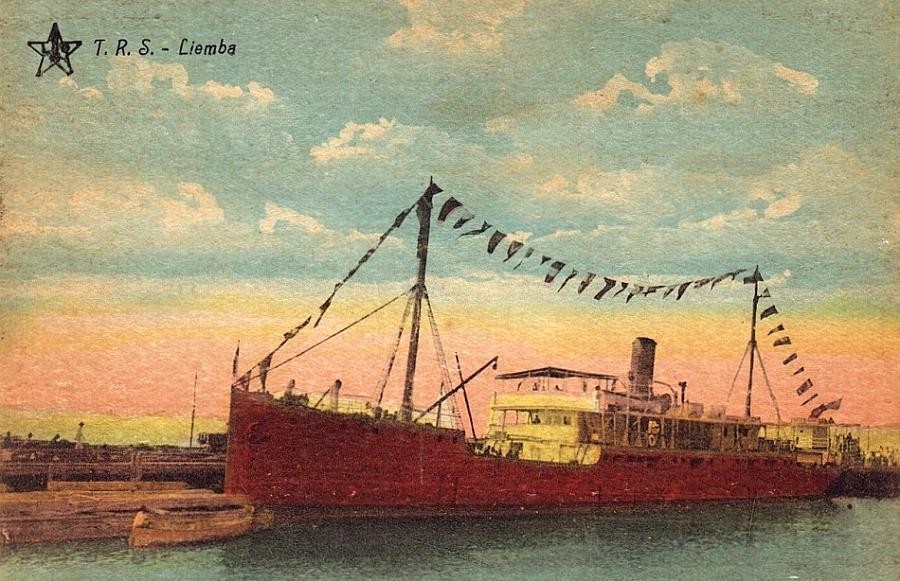
Meyer Shipyard Papenburg.
In 1930, TR&P apparently considered building a second ship for Lake Tanganyika at an estimated cost of 100,000 £. The Bremen settled branch of the Foreign Office for Foreign Trade had been made aware of this by an article in the trading section of the Manchester Guardian and had then contacted the German consulate in Nairobi, because a company affiliated to this branch, which is specialized in river- and tropical ship building, shows interest in this matter. However, the matter obviously did not go further, and the general manager of TR&P merely informed the consulate that the construction project would be put out to tender as soon as further details were available.{{ref}}
For the following years concerning the LIEMBA the usual annual maintenance work is recorded. In 1938 the TR&P finally recommended contacting the Meyer Werft shipyard in Germany. The reason was simple: since there was no reliable technical information on the ship, an attempt should be made to obtain technical descriptions, plans and other details from the manufacturer. A particular priority here – due to the ongoing problem of the lack of a double bottom – was the hull and its stability, also the permissible power of the steam engines and boilers, and better measurements and plans of the propellers. This action was probably also prompted at this time by the fact that the engine power had deteriorated and it was only possible to achieve an average speed of around 6 knots. The suggestion was, however, rejected by the responsible government offices, since they did not wish to have any contact with the German manufacturer.
Shortly before the outbreak of the Second World War the British travel company Thomas Cook and Son planned to offer a Cairo-to-Cape cruise and booked accommodation for 12 passengers on the LIEMBA. Unfortunately, the Second World War avoided this hopeful development.
During the war, the LIEMBA continued its scheduled service but also transported thousands of refugees, prisoners of war and soldiers on countless special sailings. In this period, together with the smaller MWANZA, it mainly offered trips along the east bank of the lake, and even reached Mpulungu.
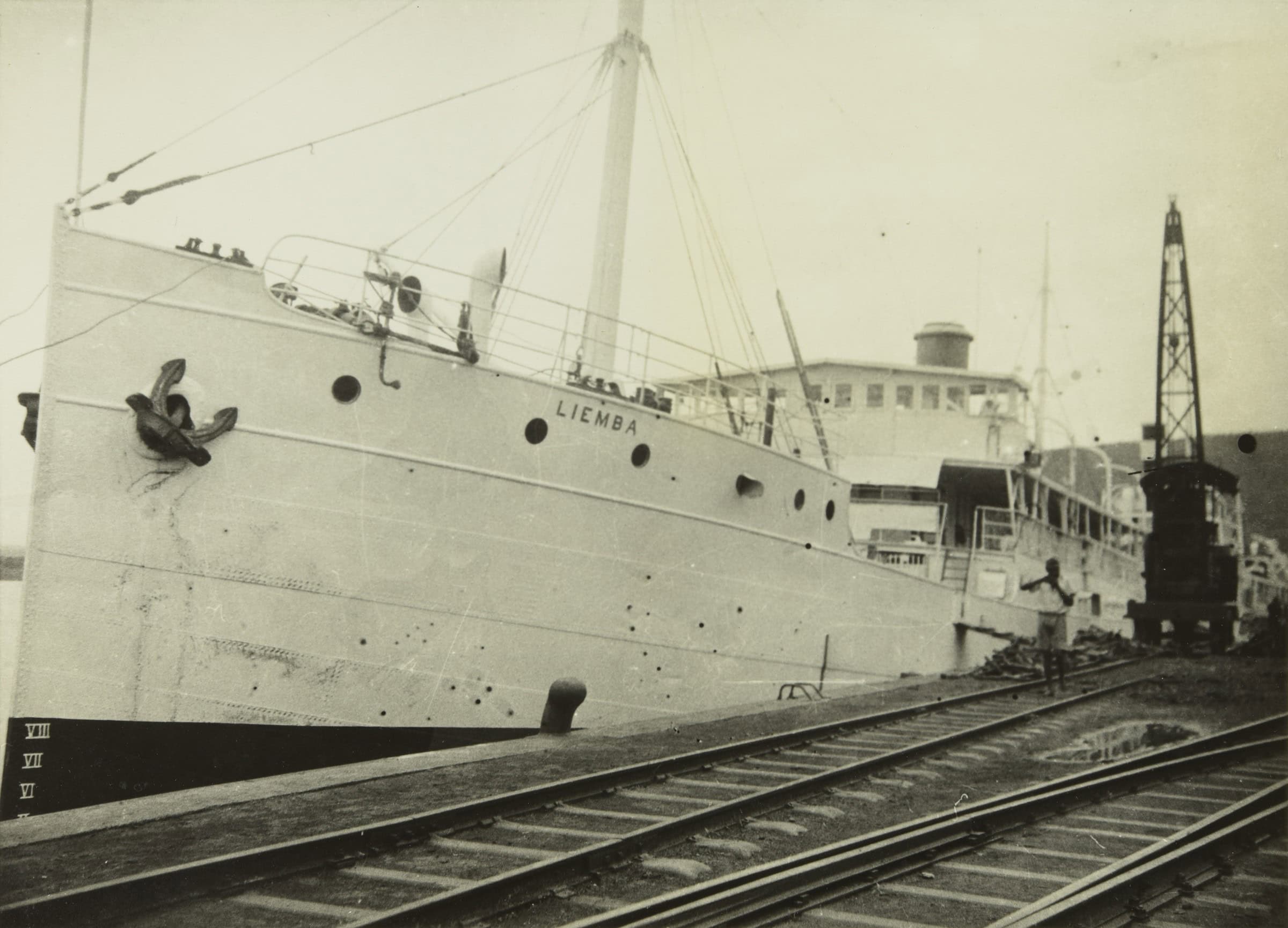
Royal Museum for Central Africa, Tervuren, Belgium. 2027.24.13.
The significance of Mpulungu appears to have increased after the end of the Second World War. Cane mentions that a new pier and a customs point had been established in Mpulungu in 1947 and that in July of that year a regular transport route was established serving the ports on the south of the lake. This statement suggests that the ship had only served this area sporadically up until then. According to Cane, at that time Albertville and Usumbura were only visited occasionally by the LIEMBA; the ship served mainly the stops of the British-administered territory by the lake. For Mpulungu in those years, there was also a planned railway link to Abercorn (now Mbala), which would have made it possible to travel south without the detour through the Belgian Congo.{{ref}} This railway line was never built but as Mbala is relatively easily accessed from Mpulungu via a tarmac road, the town developed into a significant goods transfer location and has for many years been established as the southern destination port for the LIEMBA.{{ref}}
After the Second World War: Oil-fired boilers and new superstructures.
The fusion of “Kenya and Uganda Railways and Harbour” and the “Tanganyika Railways & Port Services” in 1948 led to the formation of the “East African Railways & Harbour Administration” (EAR&H), which also took over the LIEMBA. As the LIEMBA had not received any considerable overhaul since the work carried out between 1925 and 1927, it was decided that this was the right time. After detailed examination, it was decided to replace the two original boilers with two modern oil-fired boilers from J. G. Kincaid. Once the order was placed in 1949 and the manufacturer agreed to deliver the boilers within a year, the EAR&H hoped to be able to keep the ship in service until then. But this was not possible because, following serious deterioration in the state of the boilers, the LIEMBA had to be decommissioned at the end of 1950. Despite the agreement, the new boilers were only delivered after a lengthy delay, in February 1952. This set back the other work and the ship only returned to service at the end of 1952. After the new boilers were fitted, there were initially considerable problems.{{ref}}
A major part of the restoration work also consisted in extending the superstructure with an additional deck. This also increased the passenger capacity, enabling the vessel to transport 20 first class passengers, eight second class and 200 third class passengers plus 550 tonnes of freight.{{ref}}
Other work included rebuilding the bridge, replacing the aft mast with two lateral loading cranes with modern cargo-handling gear, which also enabled the loading of cars. New propellers, a new rudder with an electric motor controlled from the bridge and a new anchor winch were also fitted. Another important measure was the installation of bilge keels on both sides of the hull, which meant that the ship rolled considerably less in rough conditions.{{ref}} The new boilers increased the maximum speed to 11 knots. On 18 December 1952 the ship started her first voyage from northern Rhodesia and was given an enthusiastic reception in Mpulungu when it came into the harbour dressed overall.{{ref}}
At the beginning of January 1954, the LIEMBA was caught in a severe storm. The crew had no choice but to cut the connection to the two towed barges (50 and 70 tonnes), during which operation the ship’s chief engineer, J. Lloyd, was injured. One crew member who was on one of the barges was still missing the next day and presumably drowned. The LIEMBA had to put into harbour at Albertville for safety.{{ref}}
After the independence of Tanganyika.
After Tanganyika gained independence in 1961, Zanzibar combined with the new state, leading to formation of the United Republic of Tanzania in 1964. The EAR&H remained responsible for the railway network and ships in Tanzania even after independence. Since the EAR&H was securely in British hands, the management positions also remained occupied by whites. Strikes by the unions were undermined by white replacement workers.{{ref}} In 1969 the EAR&H was renamed “East African Railways” (EAR).
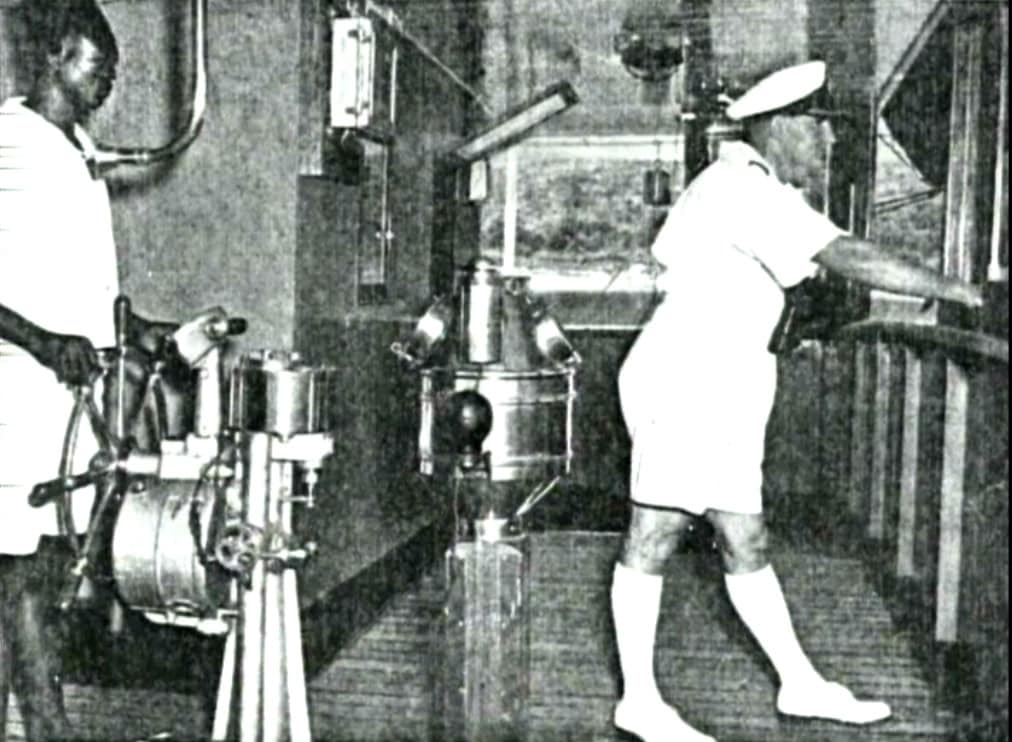
Copyright details unavailable.
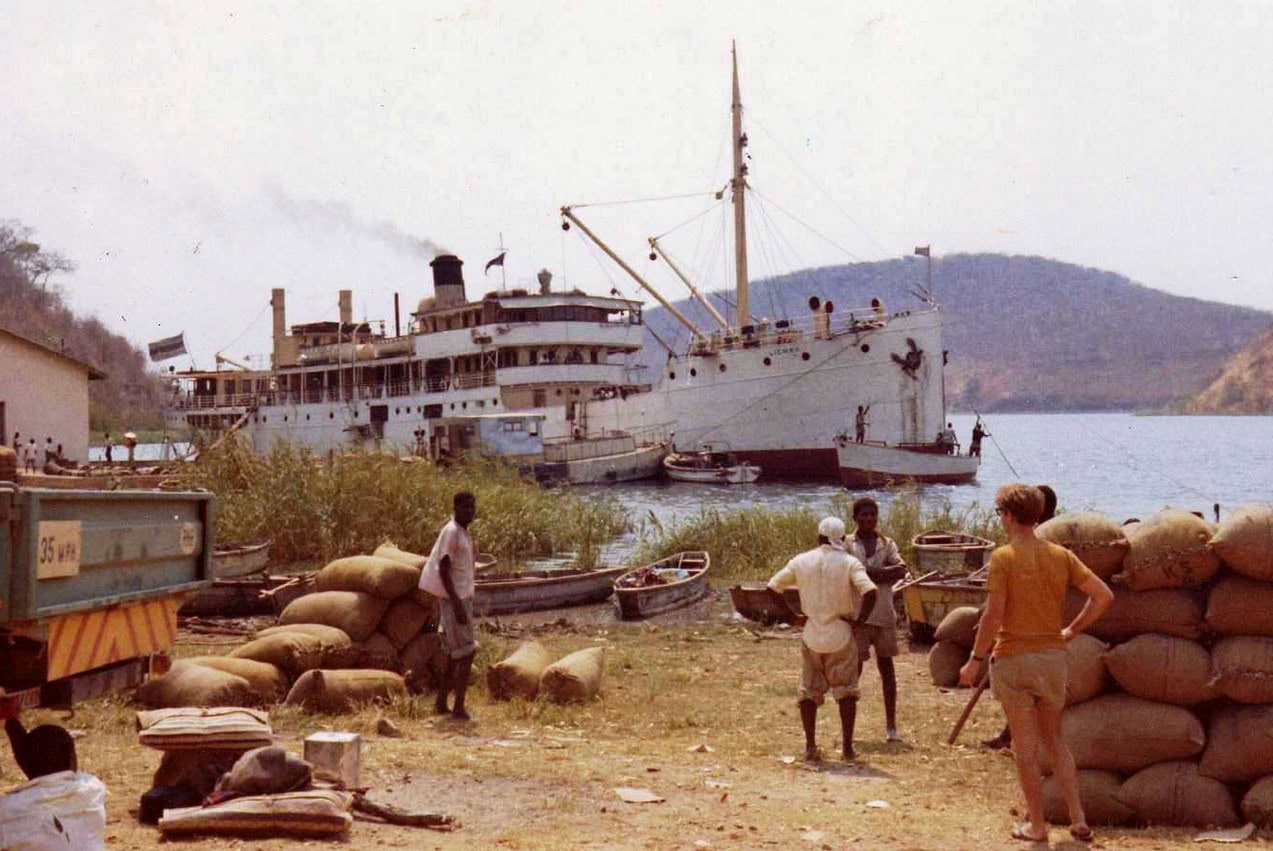
https://rosesunderthemiombotrees.files.wordpress.com/2012/08/n021.jpg%3Fw%3D900 (accessed 22 February 2015).
In the early 70s it was obvious that the LIEMBA had seen better days. Since not much money had been invested in her maintenance in the preceding years, breakdowns became more and more common despite the best efforts of the vessel’s crew. As the owners were also considering modernising their fleet, the LIEMBA was decommissioned at the beginning of the 70s. For unknown reasons the ship was repainted an orange-red colour and then tied up in the shipyard in Kigoma, where it seemed only a matter of time before it was broken up. This fear almost became a reality when workers began to remove the steam engines, boilers, funnel and rudder.{{ref}}
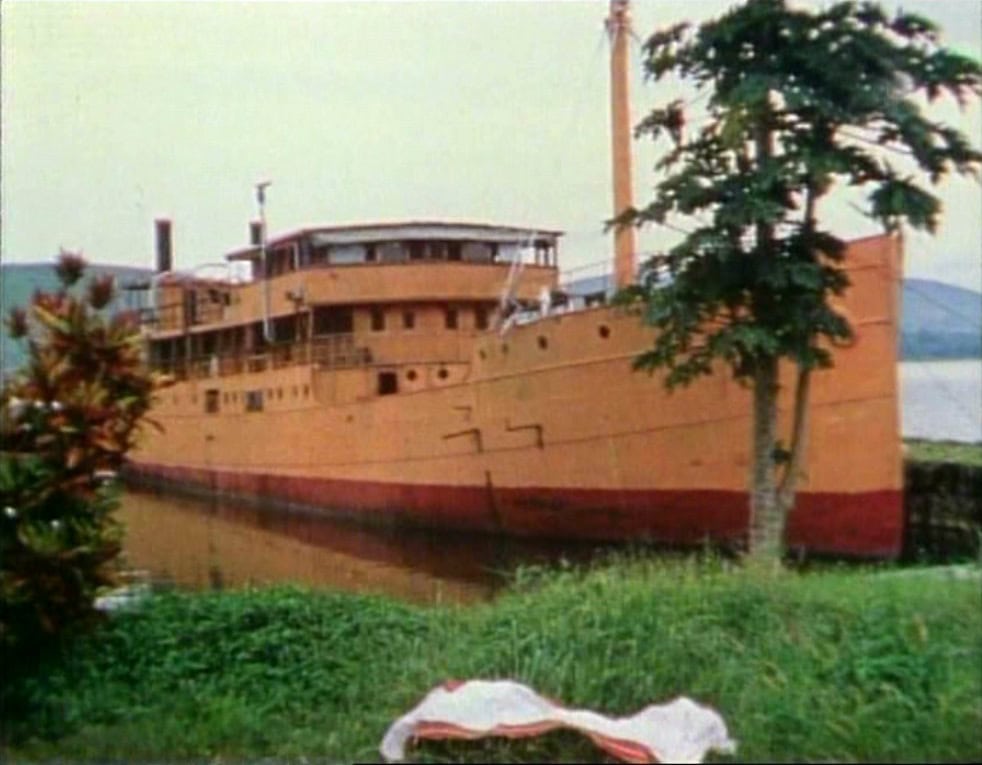
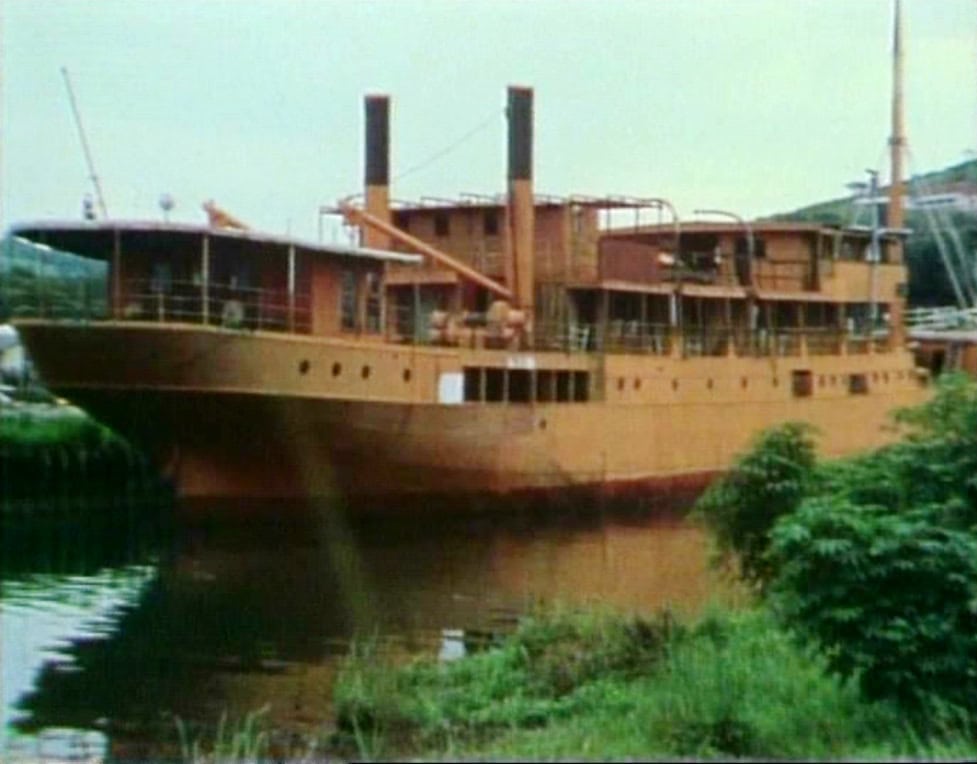
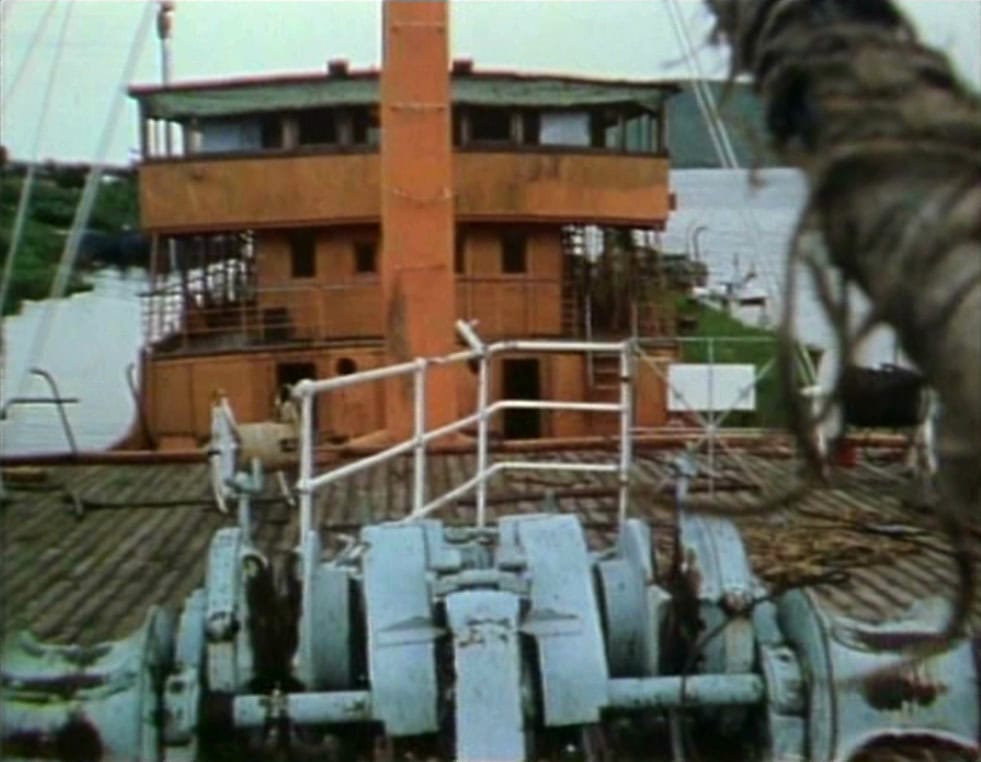
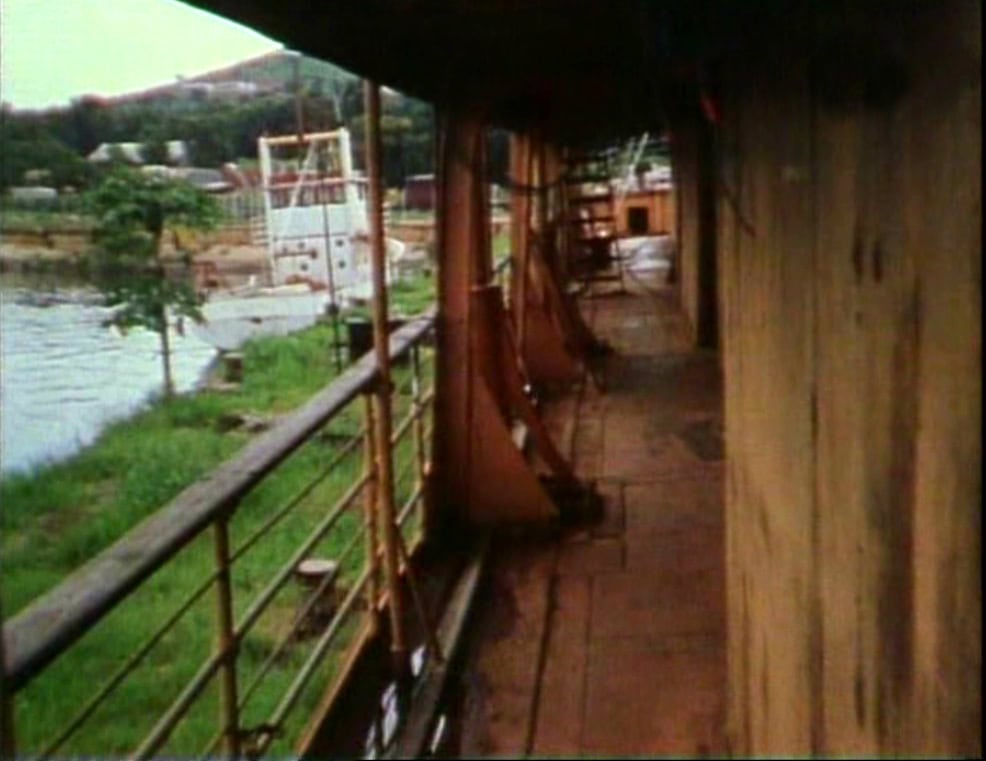
Bildrechte nicht ermittelbar.
Facing the scrap heap and a last-minute rescue.
Around 1975 Patrick Dougherty became interested in the LIEMBA and wanted to save the ship and help give it a new lease of life.
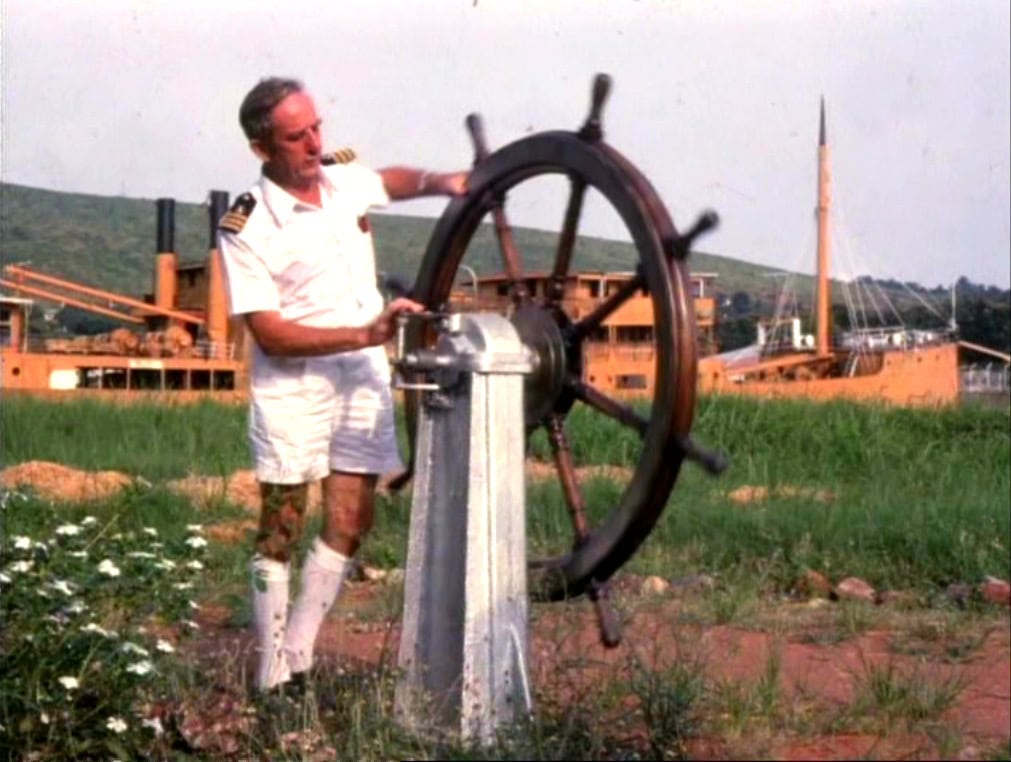
Copyright details unavailable.
Dougherty was born on 18 March 1918 in Downpatrick (Northern Ireland) and trained at the Harland & Wolff shipyard in Belfast. During the Second World War he served in the Royal Navy as a ship’s engineer.{{ref}}
On 5 November 1940 the convoy HX 84 on its way from Canada to Great Britain was attacked east of Newfoundland by the German battleship ADMIRAL SCHEER under the command of Captain Theodor Krancke. Dougherty was on a frigate escorting the convoy. The former liner JERVIS BAY, which had been refitted at the beginning of the war as an armed merchant cruiser, was the only larger armed ship accompanying the convoy. Patrick Dougherty heard the shells from the ADMIRAL SCHEER hitting the JERVIS BAY. Edward Fegen, the Irish captain of the JERVIS BAY, had decided to take on the far more heavily armed vessel and thus enabled the convoy to split up and some ships to escape. Fegen went down with his ship in the end and was posthumously decorated with the Victoria Cross for his bravery. Dougherty too, whose ship was not sunk, was grateful for Fegen’s courageous protection.{{ref}}
In the 50s he first went to Nigeria for about ten years. Then, after returning for a short time to Great Britain in the sixties and seventies, he worked as first engineer for the EAR in Kisumu (Kenya) and later as Chief Engineer on the Lake Victoria ferries. Dougherty increasingly concentrated on activities in Tanzania, where he became interested in the LIEMBA around 1975.
The issue of the ship’s future developed into his greatest worry.{{ref}} With the support of the Tanzanian president and vice-president, Dougherty managed to raise the necessary funding (from the World Bank among others) to restore the ship.{{ref}}
Since the steam engines had disappeared by now, he converted the LIEMBA to a motor ship by fitting two Caterpillar diesel engines with a combined power of 800 ihp.{{ref}} The old funnel had also been removed. Since there was no suitable crane on shore, Dougherty had a ramp erected which connected to the height of the boat deck. Then he looked for volunteers. Hundreds of strong Africans finally rolled the new funnel up the ramp and set it up on the deck of the ship while Dougherty and other helpers secured it and established connections to the engines. The funnel and all the other parts needed for the refit came from Germany.{{ref}}
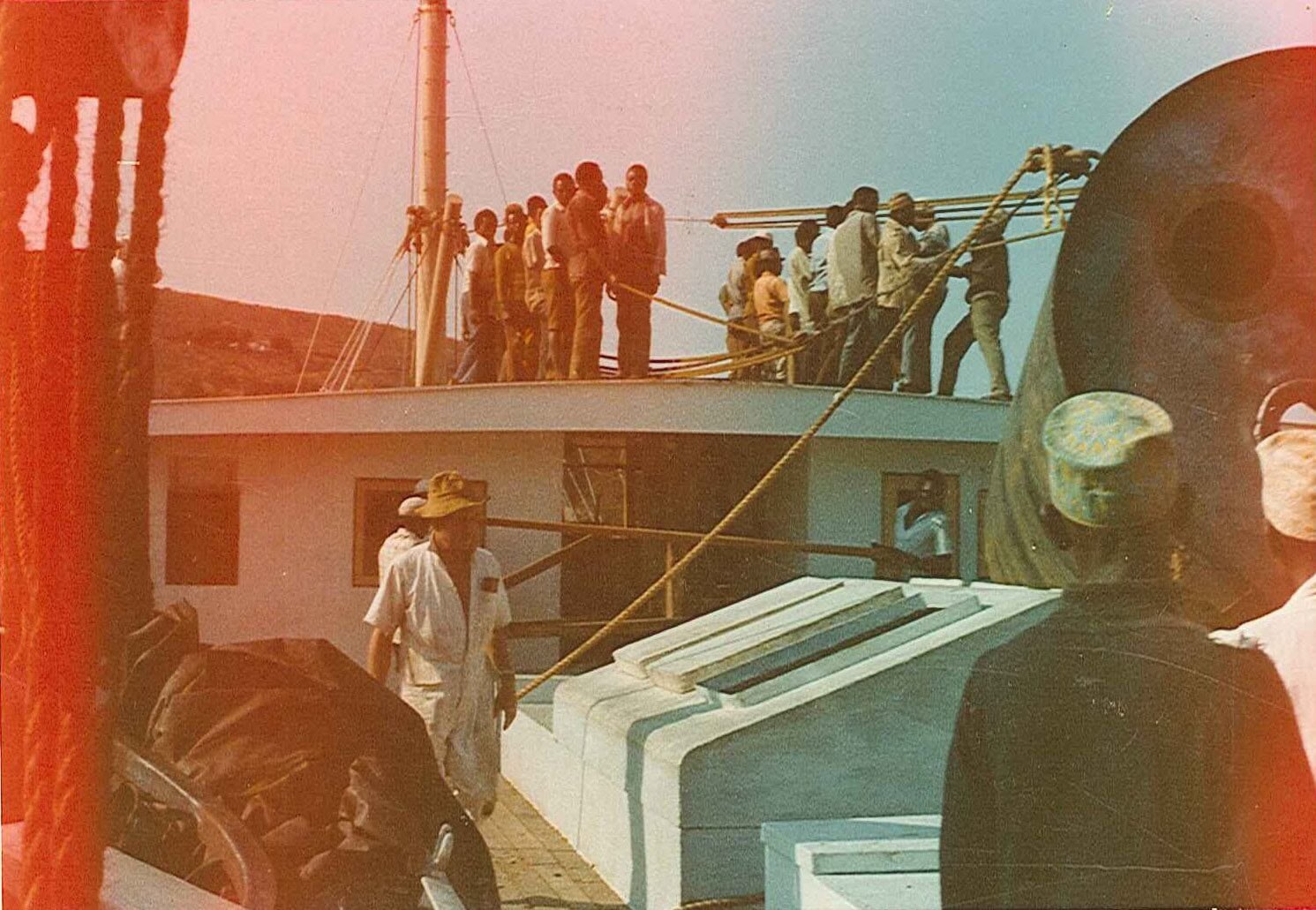
Barbara Dougherty, Paul McEelean.
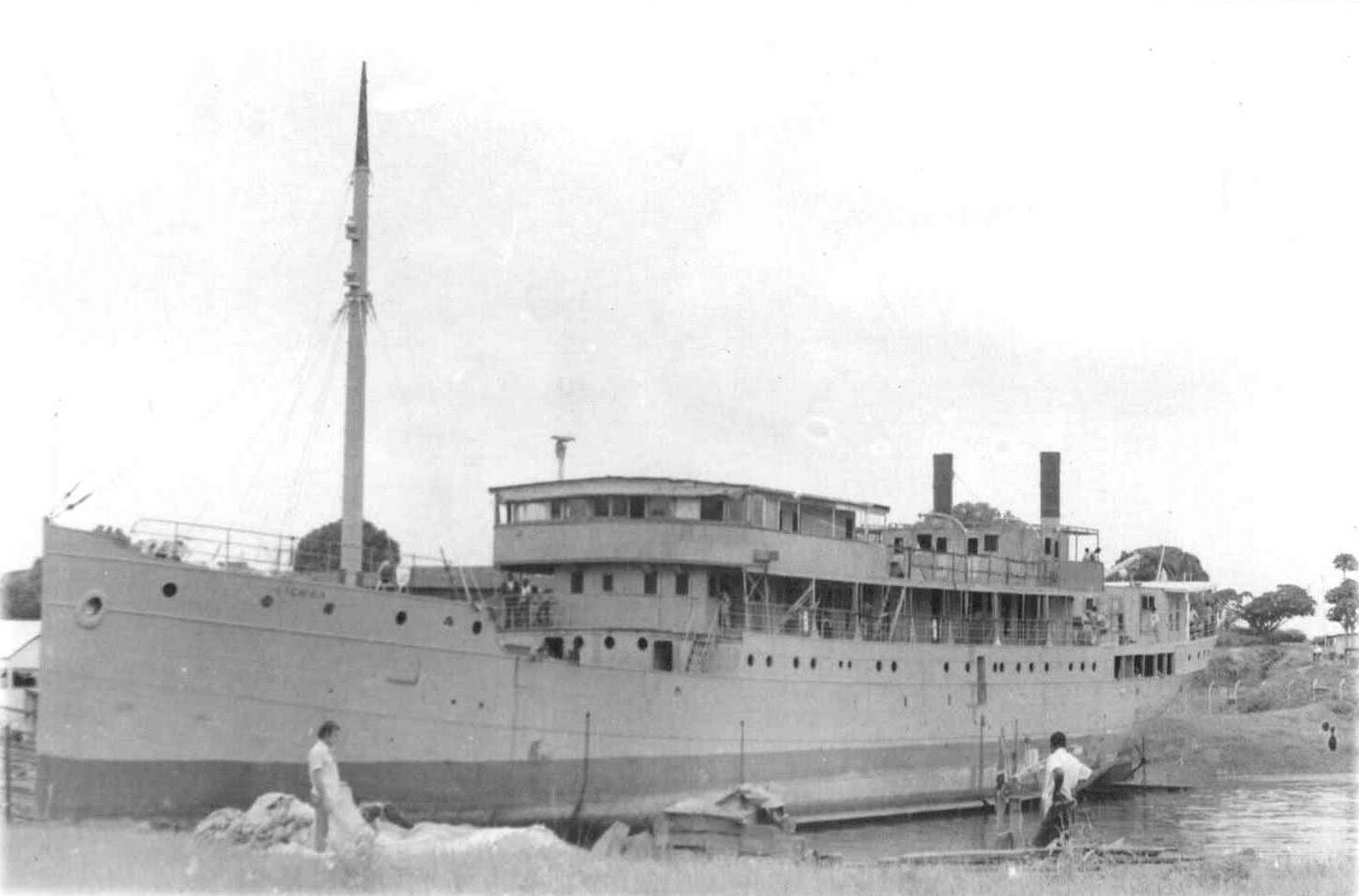
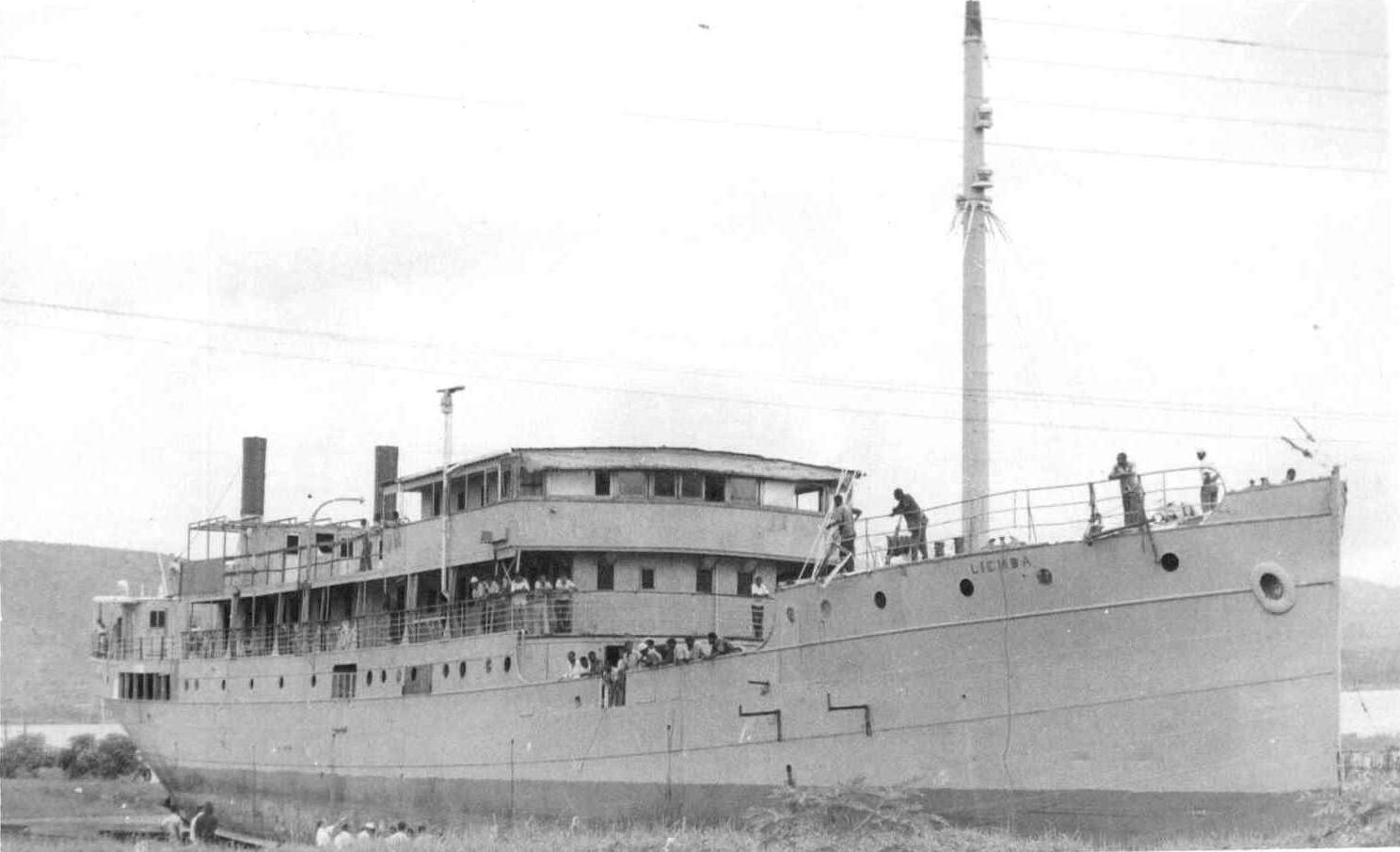
Barbara Dougherty, Paul McEelean.
All the restoration work – in the course of which passenger capacity was increased to 480 people – took from 1976 until at least 1978. It was not until the end of 1979 that the ship went back into service.{{ref}}
Dougherty was married having a son and a daughter. His family visited him occasionally in Kigoma during the restoration work on the LIEMBA. His wife knew what the work meant to him and even so far from home he was a devoted husband and father. His daughter Barbara joined him on the ship’s “third” maiden voyage after its refurbishment and described the huge excitement at every port which the ship visited again.
After refurbishing the LIEMBA, Dougherty left Tanzania and worked for the United Nations Food and Agriculture Organization (FAO) in Bangladesh and Mozambique, but right up to the last days of his life he remembered “his” ship with great pleasure and pride. He died on 12 January 2010 in Belfast and was buried in Downpatrick.{{ref}}
A very authentic account of the situation at the time in Kigoma and about Patrick Dougherty and the LIEMBA is given by Hans Dieter Nattmann, who was in Kigoma as a young development aid worker from 1975 to 1977:
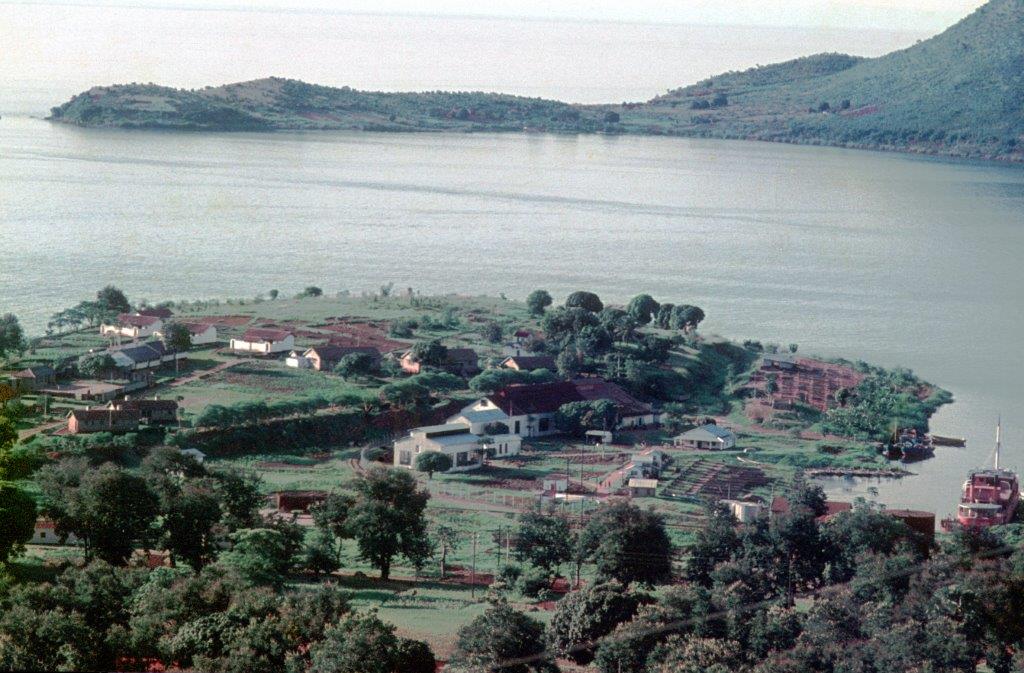
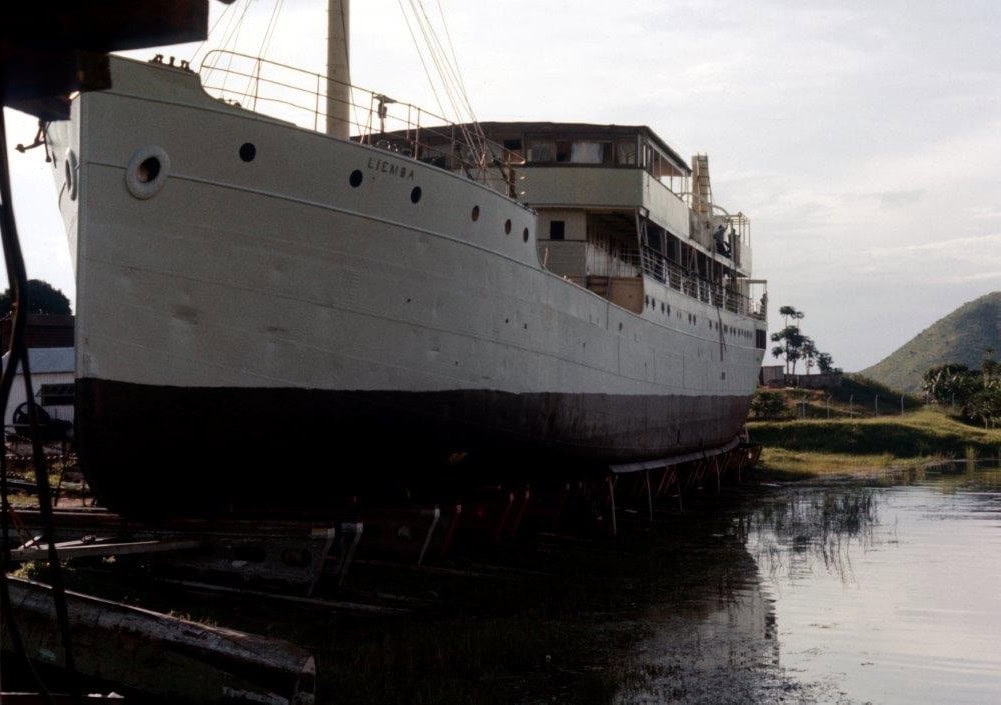
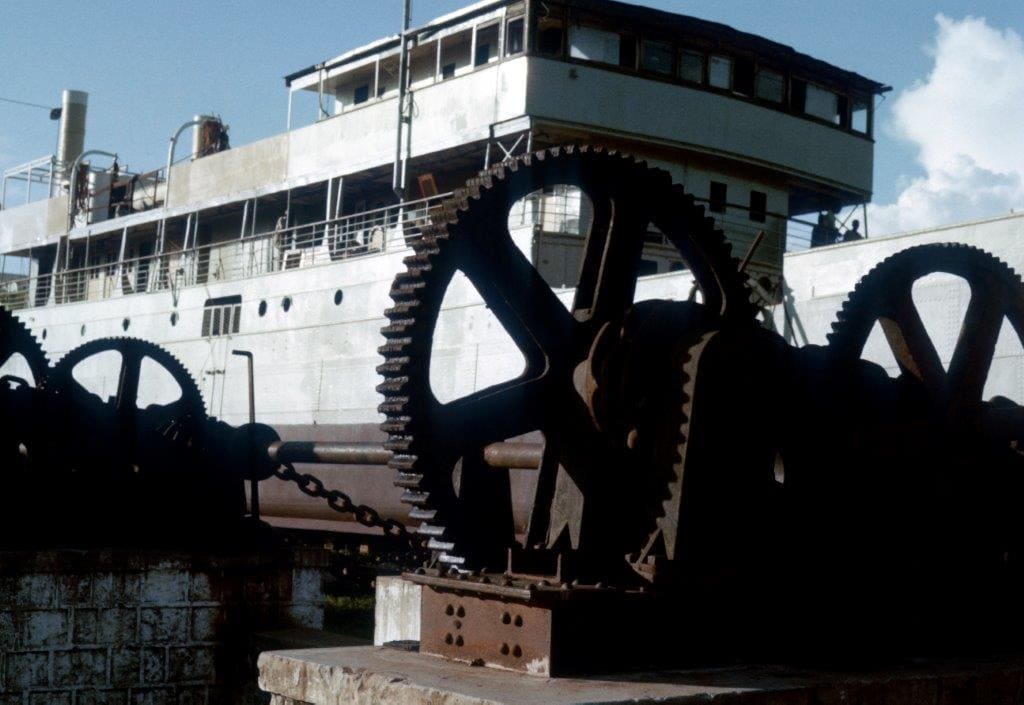
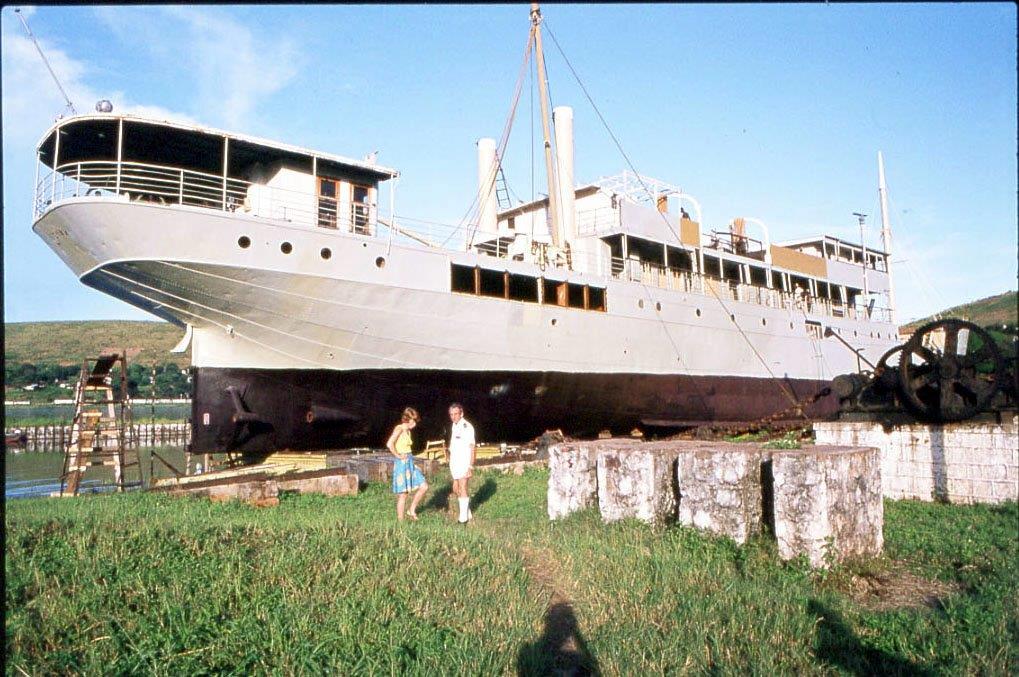
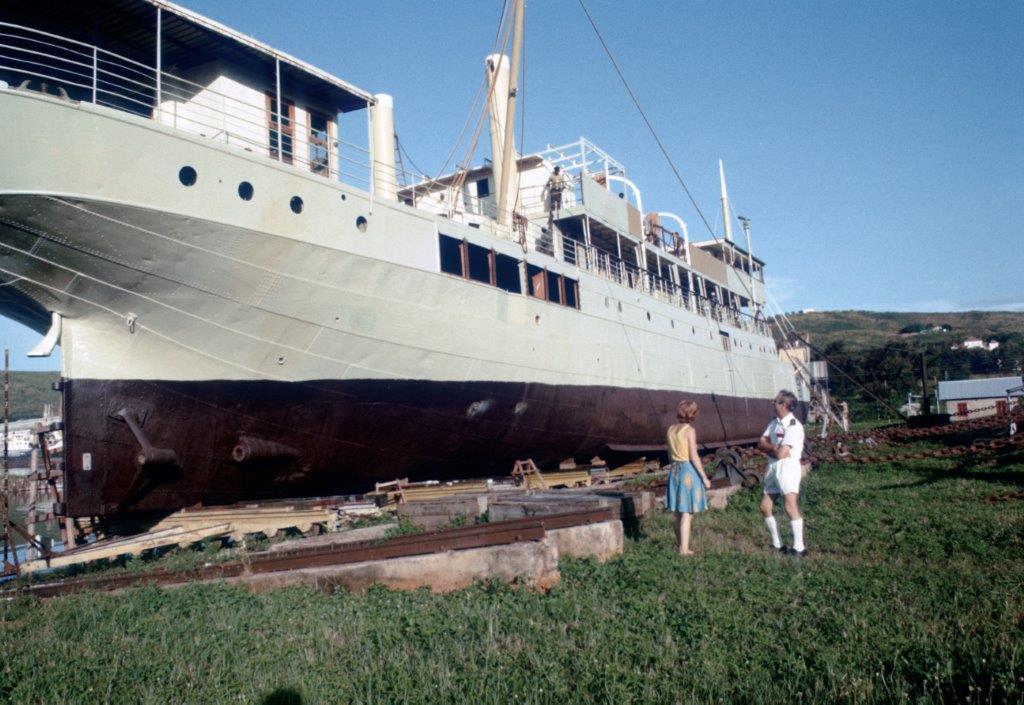
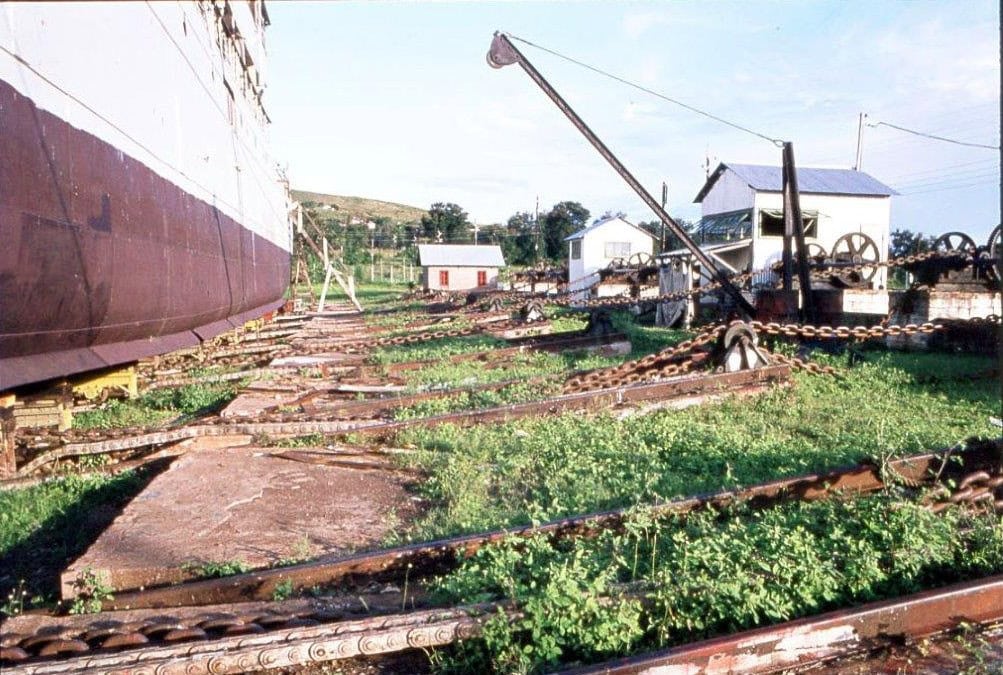
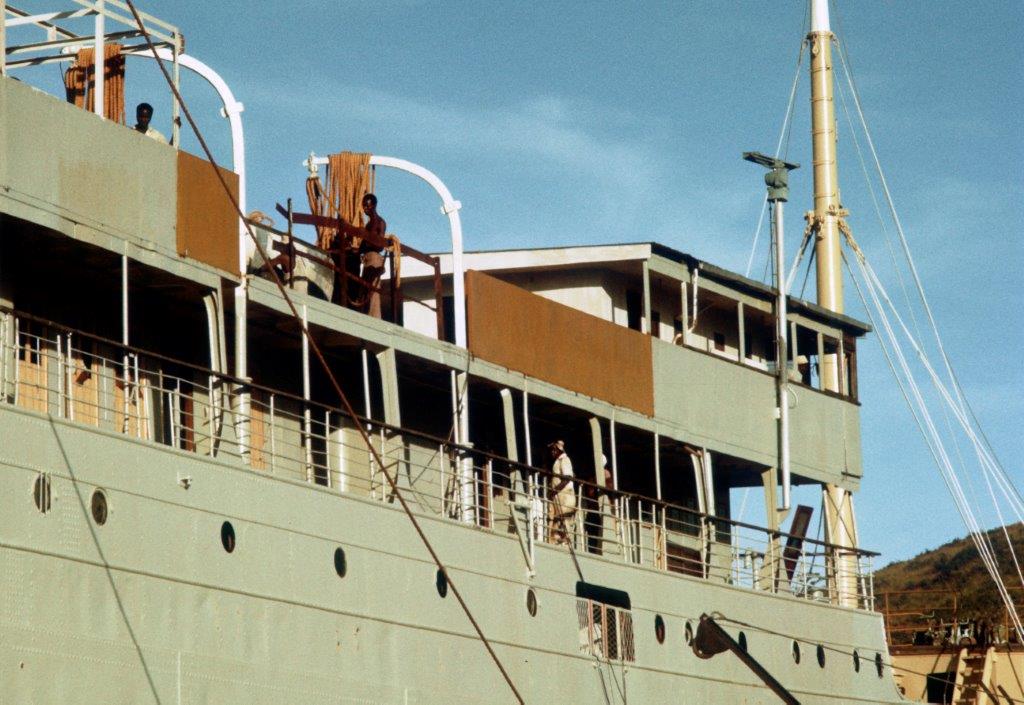
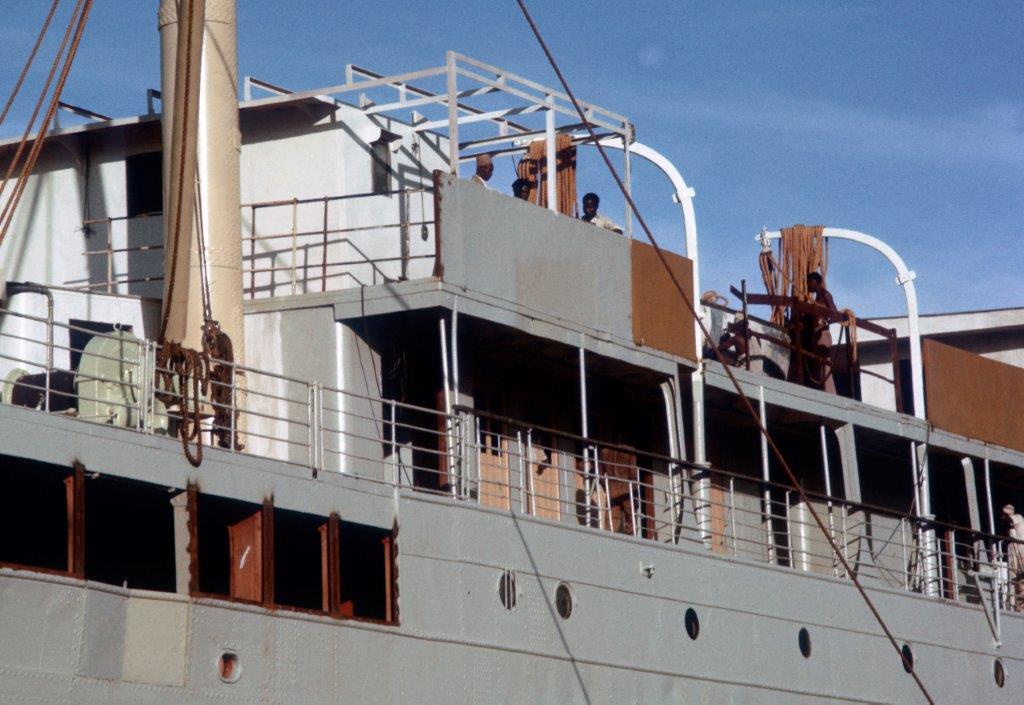
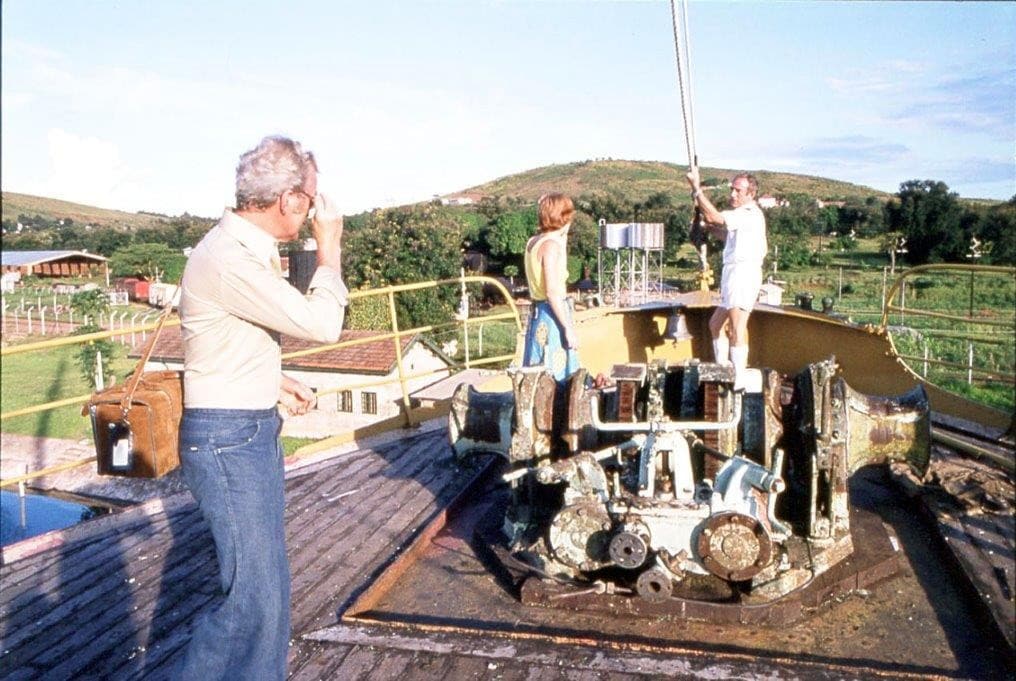
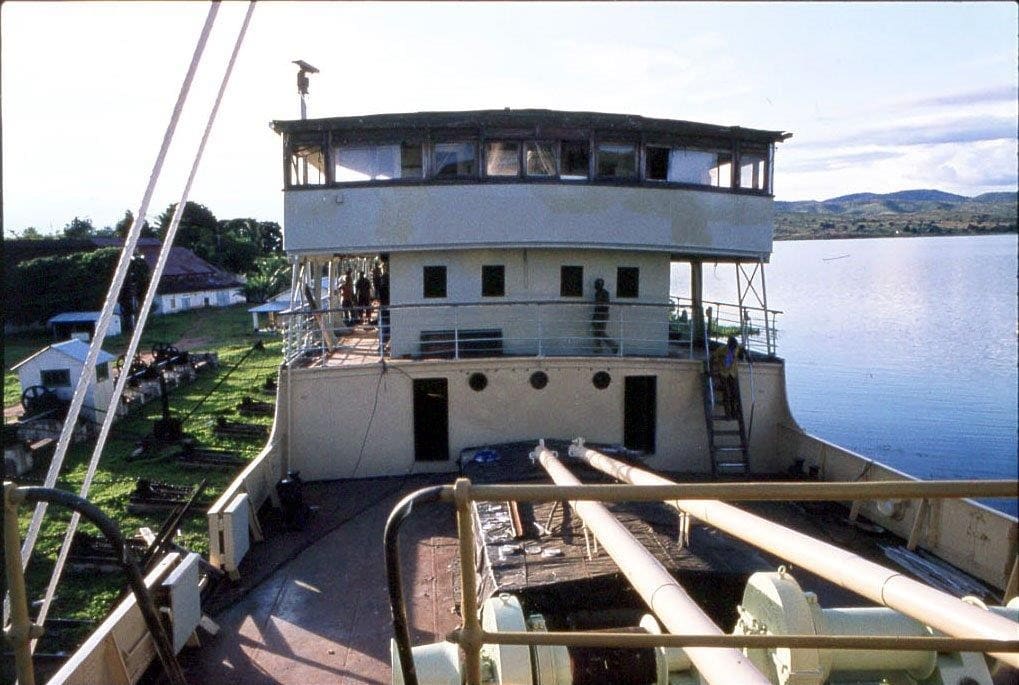
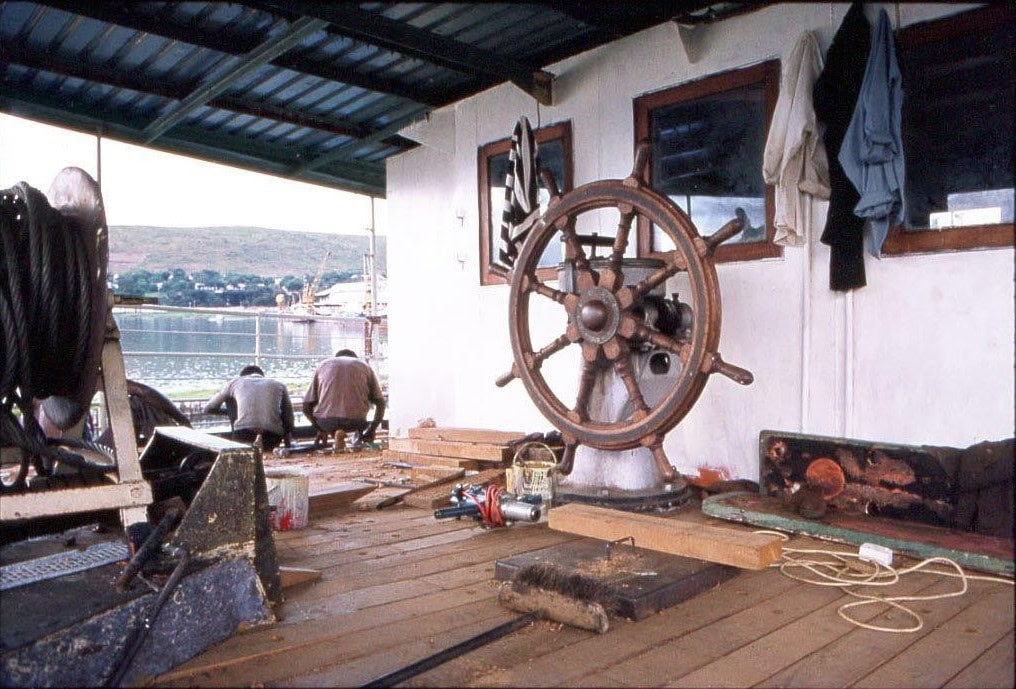
Hans-Dieter Nattmann.
[Ich kam] Mitte 1975 als junger Architekt nach Tansania. […] Als Student der “68er Zeit” wollte ich mithelfen, die Idee des Ujamaa und des afrikanischen Sozialismus von Julius Nyerere aufzubauen. Damit war ich nicht allein. Tansania und Nicaragua waren seinerzeit Schwerpunktländer des Deutschen Entwicklungsdienstes, bei dem ich mich schon vor Jahren beworben hatte. Der DED hatte damals regelmäßig rund 70 Entwicklungshelfer im Land. Nach meinem Architekturexamen hatte ich noch Ethnologie und Afrikanistik studiert (letztendlich ohne Abschluss) und wollte meine Vertragszeit nutzen und Afrikaerfahrung sammeln. Anders als heute, gab es damals beim DED überwiegend Idealisten und der klassische Entwicklungshelfer war Handwerker, Ingenieur, Arzt oder Krankenpfleger/schwester. In Tansania gab es viele unbesetzte Planstellen, die wir als Entwicklungshelfer teilweise auszufüllen hatten. Ich hatte die Planstelle des Town Engineers von Kigoma zu besetzen und war somit Chef des städtischen Bauamtes und der Feuerwehr. […]
Außer mir gab es noch eine Vielzahl weiterer Entwicklungshelfer und Experten in Kigoma, so auch einen deutschen Arzt des DED, der am Kigoma Hospital beschäftigt war. Des Weiteren gab es schwedische, norwegische, finnische, holländische und japanische Entwicklungshelfer vor Ort. Es ging um Wasserbau, Straßenbau und vieles mehr. Von der FAO gab es ein Fischereiprojekt, in dem internationale Experten tätig waren. Engländer, Amerikaner, Italiener und Schweizer beschäftigten sich als Meeresbiologen und Fischereiexperten mit dem noch recht unerforschten und wunderbaren Lake Tanganyika. Es gab einen Italiener, der für die Frachtlogistik im Hafen zuständig war, einen griechischen Kapitän, der die Route Kigoma-Bujumbura befuhr und einen israelischen Taucher, der mit seiner einheimischen Mannschaft nach den sehr gefragten Zierfischen des Sees tauchte und sie dann nach Deutschland schickte. Die Fische wurden gefangen und in Plastiktüten gepackt, die mit Sauerstoff aufgefüllt wurden und einmal pro Woche mit dem Linienflug von Kigoma nach Daressalam geflogen. Von dort aus ging es dann weiter nach Frankfurt. Heute werden die immer noch sehr gefragten seltenen Zierfische (Chilchiden) nur noch nachgezüchtet. Im Norden war der Gombe-Nationalpark mit Jane Goodall und im Süden das Mahale-Mountains Research-Camp, welches mit japanischen Primatenforschern aus Kyoto besetzt war. Meine direkten Nachbarn waren chinesische Ärzte, die ebenfalls am Krankenhaus in Kigoma arbeiteten. Sie traten immer nur im Team auf und hatten keinerlei Kontakt zu uns Wazungu. Es gab unter ihnen nur einen, der überhaupt Englisch sprach, und Kontakt zu Westlern war ihnen strengstens verboten. Sie hatten einen Oberaufpasser, der nur dafür zuständig war.
Ja, und dann gab es natürlich noch Paddy Dougherty, der schon vor Ort war, als ich Mitte 1975 in Kigoma eintraf. Die Tatsache, dass er für die Instandsetzung der LIEMBA zuständig war, war erstmal nicht besonders spektakulär. Jeder hatte sein Projekt, und das LIEMBA-Projekt war eines von vielen anderen. Außerdem war für mich Tansania voll von alter deutscher Kolonialgeschichte. Auf der Zugreise von Daressalam nach Kigoma mit der alten deutschen Eisenbahn gab es etliche alte deutsche Bahnhöfe. Der alte deutsche Bahnhof war bei meinem ersten Eintreffen unübersehbar. Ich wohnte unterhalb des alten Kaiserhofs in einem alten Kolonialhaus und nicht weit von mir lag die alte LIEMBA im Trockendock. Außerdem war die LIEMBA noch keine stolzen 100 Jahre alt, sondern gerade mal etwas über 60. […]
Zurück zu Paddy. Paddy wohnte zwei Häuser weiter und war ein recht eigenwilliger Zeitgenosse. Es war nicht leicht, mit ihm in Kontakt zu kommen, entweder er mochte einen oder eben nicht. Ich hatte das Glück, dass ich nach einiger Zeit als kleiner Entwicklungshelfer in den Kreis der sogenannten Experten aufgenommen und dann auch zu den gesellschaftlichen Ereignissen eingeladen wurde. Experten und Entwicklungshelfer unterschieden sich hauptsächlich dadurch, dass die einen viel Geld verdienten und díe anderen nur ein Unterhaltsgeld bekamen. Wie Paddy zur LIEMBA gekommen ist, wußte ich damals nicht. Jeder hatte seine Geschichte, wie er nach Afrika gekommen war, geredet wurde darüber aber eigentlich nicht. In den zwei Jahren haben wir Paddy mehrere Male auf dem Trockendock besucht. Es war schon offensichtlich, dass er sehr stolz auf seine Arbeit war. Seine Marineuniform trug er oft, und nicht nur auf der Arbeit. Für einen Besuch der LIEMBA war immer eine Einladung notwendig, denn man durfte das Hafengelände nicht einfach so betreten. Vermutlich ist das heute noch so. Ende 1976 gab es dann einen Stapellauf, um die Dichtigkeit des Schiffskörpers zu testen. Das war keine spektakuläre Aktion, sondern ein ganz normaler Testlauf. Leider waren wohl die Toiletten-Abflussleitungen undicht und das Schiff zog Wasser, so dass es schnellstens wieder auf das Dock gezogen wurde. Bis zum Ende meiner Vertragszeit Ende 1977 blieb die LIEMBA dann auch im Dock. Als meine Schwiegereltern im Mai 1977 zu Besuch kamen, wurden wir von Paddy nochmals zur Besichtigung der LIEMBA eingeladen. Aus dieser Zeit stammen auch die Fotos. Da Filmmaterial rar und teuer war, gibt es leider nicht sehr viele Bilder. Die Digitalkamera war ja noch nicht erfunden. Paddy war alleine in Kigoma, hatte aber eine Familie in Irland. Seine Frau und zwei Kinder, Tochter und Sohn, haben ihn in Kigoma besucht. Seine Tochter war damals vielleicht 14-16 Jahre alt und sein Sohn Peter vielleicht Mitte bis Ende 20. Es war nicht ungewöhnlich, dass die daheimgebliebenen Familien zu Besuch kamen. Viele der Experten hatten ihre Familien zu Hause gelassen, Paddy war da keine Ausnahme. […]
Nachdem wir Paddy 1975 kennengelernt und uns angefreundet hatten, hatte er versprochen, uns auf die Jungfernfahrt der LIEMBA mitzunehmen. Er war wohl fest der Überzeugung, dass dies vor unserem Vertragsende Ende 1977 stattfinden würde. Leider war dies nicht der Fall. Auch während der gesamten Zeit meines Projektnachfolgers, der bis Herbst 1979 in Kigoma war, hat die LIEMBA das Dock nicht verlassen. Ich glaube, dass die LIEMBA erst Ende 1979 ihren Dienst wieder aufnahm. […]
Jane Goodall war in dieser Zeit sehr selten in Kigoma. Im Mai 1975 hatten Rebellen aus dem Kongo einige Assistenten von Jane aus dem Gombestream gekidnapped. Danach kam sie erst mal nicht mehr. Ich weiß nicht, ob Paddy und sie sich sehr gut kannten. Es hat in dieser Zeit einige Übergriffe von Rebellen aus dem Kongo gegeben. Auch mein Haus hatten sie, bevor ich kam, besucht. […]{{ref}}
Hans-Dieter Nattmann.
During the restoration of the ship, the EAR broke up as the railway collaboration between Kenya, Tanzania and Uganda in 1977. For the Tanzanian territory the “Tanzania Railways Corporation” (TRC) was formed, which also took over the ship and founded a shipping department.{{ref}}
Just a few months after she went back in service, the LIEMBA ran aground just outside Katumbi on 15 September 1979. The accident report by the captain read as follows:
I was woken at 02.47 by the officer on duty and immediately switched on the radar, although the moon was shining and the shore was therefore clearly visible. But even before the radar was working, I heard that the bank must be very close. I gave the quartermaster the order to put the helm hard to port and switched the echo sounder on to find out the depth of water. But in fact, it was already too late and the ship had run aground, even though it didn’t feel like it, but speed was zero and the echo sounder was also at zero, which is how we could be sure that we really had run aground. We started manoeuvering astern and ahead, but to no avail. We put down two anchors at places where the water was deeper and pulled on the anchors at full speed with two engines, the two motor boats pushed at the same time but without success. Finally, we planned to unload the cargo but due to the difficulties we were unsuccessful. On land there were no lights visible from the residents of Katumbi because there are many lions there. The crew was very tired the whole day. The officers and crew of MV LIEMBA did everything possible to keep the vessel off the sand even though this was not successful. The ship finally got free and evidently suffered no major damage.{{ref}}
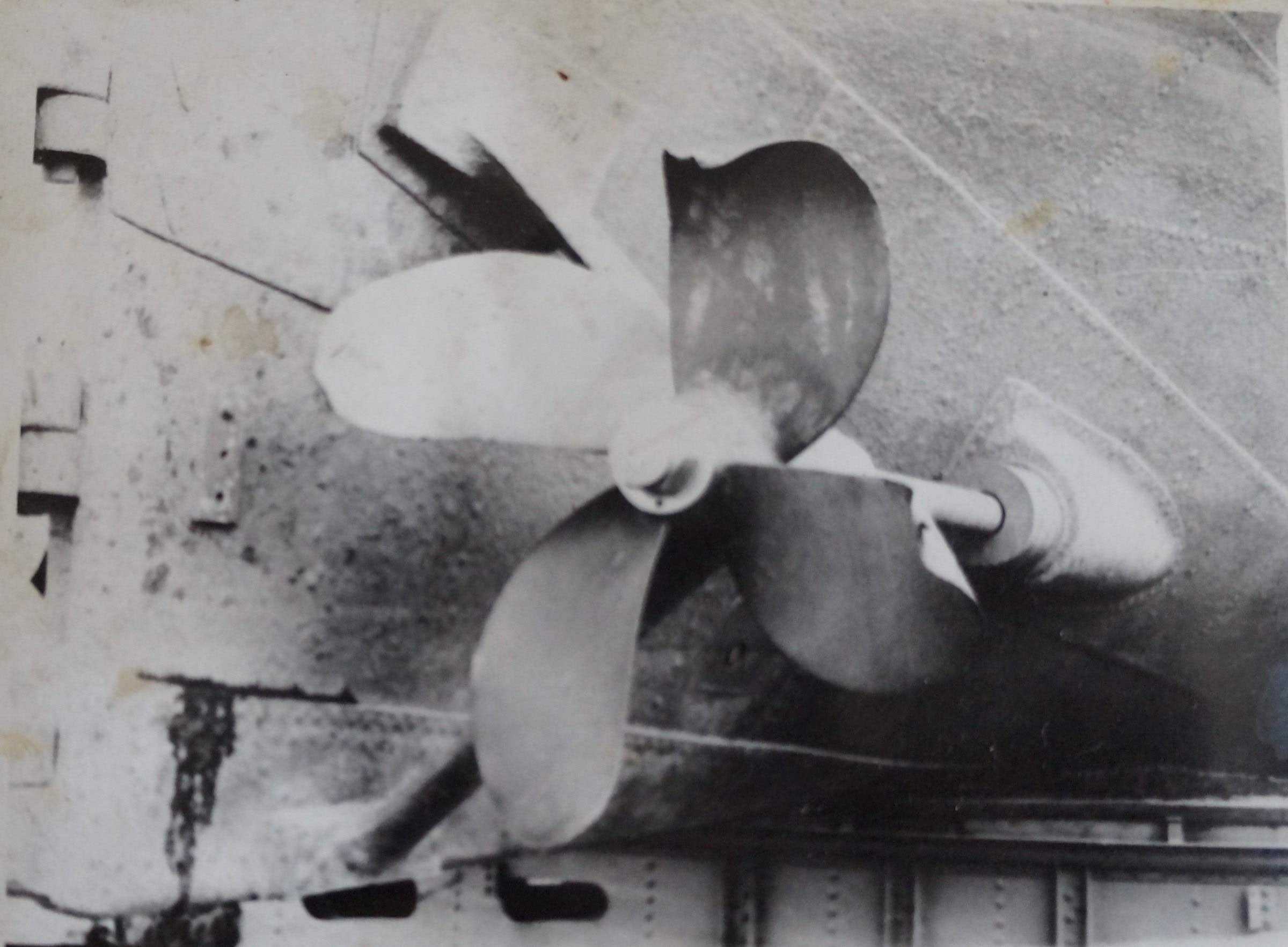
Michael Berg, finds on board the ship.
Repairs in the early 1990s by the Danish.
In 1993/94 the ship was given a general overhaul on site by the Danish Ole Steen Knudsen (OSK) ShipTech A/S. Since the caterpillar diesel engines installed in 1979 had proved less than entirely reliable, two new turbocharged four-stroke five-cylinder diesel-engines by MAN B&W, type Alpha Diesel 5L23/30 were installed, according to the then project-manager with an original power of 650 kW at 825 rpm each. To avoid having to replace the shaft/propeller system, and on account of the conditions on Lake Tanganyika, the engines were reduced to a power of 460 kW (625 HP) each.{{ref}} However, the information on the engine plates states 500 kW and 765 rpm, or 625 kW and 825 rpm, according to the operating documents found on the ship. With the installed engine power, the ship achieved a service speed of 11 kn.{{ref}} In structural terms, numerous interior supports were installed in the area of the passengers of the third class, which, together with reinforcement of the surrounding gallery, were intended to “stabilise” the hull and the superstructure and reduce vibrations. In order to improve the safety of the vessel, a double bottom was also added in the front cargo hold. The aft cargo hold was converted into an area for passengers of the third class with seating, which increased the ship’s capacity from 480 to 600 passengers. The wheelhouse was also modified, the electrical system and pipes were replaced, the passenger cabins and crew accommodation refurbished and a hydraulic crane installed on the bow section.{{ref}} The refitting was financially supported by “Danida” (Danish International Development Agency), an organisation which provides humanitarian aid and technical support in various countries in conjunction with the Danish Foreign Ministry.
The LIEMBA now has ten two-bed-cabins for the first class on the middle deck in the front part of the superstructure along the port and starboard sides. There are also two so-called family-cabins at the aft end of the middle deck, each with two beds, and two VIP-cabins at the aft end of the upper deck, one of which has a single bed and the other two beds. This means that there are in total 27 seats in the first class available. There is also a restaurant for first class travelers.
According to the current general plan, there are 18 cabins in the main deck for the second class (six two- and twelve four-bed-cabins), which would correspond to 60 seats. However, since some passenger cabins have obviously been converted into crew cabins at a later date, there are currently only 26 seats left for second class passengers. There is a small bistro with a food counter for the travelers of the second class.
The rooms of the third class are located on the one hand in the forecastle (bow area, maindeck) and in a room in the hull below (294 seats) and on the other hand in the aft main deck and in the hull below, the former aft cargo hold (242 seats). These areas only have benches, some also have tables. The travelers of the third class either take their own provisions or buy from vendors traveling with them.
The sanitary facilities – there are toilets and showers for all three classes – are also separate.
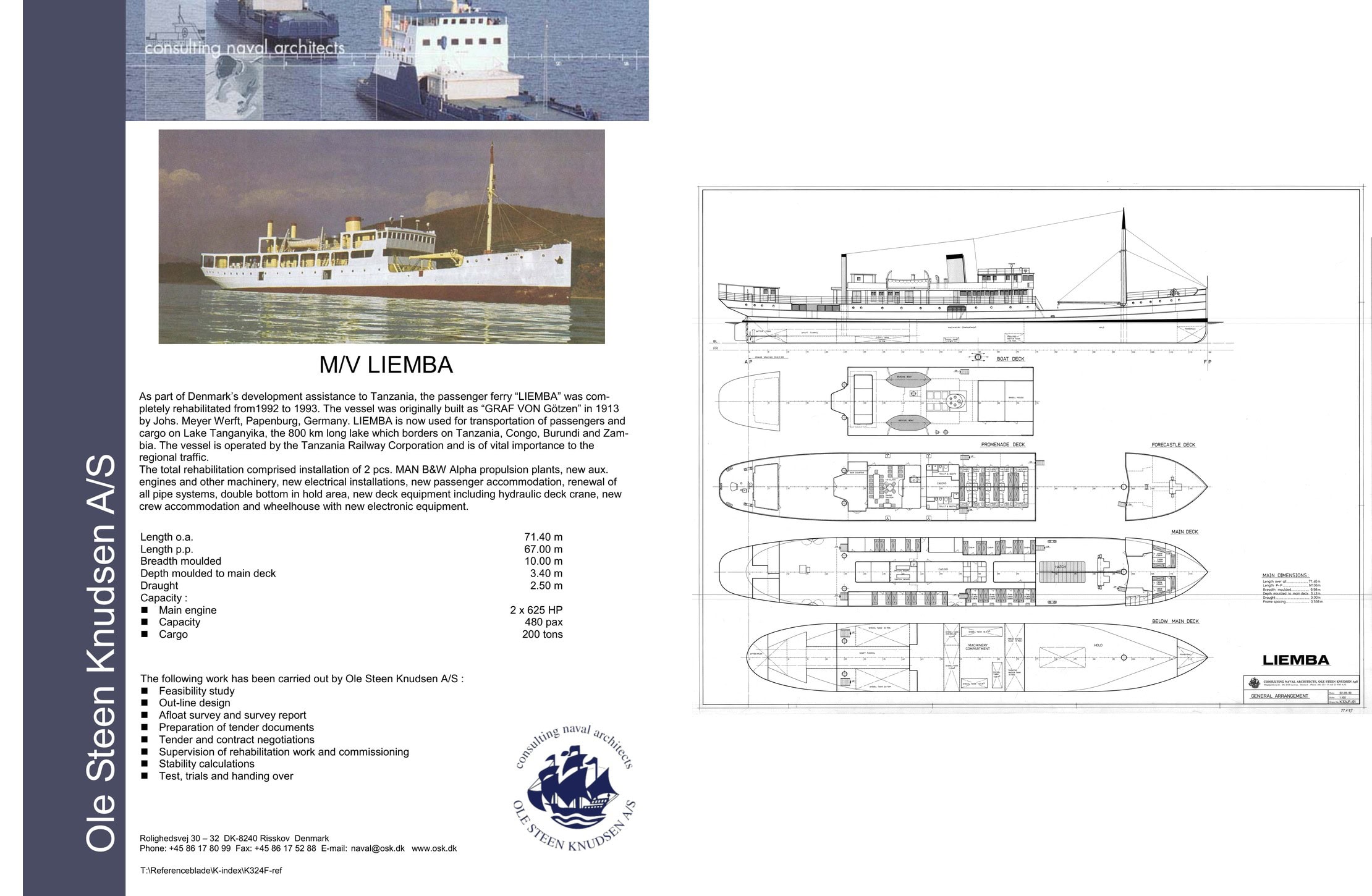
Meyer Shipyard Papenburg.
In addition to the above-mentioned number of passengers – a total of 589 people – there are 26 crew members according to a crew list found on the ship; a total of 615 people.
A leading member of the crew – the name is not mentioned here for reasons of discretion – also mentioned to me that the LIEMBA had already carried up to 800 people in exceptional cases; then, the permissible freight capacity of 200 tons had been slightly (!) reduced.{{ref}}
Until she was taken out of service in 2018, the LIEMBA was the only large passenger- and cargo-ship that offered a regular service on the lake.{{ref}} Its route went from Kigoma to Mpulungu via Tongwe, Sigunga, Rukoma, Lagosa, Kibwesa, Kalya, Ikola, Karema, Kabwe, Kolongwe, Kirando, Kipili, Ninde, Wampembe, Kala and Kasanga. Ports only exist in Kigoma and Mpulungu; Kasanga has a pier. All other stops are small villages without harbors; loading and unloading takes place there by fishing boats, which transfer the passengers and goods to the LIEMBA, which anchored in the lake.
The fares for foreigners ranged between 70 and 100 US dollars for the whole distance. Departures according to the timetable were every two weeks, on the Wednesday of even-numbered weeks, at 16.00 from Kigoma, arriving in Mpulungu 08:00 on Friday. The return journey from Mpulungu began on the same day at 20:00 hours, arriving in Kigoma at 16:00 on Sunday. However, the timetable was seldom adhered to and delays therefore had to be expected.{{ref}} The author still vividly remembers a sail in 2011 with a friended Tanzanian family: Of course, the LIEMBA reached Kigoma also on that sail quite delayed – with the consequence, that the customs officials had already gone on their well-deserved evening. The crew therefore dropped anchor and remained in sight of the Kigoma harbor entrance until the next morning. There was no sullen reaction from the travelers, let alone a protest, as it would have been inevitable in Germany. Instead, the birthday party of the daughter of my African friends took place in the evening on board the LIEMBA.
Up until the early 1990s, the LIEMBA also sailed to several other destinations on Lake Tanganyika (Bujumbura in Burundi, as well as Uvira, Kalemie and Moba in formerly Zaire) but when civil war broke out in Burundi in 1994, and some years later in Zaire, it became too dangerous there.
Because violent conflicts had constantly broken out in the area around Lake Tanganyika since the 1960s leading to large flows of refugees, the LIEMBA also was occasionally chartered by the UNHCR to bring refugees in safety over the lake respectively to transfer them back to their homelands after the conflicts had ended. So, in 1997 and in 2007, refugees were brought back to Burundi and Congo by the LIEMBA and the passenger- and cargo-ship MWONGOZO, which had been built by a Finnish shipyard and had been commissioned in 1982. Solely 75,000 refugees who had fled to Tanzania during the Congolese civil war, were brought back in 22 trips to Uvira.{{ref}}
In 2015, new conflicts flared up in Burundi after the local ruling party had nominated its candidate Pierre Nkurunziza for the pending presidential elections. It should be his third mandate as Head of State, which was constitutionally not provided. After the army had turned to the side of the demonstrators in May, the situation escalated further. Due to fears of riots, until the Election Day on 21 July, nearly 170,000 Burundians had fled to neighbouring countries or were wandering around in Burundi. About 80 people had been killed until then.
In this situation, the LIEMBA was again hired by the UNHCR to transport refugees out of the overcrowded Burundian-Tanzanian border town Kagunga to refugee-camps situated further south near Kigoma. Each of these three-hour trips costs the UNHCR 10,500 US-Dollars respectively one million Tanzanian shillings.
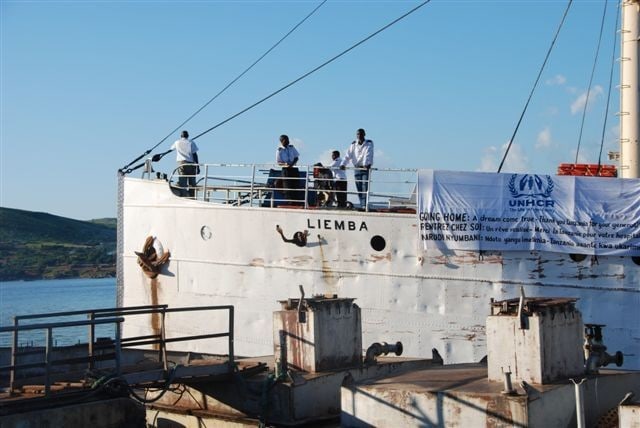
http://wuestenschiff.de/phpbb/userpix/70_liemba_2.jpg (accessed 22 February 2015).
In the words of the representative of the UNHCR in Tanzania, Joyce Mends-Cole, the LIEMBA was at certain times the only ship to carry out the refugee trips: It’s very sad and disheartening that once again we’re using this boat, that has been used to repatriate people in the past, to help them escape regional insecurity. Some of those we are picking up are the same ones we repatriated before.{{ref}}
The LIEMBA was in service until 2018, during which time the aging and dilapidated vessel experienced increasingly frequent breakdowns. After several years of lay-up, which resulted in further deterioration, a comprehensive overhaul began in mid-2024 by the Croatian shipyard Brodosplit JSC and the Tanzanian company Dar es Salaam Merchant Group Ltd. Thoroughly refurbished, the LIEMBA is scheduled to resume operations in the second half of 2026.
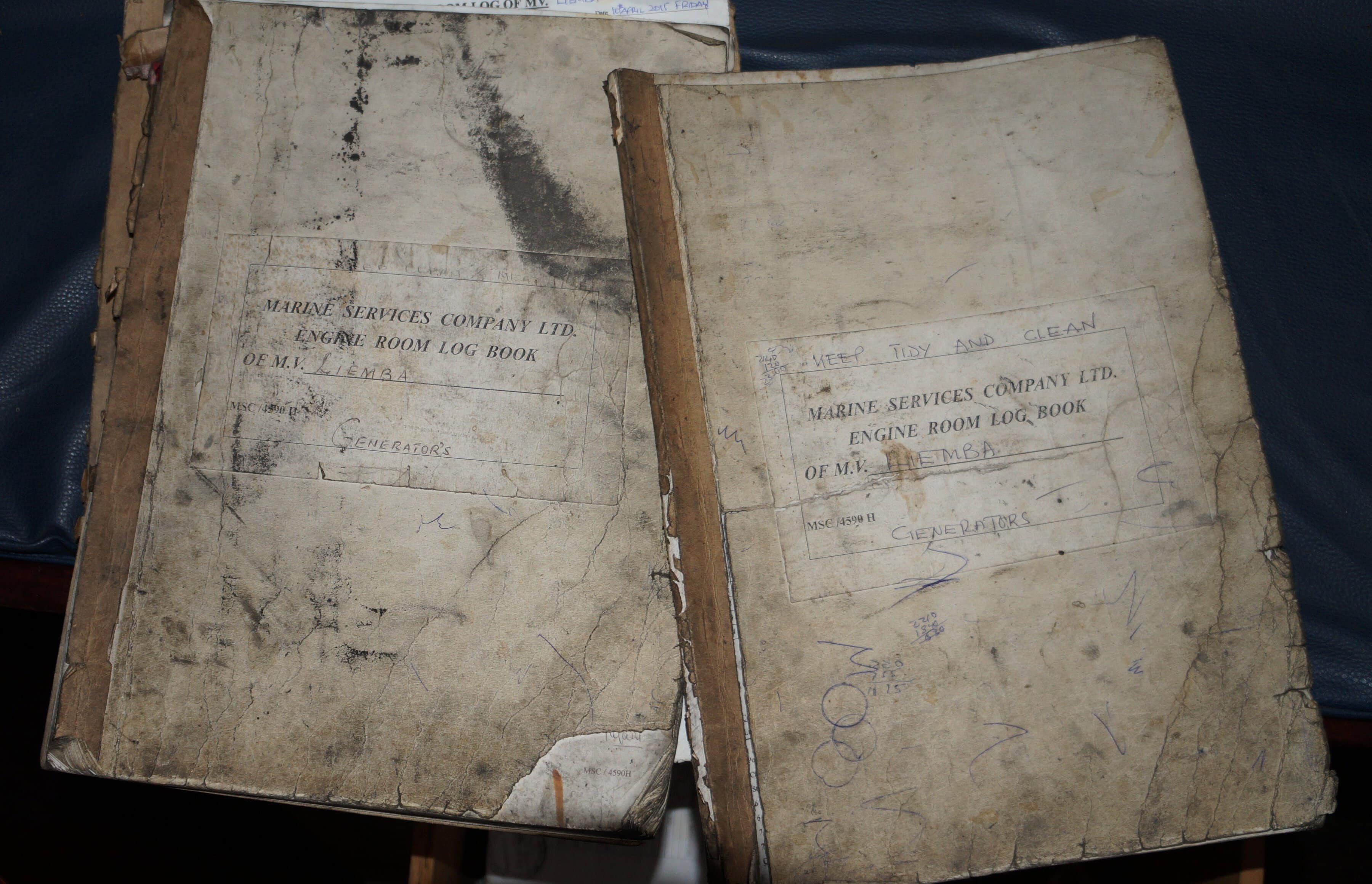
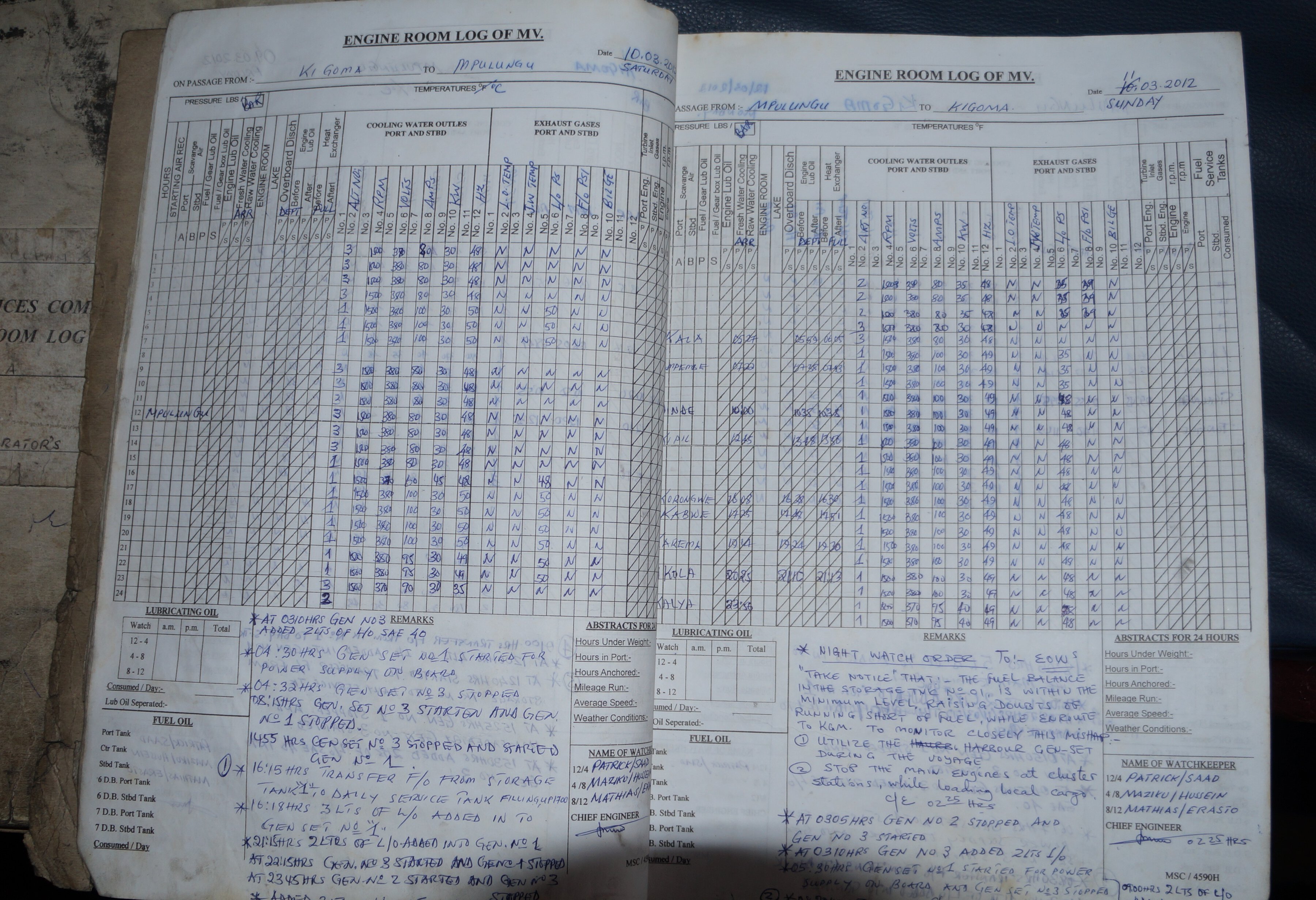
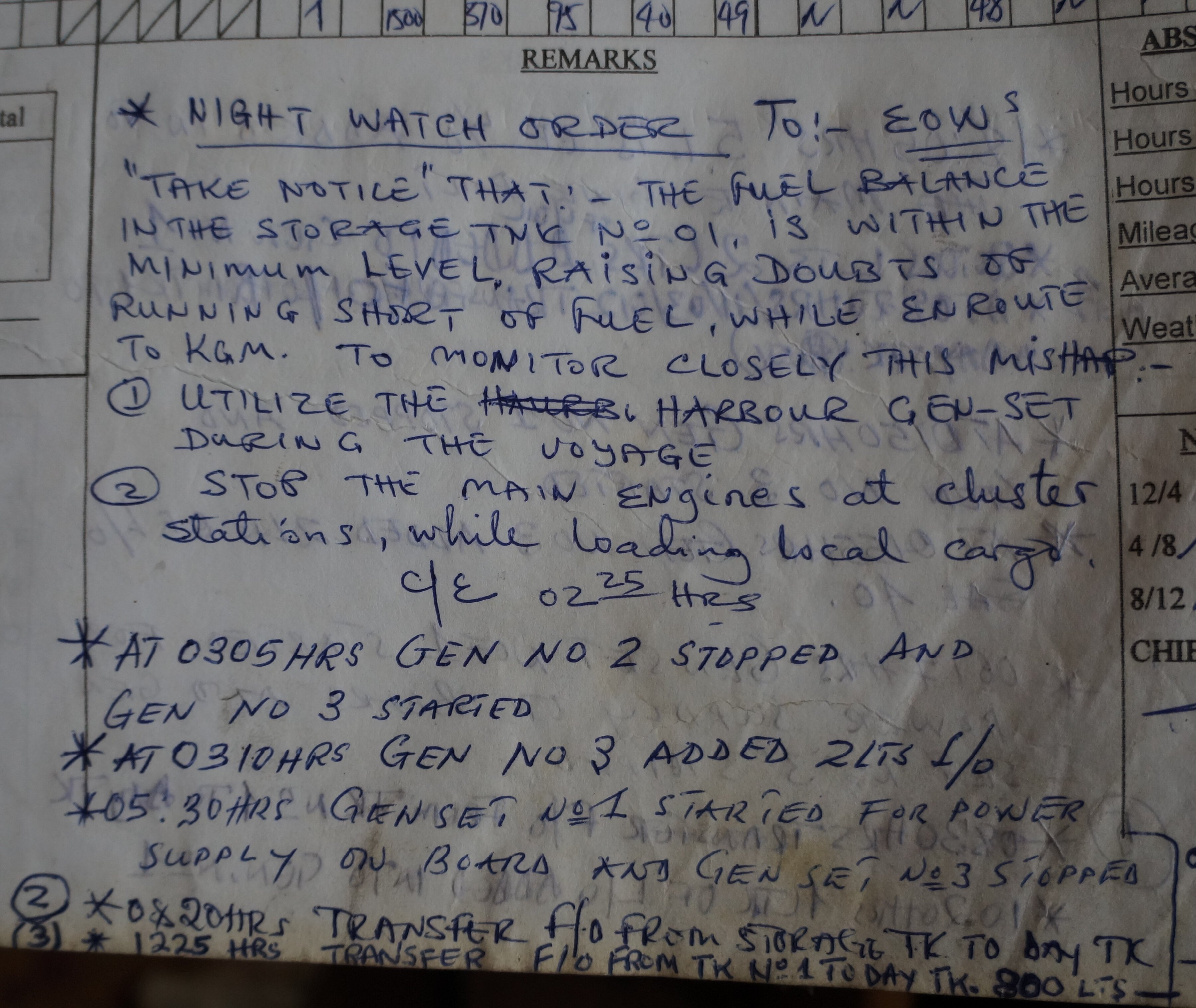
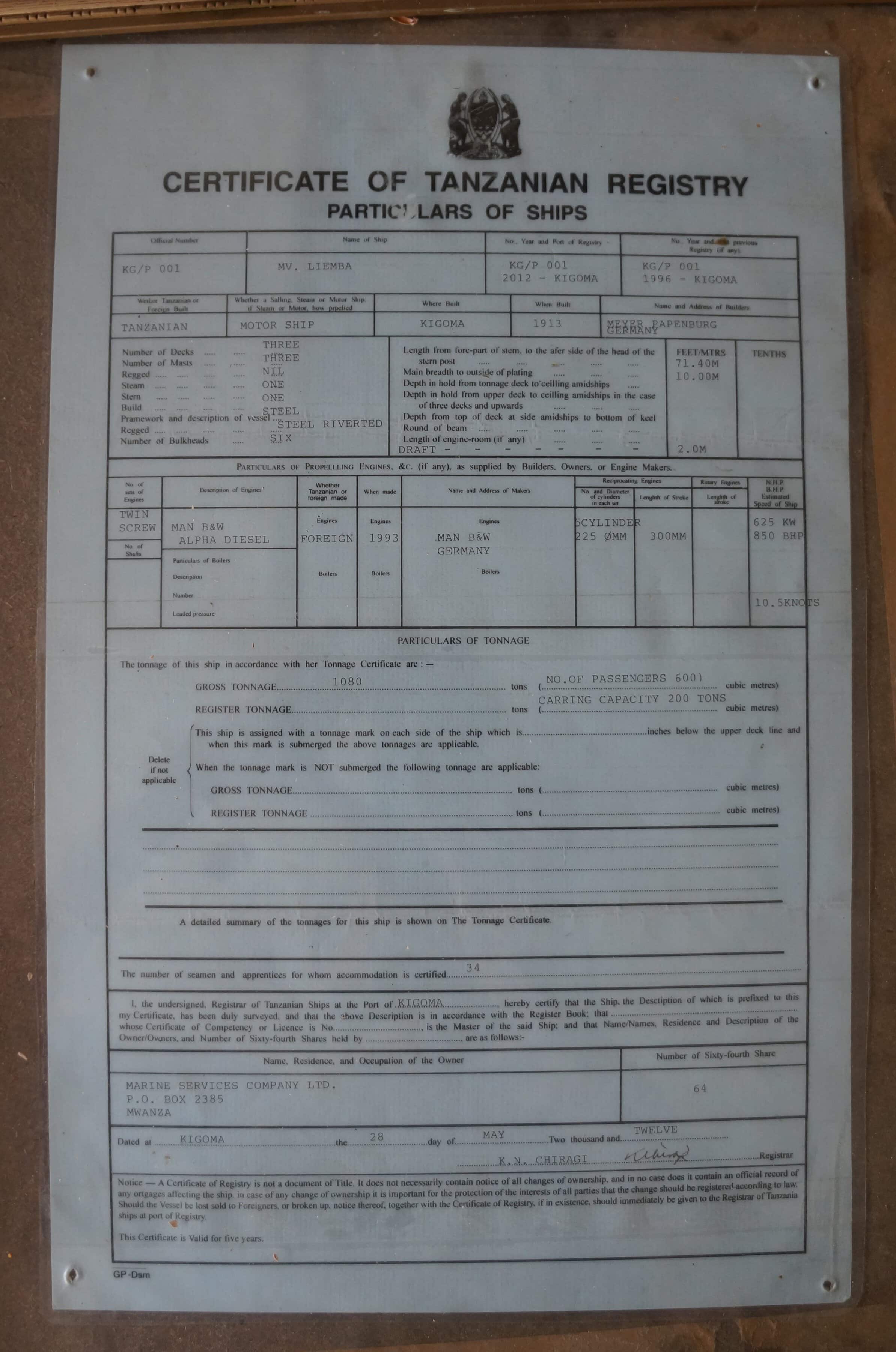
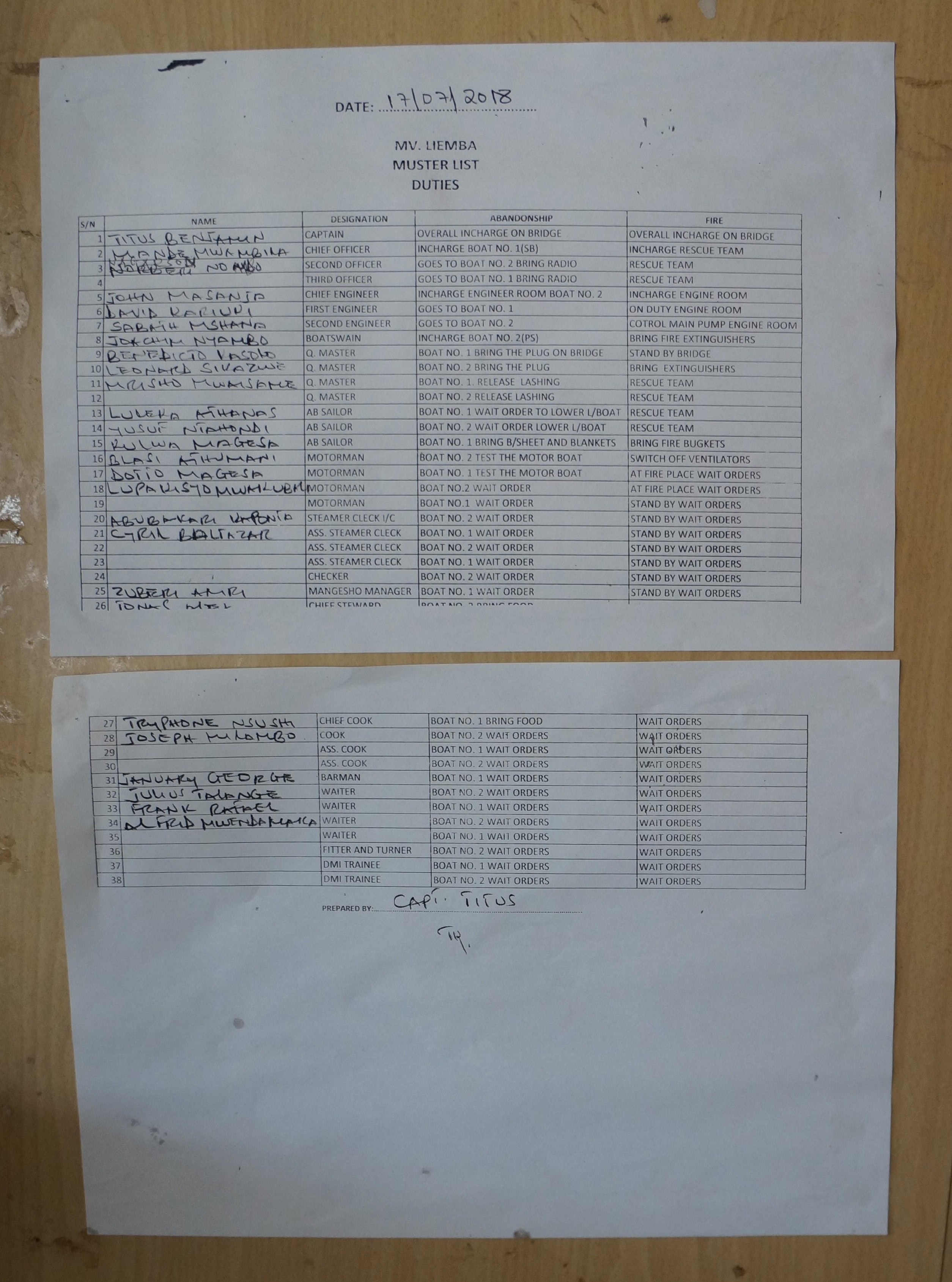
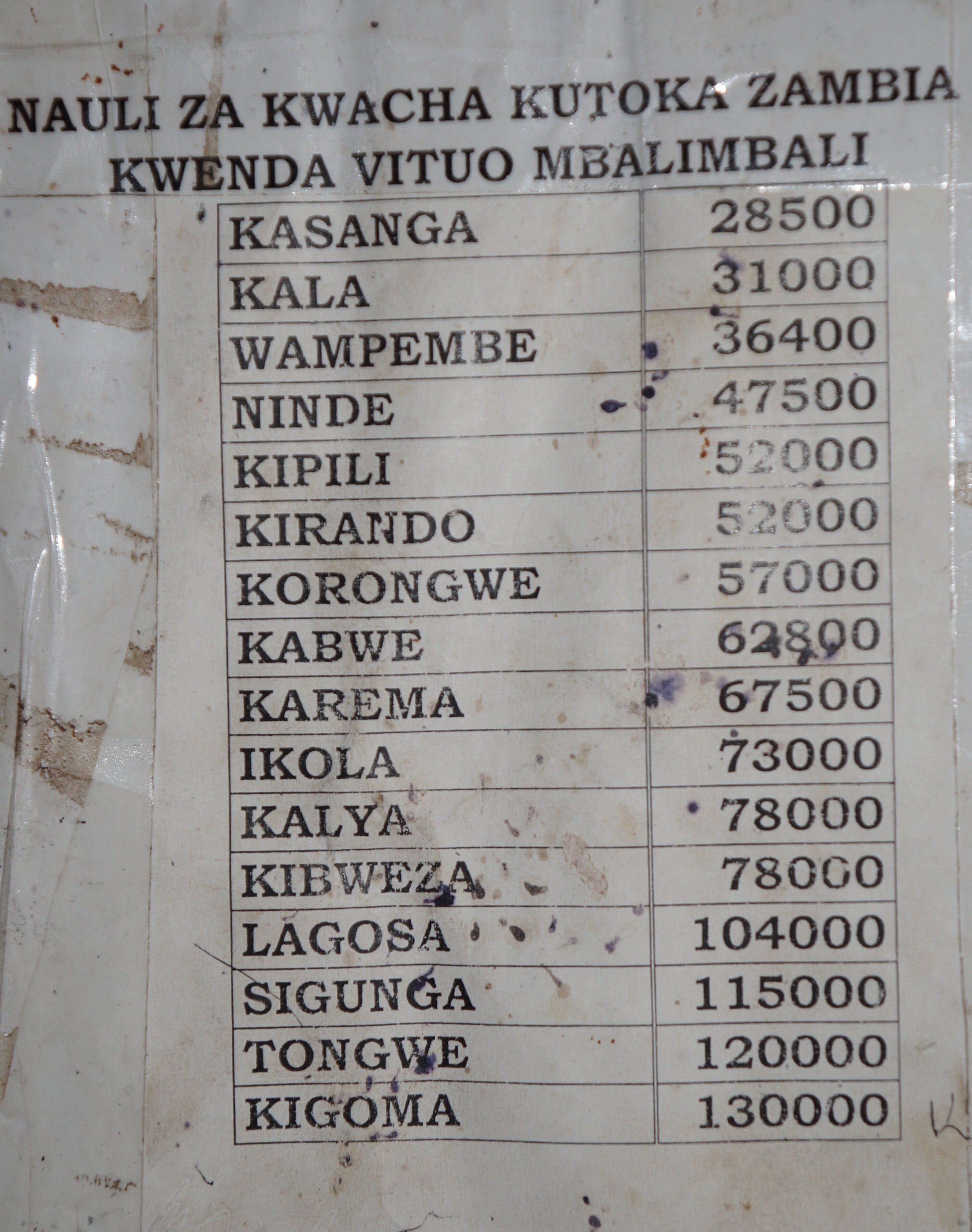
Michael Berg, finds on board the ship.
Torpedoed and sunk: An embarrassment for German development cooperation.
The following chapter is not easy to write due to the lack of available sources. Much of what is found in it became known thru my work for the “Run Liemba” association. It impressively shows, however, that in today’s Germany, while endless discussions are held, not much else happens:
Since 2010, various German delegations from politics and business have visited the LIEMBA to gather information about a possible major overhaul of the ship. Members of the Meyer Werft were also present. Federal President Horst Köhler had initiated these trips with his “Partnership with Africa” initiative launched in 2005. His successors, Christian Wulff and Frank-Walter Steinmeier, also showed keen interest in the fate of the LIEMBA. It turned out that a complete overhaul was technically feasible and, given the estimated costs of around eight million euros, economically sensible.
To support this, in 2009, together with like-minded individuals, I founded a loose initiative called “Run Liemba,” which became an association in 2012. “Run Liemba” was meant to publicly present the issue and actively seek dialog with business and politics. Due to its German-African history, we considered the restoration of the LIEMBA as a unique project in the field of German-African development cooperation, with a restored LIEMBA serving as a showcase and a starting point for further projects in the region. Dual training programs for necessary professions could be established to ensure not only the repair but also regular future maintenance. Docks and ports could be expanded, and the region could be developed economically, ecologically, and touristically.
The right people and institutions were certainly brought together: former development workers, senior employes of the state shipping company Marine Services Company Limited (MSCL), the Federal Foreign Office, the State Chancellery in Hanover with its head of the Europe and International Department, Heinz Davidsohn, Meyer Werft with Jochen Zerrahn, and the German Africa Foundation (Deutsche Afrika Stiftung) in Berlin under its then Secretary General, Jürgen Langen. The DAS was to prove itself in the following years as a valuable and committed supporter and, among other things, enable the holding of a Parliamentary Evening in Berlin.
However, it was already clear at this early stage that before any political discussion, the condition of the LIEMBA and the possibility of its repair had to be professionally assessed. The design office of the then Bodan shipyard in Kressbronn on Lake Constance offered to prepare an expert report for just over €10,000 in January 2010. The ship was to be inspected on the slipway in Kigoma, where, among other things, the material thicknesses of the underwater area were to be examined and the necessary renovation and conversion work according to German standards was to be documented and calculated. Particular attention should be paid to safety-related measures according to the standards of the Germanischer Lloyd.
Regarding the financing of the report, we advised the MSCL to submit an application for micro-projects to the German embassy in Dar es Salaam. The application submitted by the MSCL was, however, rejected by the embassy for reasons not specified.
In parallel, the Foreign Office and the Federal Ministry for Economic Cooperation and Development set the course. The BMZ commissioned an expert report from the Kreditanstalt für Wiederaufbau, which in turn subcontracted it to Hamburg Port Consulting – not a repair yard, but a consulting company in the field of port logistics. Its employe Martin Schramm was indeed seen in Kigoma, but none of the MSCL employes I interviewed could remember him being on the LIEMBA as well. Accordingly, the report concluded: The importance of inland shipping for the lakeside residents was acknowledged, but not the LIEMBA itself, which is “a candidate for the ship museum.” If at all, the renovation must consider safety standards as they apply to new ships on the high seas. Furthermore, budgetary aspects were raised, especially the key points of cooperation between Tanzania and Germany defined by the BMZ, such as good governance and water management. There is no mention of infrastructure measures there.
The Lower Saxony State Chancellery then sought support from the Federal Chancellery and the Federal Ministry of Transport, Building, and Urban Development, the latter of which is at least responsible for inland navigation. Davidsohn summarizes their assessment as follows: “There is no compelling reason to impose the same requirements on ships on Lake Tanganyika as for the high seas.” It makes no sense to require the same safety technology for ships that are a hundred years old as for new ones. That is not happening in Germany either.” The Meyer-Werft, Davidsohn continued, contributed to the objectification and developed a rehabilitation plan that is also welcomed from a safety perspective.
None of this deterred a company, which provided early support: HeidelbergCement, the German parent company of the Tanzania Portland Cement Company, the largest cement producer in Tanzania, went on the offensive and declared in February 2012 that it would “contribute an amount between 500,000 and 2.5 million euros to a private fund for the modernization of the LIEMBA,” provided that other companies would join in. The letter, signed by the company’s board member Daniel Gautier and addressed to the president of the German Africa Foundation, Hartwig Fischer, was read out during a parliamentary evening on February 9, 2012.
Shortly thereafter, when efforts were still being made in Hanover to secure German budget support and “Run Liemba” was being discussed as a Public Private Partnership, Tanzania made concrete decisions in April 2012. In the minutes of a consultation round on the design of bilateral development cooperation, which took place between representatives of the BMZ and the Tanzanian government in Dar es Salaam, it was recorded: “The Tanzanian Government confirmed that it would use its own financial resources to ensure naval traffic on Lake Tanganyika including General Budget Support or other means.”
The diplomatic dimension of the protocol was explained by Heinz Davidsohn from the Lower Saxony State Chancellery: “Nothing is happening there anymore.” The protocol is clear. Tanzania is taking care of the refurbishment of the LIEMBA itself and does not need German assistance. The BMZ rightly relies on this.
In the Lower Saxony State Chancellery, the field was nevertheless further cultivated. Looking ahead, the rehabilitation of LIEMBA was defined as part of a European policy concept, in order to immediately consider the acquisition of EU funds. The protocol of the consultation round in Dar es Salaam is indeed binding for the German government, but not for the German private sector, according to Davidsohn. Accordingly, the Lower Saxony Prime Minister has written to MAN and Siemens. MAN could take care of the engines, Siemens of the electrical and electronic systems, while Meyer-Werft could finally serve as a technical advisor and offer the company’s own training academy for a dual training program for local specialists.
In March 2014, the German Foreign Minister Frank-Walter Steinmeier visited Tanzania on the occasion of the anniversary “Fifty Years of Bilateral Relations between Germany and Tanzania.” In various speeches, Steinmeier also addressed the LIEMBA.
The trip provided a new impetus for a possible overhaul of the LIEMBA. A departmental meeting followed on June 23, 2014, at the Foreign Office, where Mr. Egon Kochanke – at that time the Africa Commissioner and later Ambassador to Tanzania – made a sincere effort to win the BMZ over to the project.
Finally, the BMZ agreed, under certain conditions, to commission the KfW to send an expert team to inspect the LIEMBA in Kigoma. The conditions included, among other things, that a legal opinion should be prepared, which would outline the safety requirements for a repaired LIEMBA. Likewise, that the project itself would become the subject of German-Tanzanian consultations on a follow-up agreement for development cooperation in late spring 2015, as well as that all BMZ regulations – particularly regarding “economy” and “efficiency” – would be adhered to.
On July 29, 2014, representatives of the Lower Saxony State Chancellery discussed the further progress and the technical framework conditions for the inspection at KfW in Frankfurt. A formal request for support from Tanzania and the results of the legal opinion were to be awaited. According to the Foreign Office, the letter from Tanzania arrived at the end of September 2014.
Additionally, the Tanzanian Minister of Transport, during his visit to the Foreign Office in Berlin in early October 2014, advocated for the complete overhaul of the ship, among other things.
The trip of the technical experts was carried out at the end of November/beginning of December 2014. A resulting cost estimate indicated a need of €7,500,000.00, plus the costs for spare parts, the transport of all parts and equipment to Tanzania, the establishment of the shipyard, and the implementation of a training project for the future maintenance and upkeep of the ship.
This hopeful development unfortunately did not continue in 2015. The year dragged on without any significant developments, and over the course of the year, I came to the conviction that the repair of the ship within the framework of a German-Tanzanian development project would no longer have any prospect of realization. At the end of 2015, I left the “Run Liemba” association and shared the reasons in an open letter to all involved – a total of 188 people.
Dear Sir or Madam,
with the year 2015, I am ending my work for the association Run “Liemba” e. V. As a founding member and former chairman, this step was not easy for me. However, I came to the conclusion that a complete overhaul of the MS Liemba within the context of a state-German development project no longer has any prospect of realization.
Based on technical feasibility, I was initially tempted to describe the undertaking of a complete overhaul of the ship as “easy to handle,” even “primitive.”
All the more remarkable, however, is the approach of the German Federal Ministry for Economic Cooperation and Development (BMZ), which would play a central role in the realization of the project. Within the ministry, regarding the MS Liemba, there is not merely disinterest or incompetence. Rather, the Liemba project has always and consistently been delayed and undermined by the BMZ – in other words: torpedoed and sunk.
In addition to obviously flawed reports (Dr. Martin Schramm, Hamburg Port Consult, 2010), missed opportunities in bilateral talks (final protocol from 27.4.2012, signed by Mr. Khijjah and Dr. Mohs), the absence of a project coordinator solely responsible for the MS Liemba at the BMZ is noticeable, who is specifically in continuous exchange with the Tanzanian side – primarily with the MSCL and secondarily with the higher-level Tanzanian ministries. The African mentality differs significantly from ours in this regard; personal contacts must be maintained much more intensively, especially beyond official occasions. Not considering this detail from the outset prevents an equal development “cooperation” on an equal footing.
Instead, traditional methods of development “aid” are used, in which the First World – after a one hundred and fifty percent review – blesses the Third World with a project, or not. Even in the case of the Liemba, extensive review steps must be completed: In addition to a legal opinion already prepared and the various technical inspections of recent years, a “comprehensive review” is to be conducted. Likewise, aspects of “demand,” “total costs,” “cost-benefit ratio,” and – particularly impressively – “sustainability,” “socio-economic,” “socio-cultural,” and “ecological impacts” are to be examined.
It becomes almost unrealistic when it is further examined to what extent the owner is capable of operating in a “socially,” “economically,” and “ecologically sustainable” as well as “corruption-free” manner.
Pointedly sharpened: A hundred years ago, the German industry delivered a ship to Africa within two years. Today, after more than five years, politics delivers petty nitpicking, coupled with an overwhelming regulatory frenzy. The industry delivers nothing.
In addition, the BMZ’s plans do not include any alternative option in the form of a new ship: Thus, a decision against a general overhaul of the Liemba would mean a blatant regression for shipping on Lake Tanganyika, especially in terms of safety. This initially takes the form of the continued operation of a Liemba with its increasing technical failures, but above all after its ultimately expected decommissioning. Even today, in the event of the Liemba’s failure, it can be observed that travelers are resorting to small fishing boats. The risks of this regressive development – especially at night, in the rain, or during a storm – are obvious: Since the turn of the millenium, there have been at least four major accidents on Lake Tanganyika: on March 24, 2003, with 111 dead, on January 30, 2008, with at least 100 dead, on December 15, 2014, with 120 dead, and on January 16, 2015, with 12 dead. Against this background, the fact that a renovated Liemba could possibly be “only” the second-best solution in terms of safety aspects is completely put into perspective.
This entire development is all the more regrettable because the restoration of the Liemba, due to its shared German-African history, would represent a unique development project for Germany. The Liemba could be a flagship for German development cooperation as well as an impressive example of the quality standard “Made in Germany.”
Last but not least, efficient and uncomplicated development aid is particularly the order of the day in today’s times. (…) Even in Tanzania, I spoke with people on my travels who saw their future in Europe. Keeping these people in their country requires efficient local aid – pseudointellectual discussions about “socio-cultural impacts” or “corruption-free operations” back and forth.
(…)
Best regards,
Michael Berg.
In mid-2016, the LIEMBA project was handed over from the BMZ to the Foreign Office. Thus, the ministry that had been supportive of the project from the beginning and had also provided assistance to the best of its ability had now become responsible. The Foreign Office allegedly received a budget of 5,000,000.00 €. Additionally, there might be the sum promised by Heidelberg Cement in February 2012, which ranges between €500,000.00 and €2,500,000.00, if it is still valid.
However, communication with Tanzania had meanwhile reached a standstill; evidently, they had grown tired of the discussions with Germany that had been ongoing for five years. There, in November 2015, a new president was sworn in with John Magufuli (nickname: “The Bulldozer”), who had made the fight against mismanagement and corruption one of his priorities.
The MSCL also came under the president’s scrutiny, and on October 7, 2016, the shipping company issued a tender for the repair of three of its ships – including the LIEMBA. I had already received the tender before this date, immediately forwarded it to Meyer Werft, and they in turn forwarded it to the Lower Saxony State Chancellery and the Foreign Office. Whether anyone there was interested in the detailed tender information, which had to be requested from MSCL for a fee, is beyond my knowledge.
The details of the tender were also very vaguely formulated by the MSCL, such as the items “repairs of the whole wooden deck” or “complete re-painting from keel to top, inside and outside”: This said nothing about the type of wood and the laying technique regarding the deck, and nothing about the preparation, the paint structure, or the paint specifications regarding the painting work. Other important points were completely missing, such as the removal of hull damage, which the technical experts from Germany had documented during their inspection at the end of 2014 on the ship that was then on the slipway.
Interestingly, Tanzania was able to provide €2,500,000.00 from its own funds solely for the repair of the LIEMBA – exactly one quarter of the total amount that had actually been agreed upon with the German side in 2015. But the communication between the official authorities in Germany and Tanzania had – as mentioned – meanwhile broken off, and on January 11, 2017, I was asked to look into it.
As a result, it became clear that in Tanzania they were “uncertain about German interests” and that, due to the president’s directive, they could no longer wait. Apparently, the directive was to carry out the overhaul of the LIEMBA exclusively with the funds available – which, of course, would not be nearly enough.
The further schedule also seemed very ambitious: Evaluation of the bids starting from January 16, 2017, award at the beginning of February, followed by contract signing. The work was to begin in March 2017 and last for nine months.
Within the tender period set by MSCL, several shipyards had applied, including one each from Denmark and Croatia. Of course, an offer from a German shipyard was not among them.
After I became aware of all this, I suggested that the German ambassador should seek a personal meeting as soon as possible, on the one hand with the Tanzanian president and on the other hand with the MSCL. On the one hand, to point out the German funds that have been made available in the meantime, and on the other hand, to maintain influence over the project and achieve the highest possible quality result. The proposal was submitted to the Foreign Office, but no further developments have been reported.
Ultimately, the LIEMBA continued to operate until 2018. As the technical failures increased, the ship was decommissioned.
In 2020, the opportunity arose to participate in a 3D documentation of the LIEMBA, funded by Meyer Werft. It lay in Kigoma on the transverse slipway where it had once been built, and was left to complete neglect. Many parts were defective or completely missing, dirt, mold, and dampness permeated the entire ship. We were sure to document the end of this legend.
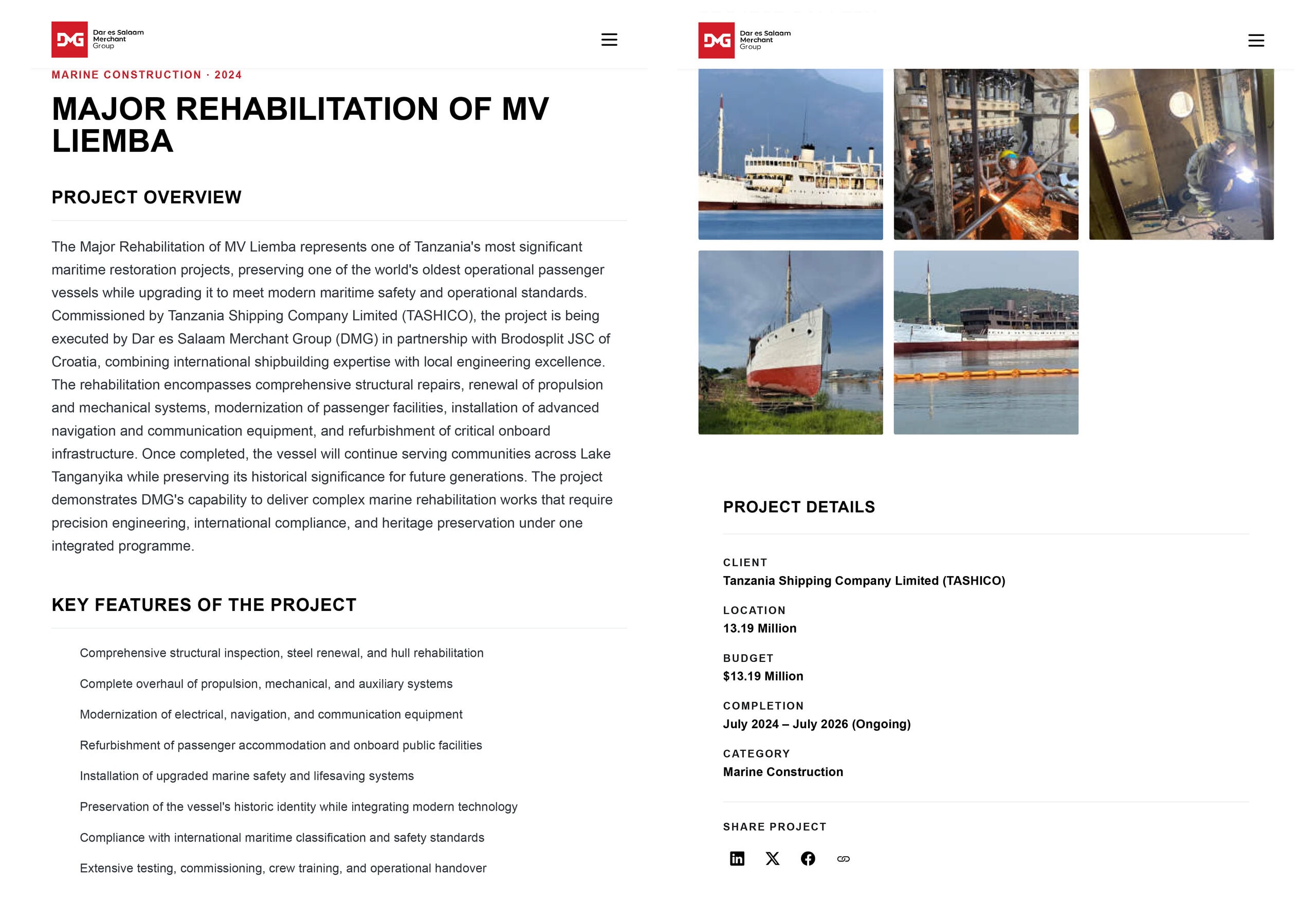
https://www.dmg.co.tz/projects/major-rehabilitation-of-mv-liemba (accessed 24 July 2026).
Footnote
- Bernhard Dernburg is worth mentioning as one of the leading advocates of fundamental reforms in German colonial policy; he headed the Colonial Department of the Foreign Office from 1906 to 1907 and, from 1907 to 1910, the Reichskolonialamat (Empire Colonial Office), which was established as its successor. Dernburg is credited with the statement that colonisation had previously been carried out using “means of destruction“ and that the aim was now to colonise using “means of preservation“. As means to this end, Dernburg cited the missionary and the doctor, the railway and the machine, but also science. Of essential importance, of course, was also the development of the then sparsely populated colonies with regard to their native population in order to obtain urgently needed workers.
- The last governor of the colony provides a detailed description: Heinrich Schnee: Deutsch-Ostafrika im Weltkriege. Wie wir lebten und kämpften. Leipzig, 1919, p. 3 to 11, 16 f., 19 to 23. Bruce Gilley: Verteidigung des deutschen Kolonialismus. Lüdinghausen, 2021: Gilley concludes that, objectively speaking, the colonial era was beneficial to the colonised, whilst subjectively it was justified in the eyes of the colonisers. The longer a country was colonised, the higher the resulting levels of economic growth, standard of living, political participation, quality of healthcare, education, human rights and legal certainty.Rainer F. Schmidt. Kaiserdämmerung. Berlin, London, Paris, St. Petersburg und der Weg in den Untergang. Stuttgart, 2021.Wolfgang Kaufmann: Kolonialismus hatte nicht nur Schattenseiten. In: Preußische Allgemeine Zeitung, 29. 11. 2019.
- Heinrich Schnee: Deutsch-Ostafrika im Weltkriege, p. 10 and 19.
- Kolonie und Heimat (publisher): Eine Reise durch die Deutschen Kolonien. Deutsch-Ostafrika. Berlin, 1912. Reprint Wolfenbüttel, 2008, p. 91. Heinrich Schnee: Deutsch-Ostafrika im Weltkriege, p. 19.
- Unknown author: The last of the Mohicans. Germany’s one last unconquered colony. In: The Hawera And Normanby Star, Volume LXXI, 22 February 1916, p. 3: http://paperspast.natlib.govt.nz/cgi-bin/paperspast?a=d&d=HNS19160222.2.10 (accessed 16. 3. 2014); Willibald Sonntag: Dampfer „Liemba“ ex „Götzen“ – Deutscher Schiffsveteran auf dem Tanganjikasee. In: Technikgeschichte, Volume 40, 2/1973, p. 162, quoting an article published in 1913 by Schlüpmann in the Deutsches Kolonialblatt; unknown author: Tanganjika-Bahn. In: Hansa. Deutsche nautische Zeitschrift, Nr. 6, 7. 2. 1914, p. 211; unknown author: Nachrichten von den Werften und aus der Industrie. Deutscher Schiffbau in Ostafrika. In: Schiffbau, Nr. 18, 23. 6. 1915, S. 510, quoting a report published in the “Vorwärts”.Franz Baltzer: Die Kolonialbahnen mit besonderer Berücksichtigung Afrikas. Berlin, Leipzig, 1916. Reprint Holzminden, 2007, p. 56.Wilhelm Arning: Vier Jahre Weltkrieg in Deutsch-Ostafrika. Hannover, 1919, reprint Wolfenbüttel, 2011, p. 232.
- Roel Ramaer: Gari la Moshi. Steam Locomotives of the East African Railways. Malmö, 2009, p. 10.
- Franz Baltzer: Die Kolonialbahnen mit besonderer Berücksichtigung Afrikas. Berlin, Leipzig, 1916. Reprint Holzminden, 2007, p. 24.
- Heinrich Schnee: Deutsch-Ostafrika im Weltkriege, p. 6.
- Kurt Assmann: Der Krieg zur See 1914-1918. Volume 6: Die Kämpfe der Kaiserlichen Marine in den Deutschen Kolonien. Part 2: Deutsch-Ostafrika. Publisher: Marine-Archiv. Berlin, 1935, footnote 1, p. 176.
- Letter imperial governor, Dar es Salaam, to colonial department foreign office, Berlin, 4. 9. 1906, with enclosed travel report of government councilor Chrapkowski of his business trip from Chinde to Lake Nyasa. R 1001/973, Federal Archive Berlin.
- Franz Joseph Meyer: Passagierdampfer für den Tanganjika-See. In: Werft, Reederei, Hafen, 4/1922, p. 99; L. B. Cane: S.S. „Liemba“. In: Tanganyika Notes and Records, 23/1947, p. 31.
- L. B. Cane: S.S. „Liemba“, p. 32, citing a communication from the director of the OAEG on the question of the use of diesel or steam engines, and appending a summary of the essay by J. Kollmann: Die technischen Fortschritte des Jahres 1911. In: Technische Monatshefte, 2/1912, p. 33. Author’s note: Drawings of oil tanks and diesel engines intended for installation in “S 300” can be seen in the Meyer Werft company archive under the index “GOETZEN S. 300”.
- L. B. Cane: S.S. „Liemba“, p. 35.
- Information supplied by Waldemar von Gruchalla, head of the company archive at Meyer Werft GmbH, 28. 2. 2014, according to which, the stated weight of “200 tonnes” refers to the deadweight tonnage of the barges.
- Letter secretary of state imperial colonial office, Berlin, to imperial governor, Dar es Salaam, 18. 5. 1912. The input of the OAEG itself is not enclosed to the archival document. R 1001/973, Federal Archive Berlin.
- L. B. Cane: S.S. „Liemba“, p. 32.
- Details about governor von Goetzen at: http://de.wikipedia.org/wiki/Gustav_Adolf_von_Götzen (accessed 16. 3. 2014).
- Franz Joseph Meyer: Passagierdampfer für den Tanganjika-See, p. 100; Unknown author: Götzen. In: Schiffbau, No. 22, 25. 8. 1915, p. 645, citing information from the Deutsches Kolonialblatt.
- L. B. Cane: S.S. „Liemba“, p. 35.
- Assessment of the general arrangement plan in the article by Franz Joseph Meyer: Passagierdampfer für den Tanganjika-See, p. 99: This general arrangement plan shows seven first-class cabins. It conflicts with another general arrangement plan from April 1913, to be found in the Meyer Werft archive under the index “GOETZEN S. 300”. In this plan, only six cabins are shown as first-class, while the seventh is for the mate.
- Unknown author: Götzen, p. 645; see also the images in Rolf Eilers/Klaus-Peter Kiedel: Sechs Generationen Schiffbau in Papenburg. Publisher: Meyer Werft. Bremerhaven, 1988, p. 81 f.
- Assessment of the ship’s plan in Franz Joseph Meyer: Passagierdampfer für den Tanganjika-See, p. 99.
- L. B. Cane: S.S. „Liemba“, p. 33.
- Oral information from Waldemar von Gruchalla, head of the company archive at Meyer Werft GmbH, 16. 1. 2014.
- Erich Gröner: Die deutschen Kriegsschiffe 1815-1945. Vol. 7, Munich, 1990, p. 221.
- L. B. Cane: S.S. „Liemba“, p. 33.
- Unknown author: Götzen, p. 645; Meyer Werft payroll records for 1913, p. 71. Shelf mark “K6/64”, archive of Meyer Werft GmbH
- It is not possible to establish an exact date. 20. 11. (Judith Fehrenbacher: Jenseits von Papenburg – im Kielwasser deutscher Kolonialgeschichte. SWR 2 radio report, 1. 1. 2012) and 22. 11. (Sarah Paulus: Tansania (Teil 2): Daten zur MV Liemba, früher SMS Graf GOETZEN; http://sarahpaulus33.wordpress.com/2011/11/28/daten-und-informationen-zur-mv-liemba-fruher-sms-graf-goetzen, accessed 16. 3. 2014) are both mentioned. L. B. Cane: S.S. „Liemba“, p. 33, states that the director of the OAEG in Berlin reported completion of the acceptance test to Dar es Salaam on 26.11. See also: Unknown author: Schiffahrt auf dem Tanganika- und Viktoria-See. In: Deutsch-Ostafrikanische Zeitung, 8. 11. 1913, p. 2. This source, however, merely mentions that the Goetzen was the first of several new steamers to be built and would soon be launched.
- Meyer Werft payroll records for 1913 and 1914, pp. 65 to 74 and 98. Shelf mark “K6/64”, archive of Meyer Werft GmbH.
- Information supplied by Waldemar von Gruchalla, head of the company archive at Meyer Werft GmbH, 28. 2. 2014.
- Author’s note.
- Unknown author: Passagierverkehr auf den Dampfern der Deutschen Ost-Afrika-Linie. In: Deutsch-Ostafrikanische Zeitung, 21. 2. 1914, p. 3; L. B. Cane: S.S. „Liemba“, p. 33.
- Wilhelm Arning: Vier Jahre Weltkrieg in Deutsch-Ostafrika, p. 232.
- Quote in L. B. Cane: S.S. „Liemba“, p. 34, in English translation.
- L. B. Cane: S.S. „Liemba“, p. 34 f. There, “Wm. Brandt, Söhne & Co” are named as the insurers, and “Schwartse, Petersen und Co.” as the brokers.
- Sarah Paulus/Rolf G. Wackenberg: Von Goetzen bis Liemba – Auf Reisen mit einem Jahrhundertschiff. Berlin, 2013, p. 133 f., who quote from Anton Rüter’s contract of employment. This contract, dated 29. 11. 1913 is in the author’s possession.
- Unknown author: Passagierverkehr auf den Dampfern der Deutschen Ost-Afrika-Linie. In: Deutsch-Ostafrikanische Zeitung, 21. 2. 1914, p. 3; L. B. Cane: S.S. „Liemba“, p. 33.
- Unknown author: Kigoma von der Tanganikabahn erreicht. In: Deutsch-Ostafrikanische Zeitung, 4. 2. 1914, p. 1.
- Unknown author: Götzen, p. 645.
- Kurt Assmann: Der Krieg zur See 1914-1918, p. 178.
- A. o. at Stephan Lamby: Die lange Fahrt der „Graf Götzen“. Von Papenburg nach Afrika. Documentary film, made by EcoMedia, NDR 2001; Gisela Graichen/Horst Gründer: Deutsche Kolonien – Traum und Trauma. 2nd edition, Berlin 2005, p. 326; Michael Stührenberg: Die endlose Fahrt der Liemba. In: GEO, 4/2007, p. 116.
- Kolonie und Heimat (Editor): Eine Reise durch die Deutschen Kolonien. Deutsch-Ostafrika. Berlin, 1912; Reprint Wolfenbüttel, 2008, S. 101. Concerning the transport of HEDWIG VON WISSMANN also detailed at Rudolf Fitzner: Ein deutscher Dampfer für den Tanganyika. Berlin 1897. Reprint without indication of place, 1994, p. 15. https://de.wikipedia.org/wiki/Hermann_von_Wissmann_(Schiff) (accessed 6. 6. 2020).
- Gustav Zimmer: Die „Möwe-Abteilung“ auf dem Tanganjikasee in Deutsch-Ostafrika 1914-1916. Manuscript, Berlin, 1931; reprint, 1994, p. 9. Regarding Gustav Zimmer, see also: Kurt Assmann: Der Krieg zur See 1914-1918, p. 175 ff. There is also a one-page handwritten summary of Gustav Zimmer’s life and military career: MSG 225/13, Federal Military Archive Freiburg: At the outbreak of war, Gustav Zimmer accordingly was commander of the survey ship SMS MÖWE, belonging to the Imperial German Navy. The vessel was scuttled by its own crew in the port of Dar es Salaam on 8.8.1914 to prevent it falling into British hands. Zimmer then put his crew at the disposal of the Governor for the defence of the colony. He became leader of the “Marine-Expeditionskorps” (naval expeditionary corps), which later became known as “Abteilung Möwe” (Möwe Battalion), and assumed the position of military commander on Lakes Tanganyika and Kivu. The GOETZEN was thus a unit under Zimmer’s command. Zimmer’s own direct superior was the commander of the “Schutztruppe” (colonial armed forces), Colonel (later Major General) Lettow-Vorbeck. In November 1917, he was injured and taken prisoner by the British. On his release in 1919, he was retired with the rank of “Kapitän zur See” (Captain). Up to 1931 he wrote the report mentioned above about the wartime events in German East Africa.
- Franz Baltzer: Die Kolonialbahnen mit besonderer Berücksichtigung Afrikas. Berlin, Leipzig, 1916. Reprint Holzminden, 2007, p. 52, 54.
- Marginal note Deutsch-Ostafrikanische Zeitung, 25. 4. 1914, p. 3.: Here we read that as of now […] all the waggon-loads [pass] through because transhipments no longer take place in Tabora. See also: Kurt Assmann: Der Krieg zur See 1914-1918, footnote 1, p. 176: According to this source, the official opening of the completed railway line was to take place in August 1914, during the regional exhibition in Dar es Salaam.
- Heinrich Schnee: Deutsch-Ostafrika im Weltkriege, p. 109.
- Franz Joseph Meyer: Passagierdampfer für den Tanganjika-See, p. 100; Kurt Assmann: Der Krieg zur See 1914-1918, p. 177 f.
- Rolf Eilers/Klaus-Peter Kiedel: Sechs Generationen Schiffbau in Papenburg, p. 80 f.; documentary film Die lange Fahrt der „Graf Götzen“. Author’s note: The letters were the property of Franz Josef Meyer, Papenburg, but unfortunately none of them ended up in the Meyer Werft archive. For the purpose of his publication, Klaus-Peter Kiedel was able to examine the originals.
- This letter was numbered “11/4 1914” by Rüter. That this cannot be a date is clear from the context: In his reply, Rüter refers, among other things, to a letter received from Joseph Lambert Meyer dated May 9th. Most importantly, however, he states that approximately eight weeks had passed since the start of the riveting of the hull on April 19th – the letter therefore dates from the second half of June 1914. Transcription received on November 19, 2010, by Inga Graber, editor of ems-vechta-welle, Lingen. Chronological classification provided by email to Mr. Waldemar von Gruchalla, Head of Company Archives, Meyer Werft, March 22, 2013.
- L. B. Cane: S.S. „Liemba“, p. 35.
- F. Baltzer: Karl Hillenkamp †. In: Zentralblatt der Bauverwaltung, No. 37, 4. 5. 1918, p. 184.Wilhelm Arning: Vier Jahre Weltkrieg in Deutsch-Ostafrika, p. 232; Kurt Assmann: Der Krieg zur See 1914-1918, p. 177 f.; L. B. Cane: S.S. „Liemba“, p. 35; Unknown author: Nachrichten von den Werften und aus der Industrie, p. 510. Heinrich Schnee: Deutsch-Ostafrika im Weltkriege, p. 109.
- Franz Joseph Meyer: Passagierdampfer für den Tanganjika-See, p. 101.
- Franz Joseph Meyer: Passagierdampfer für den Tanganjika-See, p. 101; L. B. Cane: S.S. „Liemba“, p. 35.
- L. B. Cane: S.S. „Liemba“, p. 36. Author’s note: This amount corresponds to €3,652,500 today, using a conversion factor of 4.87 (Federal Statistical Office, consumer price index October 2011), but this is in fact a relatively low figure. It is therefore to be assumed that, for a realistic conversion, additional factors need to be considered, such as changed labour and material costs.
- The precise day of this voyage is unclear. L. B. Cane: S.S. „Liemba“, on p. 36, puts the date of departure before 1 June, whereas Assmann, on p. 189, gives a date after 10 June.
- L. B. Cane: S.S. „Liemba“, p. 36 f., who translated the report word for word into English.
- Ascan Roderich Lutteroth: Tunakwenda. Auf Kriegssafari in Deutsch-Ostafrika. Hamburg, 1938, p. 120 f.: Lutteroth viewed the Goetzen on 18 February 1916 and mentions the ship’s “gleaming electric lights”. This indicates that, at some later stage, they succeeded in making the lighting system operational.
- L. B. Cane: S.S. „Liemba“, p. 35; Kurt Assmann: Der Krieg zur See 1914-1918, p. 178.
- Kurt Assmann: Der Krieg zur See 1914-1918, p. 188 and Appendix 1. See also: Carl Jungblut: Vierzig Jahre Afrika 1900-1940. Lippa, 1941, p. 87 and Ascan Roderich Lutteroth: Tunakwenda, p. 120: Siebel had sailed for the Deutsche Ost-Afrika-Linie shipping line before the First World War. At the start of the First World War, he was captain of the steamship MWANZA, stationed on Lake Victoria, and after the War he was again a ship’s captain for the Deutsche Ost-Afrika-Linie, but also for the Woermann-Linie, where he commanded the WATUSSI.
- Edel: Bei den Funkern in Deutsch-Ostafrika. In: Illustrierte Zeitung, No. 3915, Kriegsnummer 206, 11. 7. 1918, p. 19.: Before the War, Edel was third officer on the Imperial Mail Steamer KÖNIG, and in 1914 was involved in setting up the radio stations in Dar es Salaam and Tabora.
- L. B. Cane: S.S. „Liemba“, p. 37 f., who translated the report word for word into English. See also Alex Capus: Eine Frage der Zeit. 7th edition, Munich, 2007, p. 242 f.
- The draught of the RECHENBERG, the second ship in the series, was enlarged by Meyer-Werft at the outset from 2.3 m to 3 m: Franz Joseph Meyer: Passagierdampfer für den Tanganjika-See, p. 101.
- Author’s note: The same wish was expressed to me by Mr. Titus-Benjamin Mnyanyi, the captain of the vessel, during a conversation in January 2011.
- At the same time as the 10.5-cm gun was installed, the funnel was extended, as can be seen on various contemporary photographs. Also: Royaume de Belgique: Ministère de la Défense Nationale – Etat-Major Général de’l Armée Section de’l Historique: Les campagnes coloniales belges 1914-1918. Vol. II, Brussels, 1929, p. 346; Erich Gröner: Die deutschen Kriegsschiffe 1815-1945, p. 221.
- SMS MÖWE was a survey ship in the Imperial Navy, and mainly saw service in the colonies and in foreign waters. The vessel was scuttled by its own crew in the port of Dar es Salaam on 8.8.1914 to prevent it falling into British hands.
- Kurt Assmann: Der Krieg zur See 1914-1918, p. 188; L. B. Cane: S.S. „Liemba“, p. 35.
- The KINGANI was a customs cruiser which, together with its sister ship WAMI, was ordered in 1893 by the colonial department of the Foreign Office at Meyer Werft in Papenburg and put into service the following year. The ships presumably operated from Dar es Salaam. According to Arning, the KINGANI was taken to Kigoma by train soon after the outbreak of war […] after the boiler had been removed, otherwise not dismantled: Wilhelm Arning: Vier Jahre Weltkrieg in Deutsch-Ostafrika, p. 232.
- Gustav Zimmer: Die „Möwe-Abteilung“ auf dem Tanganjikasee in Deutsch-Ostafrika 1914-1916, pp. 14, 19 f.; Ludwig Boell: Die Operationen in Ost-Afrika. Hamburg, 1951, p. 115 and p. 117.
- Arning mentions HEDWIG VON WISSMANN instead of GOETZEN. However, the source generally remains very imprecise. Furthermore, it can be doubted whether that ship would have been able to do this because of its small size and engine power: Wilhelm Arning: Vier Jahre Weltkrieg in Deutsch-Ostafrika, p. 231.
- Kurt Assmann: Der Krieg zur See 1914-1918, p. 189 and Sarah Paulus e-mail dated 30. 8. 2013 after appropriate evaluation of the inventory number RM/8, archive number 368 and inventory number N 103, archive number 84 in the Bundesmilitärarchiv (Federal Military Archive), Freiburg: The sinking of the British wreck by the GOETZEN is apparently confirmed by document copies from the Bundesmilitärarchiv Freiburg. At the beginning of July 1915, Zimmer sailed to Bismarckburg on account of a discussion with Wahle. On 4 July he anchored with the GOETZEN off Kasakalawe. On the same day, or shortly thereafter, the wreck of the CECIL RHODES was pulled off the beach and towed into deep water, where it sank a short time later.
- Ludwig Boell: Die Operationen in Ost-Afrika, p. 100 f. and Gustav Zimmer: Die „Möwe-Abteilung“ auf dem Tanganjikasee in Deutsch-Ostafrika 1914-1916, p. 9 f.
- Frank J. Magee: Transporting a navy through the jungles of Africa in war time. In: The National Geographic Magazine, No. 4/October 1922, p. 331.
- Frank J. Magee: Transporting a navy through the jungles of Africa in war time, p. 331; Buxton: The Tanganyika Naval Expedition. In: The London Gazette, 13. 7. 1917, pp. 7067 to 7072. Wilhelm Arning: Vier Jahre Weltkrieg in Deutsch-Ostafrika, p. 233. Heinrich Schnee: Deutsch-Ostafrika im Weltkriege, p. 114.
- Gustav Zimmer: Die „Möwe-Abteilung“ auf dem Tanganjikasee in Deutsch-Ostafrika 1914-1916, p. 28.
- Kurt Assmann: Der Krieg zur See 1914-1918, p. 177 f.
- Carl Jungblut: Vierzig Jahre Afrika 1900-1940, p. 118: According to this source, the British kept the MWANZA in service there at least until before World War II.
- Arnold Kludas: Die Schiffe der deutschen Afrika-Linien 1880-1945. Hamburg, Oldenburg, 1975, p. 142 f.
- Heinrich Schnee: Deutsch-Ostafrika im Weltkriege, p. 110 f.https://www.britishempire.co.uk/article/navalactiononlaketanganyika.htm (accessed 24. 1. 2021); https://www.naval-encyclopedia.com/ww1/lake-tanganykas-naval-battles/ (accessed 24. 1. 2021);https://weaponsandwarfare.com/2015/08/08/the-naval-africa-expedition-and-the-battle-for-lake-tanganyika/ (accessed 24. 1. 2021).
- Wilhelm Arning: Vier Jahre Weltkrieg in Deutsch-Ostafrika, p. 233.
- Ascan Roderich Lutteroth: Tunakwenda, p. 120 f.
- Kurt Assmann: Der Krieg zur See 1914-1918, p. 258.
- Ludwig Boell: Die Operationen in Ost-Afrika, p. 273 f.
- Gustav Zimmer: Die „Möwe-Abteilung“ auf dem Tanganjikasee in Deutsch-Ostafrika 1914-1916, p. 31.
- Kurt Assmann: Der Krieg zur See 1914-1918, p. 260.
- Tillo Behaeghe: Aimé Behaeghe. First pilot in Central Africa. In: Cross & Cockade International, 39, 1/2008, p. 7 f. Cf.: George Moulaert: La campagne du Tanganika (1916-1917). Brussels, 1934, p. 93 f.
- Kurt Assmann: Der Krieg zur See 1914-1918, p. 260.
- Tillo Behaeghe: Aimé Behaeghe, p. 12; Unknown author: The Belgian Advance. In: The Times, 16. 6. 1916, p. 8; George Moulaert: La campagne du Tanganika, pp. 101 f. and 103.
- Louis Leconte: Les ancêtres de notre Force Navale. Brussels, 1952, p. 329; Charles Stiénon: La campagne anglo-belge de l’Afrique Orientale Allemande. Paris, 1917, p. 178; Jean-Pierre Sonck: Les hydravions belges du Tanganyika: http://www.congo-1960.be/LesHydraviationAuCongoBelge.html (accessed 17. 3. 2014); George Moulaert: La campagne du Tanganika, p. 101; Tillo Behaeghe: Aimé Behaeghe, p. 12.
- Kurt Assmann: Der Krieg zur See 1914-1918, p. 260; Gustav Zimmer: Die „Möwe-Abteilung“ auf dem Tanganjikasee in Deutsch-Ostafrika 1914-1916, p. 31; Ludwig Boell: Die Operationen in Ost-Afrika, p. 274.
- C. F. Laver: Lake Salvage. In: East African Railways and Harbours Magazine, 4/1956, Vol. 2-8, p. 257.
- Louis Leconte: Les ancêtres de notre Force Navale, p. 329; Jean-Pierre Sonck: Les hydravions belges du Tanganyika.
- See also: Gustav Zimmer: Die „Möwe-Abteilung“ auf dem Tanganjikasee in Deutsch-Ostafrika 1914-1916, p. 22.
- Kurt Assmann: Der Krieg zur See 1914-1918, p. 261 f.; Wilhelm Arning: Vier Jahre Weltkrieg in Deutsch-Ostafrika, p. 233 f.
- Ludwig Boell: Die Operationen in Ostafrika, p. 274; Wilhelm Arning: Vier Jahre Weltkrieg in Deutsch-Ostafrika, p. 234.
- 2274.S.S. to Western Commander Tabora of July 29, 1916: In Kigoma, before the main detachment left, everything was destroyed except the crane, Götzen, Wami. Preparations for blasting had been made, with constant watch. Forstmann’s department had orders, if the enemy was sure to march on Kigoma, to blow up the crane and Götzen, to keep Wami clear for a possible retreat, and to blow it up if necessary. Retreat to the main department south of Malagarassi. And: 2285.S.S. to Western Commander Tabora of July 29, 1916: Forstmann is said to have evacuated Kigoma on the 27th in the evening. In: Letter from Corvette Captain Zimmer to Major General Wahle from April 18, 1917 with a compilation of the orders from July 19, 1916 to September 3, 1916. N 103/84, p. 36. Federal Military Archive Freiburg. The facts make it clear that the sinking of the GOETZEN was carried out unauthorized on site and stood in contradiction to an order to blow up the ship. The superiors obviously even assumed after Forstmann’s retreat from Kigoma that the GOETZEN would have been blown up; Wilhelm Arning: Vier Jahre Weltkrieg in Deutsch-Ostafrika, p. 234; Sarah Paulus/Rolf G. Wackenberg: Von Goetzen bis Liemba, p. 157; Heinrich Schnee: Deutsch-Ostafrika im Weltkriege, p. 208 f., who dates Zimmer’s withdrawal from Kigoma, however, on July 23: Parts of the Belgian Southern Brigade under Colonel Olsen advanced towards the Tabora-Kigoma line of the central line. The starting point of the train, the port of Kigoma on Lake Tanganyika, which was occupied by a division under Corvette Captain Zimmer, was evacuated on July 23. A few days later, the small detachment under Lieutenant Forstmann, which had been left behind, withdrew from the approaching Belgians. After the “Königsberg” cannon, which had been installed to defend the harbor entrance, was blown up and the steamer “Goetzen” was sunk, the detachment marched along the railway eastwards, pursued by the enemy. District administrator Lange in Udjidji, which is only 1½ hours away from Kigoma on Lake Tanganyika, also took the last train to Tabora. Another official was still with some colored employees in Udjidji when the enemy had already occupied Kigoma, and was just able to escape the enemy enclosure by marching to the railway overland.
- L. B. Cane: S.S. „Liemba“, p. 41, citing a memorandum from the general manager of the Tanganyika Railways & Ports Services, dated 29. 3. 1924; documentary film Die lange Fahrt der „Graf Götzen“.
- http://en.wikipedia.org/wiki/Battle_for_Lake_Tanganyika (accessed 16. 3. 2014); George Moulaert: La campagne du Tanganika, p. 119; Louis Leconte: Les ancêtres de notre Force Navale, p. 331; Royaume de Belgique: Les campagnes coloniales belges 1914-1918, p. 373; Chalux (Marquis Roger von Chateleux): Un an au congo belge. Brussels, 1925, p. 545: The author mentions, that the ship was sunk by two explosive charges in the front- and the eighth ship, which were ignited by ignition cables from shore. The result consisted in two holes in the hull in a size of a square meter; Thomas Alexander Barns The wonderland of the Eastern Congo. London, 1922, p. 14; photographs from the Royal Museum for Central Africa in Tervuren/Belgium with No. HP.1966.1.119 and HP.1966.1.128, with the aid of which the location where the ship was scuttled can be identified. See also the interview with Mohammed Hassan in the documentary film Die lange Fahrt der „Graf Götzen“.
- C. F. Laver: Lake Salvage, S. 257.
- Inspection Michael Berg.
- Amongst other sources: Unknown author: Belgians bombarding Ujiji. Citing a dispatch from the Belgian General Charles Tombeur. In: The Times, 2. 8. 1916, p. 7; Unknown author: End of the German lakefleet. In: The Times, 3. 8. 1916, p. 5; Unknown author: Nearing the end in East Africa. In: The Times, 15. 8. 1916, p. 9; L. B. Cane: S.S. „Liemba“, p. 39 f.
- The ship was scuttled by its own crew, and raised by the Belgians in 1918. They renamed it WAPI and put it back into service: George Moulaert: La campagne du Tanganika, p. 117, footnote 1; Kevin Patience: Shipwrecks and Salvage on the East African Coast. Self-published, Poole, Dorset, 2006, p. 244.
- Missions le 28 juillet 1916: http://www.marinebelge.be/netta.html (accessed 16. 3. 2014).
- Charles Stiénon: La campagne anglo-belge de l’Afrique Orientale Allemande, p. 69; Louis Leconte: Les ancêtres de notre Force Navale, p. 331.
- Unknown author: Verlustlisten der Kaiserlichen Schutztruppen und Internierte. In Deutsch-Ostafrika in Gefangenschaft geraten und jetzt interniert. g) in Blantyre.. In: Deutsches Kolonialblatt, 15.9.1917, p. 230: Among the prisoners of war mentioned in these lists are “Gefreiter der Landwehr” Anton Rüter, from Papenburg, “Landsturmmann” Rudolf Tellmann, from Aschendorf, and “Landsturmmann” Hermann Wendt, from Papenburg. See also: documentary film Die lange Fahrt der „Graf Götzen“.
- As an example: Witthöft, Hans Jürgen: Meyer Werft. Innovativer Schiffbau aus Papenburg. Hamburg, 2005, p. 58.
- Various authors: In the wake of The African Queen. In: Reflections. A literary supplement to the “C. S. Forester Society” Newsletter. No. 1, July 2002: http://csforester.files.wordpress.com/2011/04/reflections-1.pdf (accessed 17. 3. 2014).
- The KÖMIGIN LUISE was a German ship used as a ferry service between coastal resorts, which was sunk by British destroyers during mine laying in the Thames Estuary on 5 August 1914.
- Frank J. Magee: Transporting a navy through the jungles of Africa in war time, p. 331; Buxton: The Tanganyika Naval Expedition. In: The London Gazette, 13. 7. 1917, pp. 7067 to 7072.
- Thomas Alexander Barns: The wonderland of the Eastern Congo. London, 1922, p. 14; George Moulaert: La campagne du Tanganika, p. 119 footnotes 1 and 121; Institut Royal Colonial Belge: Biographie Coloniale Belge. Part II, Brussels, 1951, chapter John-Ludwig Wall http://www.kaowarsom.be/en/notices_wall_john_ludwig (accessed 17. 3. 2014); Chalux: Un an au congo belge, p. 545 f.; Mervyn F. Hill: Permanent Way, Vol. II: The Story of the Tanganyika Railway. Nairobi, 1957, p. 95: Hill states that the GOETZEN sank at its moorings (!); C. F. Laver: Lake Salvage, S. 257: Laver states, that the salvage operations were ultimately abandoned; L. B. Cane: S.S. „Liemba“, p. 39: Cane does not specify the cause of the second sinking, but mentions, that during the German retreat, a smaller ship, the ADJUTANT, was blown up on the slipway. The not usable slipway could be the reason, why the salvage of the GOETZEN was not continued.
- Bataille du lac de Tanganyika (débute le 26 décembre 1915): http://www.unesco.org/new/fr/culture/themes/ underwater-cultural-heritage/world-war-i/underwater-cultural-heritage-from-wwi/#topPage (accessed 17. 3. 2014); Hans Jürgen Witthöft Legenden leben lange – eine GRAF GOETZEN gab es gar nicht. In: Köhlers Flottenkalender. Hamburg, 2011, p. 263.
- Pierre Daye: L’Empire Colonial Belge. Brussels, 1923: On p. 424 there is a picture of the flag parade; C. F. Laver: Lake Salvage, p. 257: Laver mentioned a purchase price of £4.000; Institut Royal Colonial Belge: Biographie Coloniale Belge, Kapitel John-Ludwig Wall: This source mentioned that the wreck was entrusted the new British mandate government by the Belgians at the delivery of the territory.
- L. B. Cane: S.S. „Liemba“, p. 40 ff.
- L. B. Cane: S.S. „Liemba“, pp. 40 & 42; C. F. Laver: Lake Salvage, p. 257.
- Mervyn F. Hill: Permanent Way, p. 199 f.
- C. F. Laver: Lake Salvage, p. 257-260.
- L. B. Cane: S.S. „Liemba“, p. 41, citing a memorandum from G. A. P. Maxwell (general manager of TR&P), dated 29. 3. 1924. See also the report by Chalux (Marquis Roger de Chateleux): Un an au congo belge, pp. 525 and 545, who visited Kigoma shortly before and after the salvage.
- L. B. Cane: S.S. „Liemba“, p. 41. See also: Unknown author: Tanganyika Trade. In: The Times, 2. 1. 1925, p. 9; Report of the East Africa Commission. Presented by the Secretary of State for the Colonies to Parliament by Command of His Majesty, April, 1925. London, 1925, pp. 95 and 100 f., which also deals with the geographical and infrastructure problems of North-Western Rhodesia and North-Eastern Rhodesia in getting its export goods to the coast: http://www.waado.org/colonial_rule/east_africa/east_africa_commission_1925.pdf (accessed 17. 3. 2014).
- L. B. Cane: S.S. „Liemba“, p. 41; Report of the East Africa Commission, p. 100 f.
- L. B. Cane: S.S. „Liemba“, pp. 36 and 41, citing the original documents. On the subject of the restoration costs, see also Mervyn F. Hill: Permanent Way, p. 95.
- L. B. Cane: S.S. „Liemba“, p. 36.
- Mervyn F. Hill: Permanent Way, p. 204. Cf. L. B. Cane: S.S. „Liemba“, p. 45, Appendix I: According to Cane, there were twelve double cabins (presumably first-class) and eight four-bunk cabins (presumably second-class). Cane does not mention the third-class passenger capacity, but does mention a transport capacity of 252 soldiers.
- L. B. Cane: S.S. „Liemba“, p. 41, citing a communication from G. A. P. Maxwell, general manager of TR&P, dated 29. 3. 1924.
- L. B. Cane: S.S. „Liemba“, p. 42 f. See also: Unknown author: The Liemba returns to service. In: Staff Magazine, 3/1953, Vol. 1-4, p. 6: According to this source, the word “Liemba” means “lake” in the dialect of the Kirungu, who live in the Kasanga area.
- Oral information Miriam Lucas Mkonya, head of Dr. Livingstone Memorial Museum, Ujiji, Tanzania, October 1, 2020.
- Tanganjika Railway Ship.
- Mary Katherine Scott was the wife of the Chief Secretary and Acting Governor, John Scott.
- L. B. Cane: S.S. „Liemba“, pp. 43 f. and 46 Appendix 2.
- Bendera, Ibrahim Mbiu: MV Liemba: Sailing through history with floating museum. In: The Citizen, 6. 3. 2016.
- Letter German consulate Nairobi to foreign office Berlin, 10. 5. 1930. R 1001/973, Federal Archive Berlin.
- L. B. Cane: S.S. „Liemba“, p. 44 f.; Mervyn F. Hill: Permanent Way, p. 261.
- Author’s note.
- Unknown author: The Liemba returns to service. In: Staff Magazine, 3/1953, Vol. 1-4, p. 5 f.; Arthur Kirby: An Account of Stewardship (section entitled The Lake Service). In: East African Railways & Harbour Magazine, 6/1957, Vol. 3-3, p. 87.
- Unknown author: Severe storm over Lake Tanganyika – Steamer in trouble. In: The Times, 6. 1.1954, p. 5: This source states a capacity of 20 first-class passengers, eight second-class, 200 third-class and 550 tonnes of cargo. Cf. Willibald Sonntag: Dampfer „Liemba“ ex „Götzen“, p. 165, which talks about 18 first-class passengers, 16 second-class and 350 third-class.
- Willibald Sonntag: Dampfer „Liemba“ ex „Götzen“, p. 165: The addition of bilge keels rectified one of the shortcomings which Commander Zimmer had addressed in his report of 20. 8. 1915, which is mentioned above.
- Unknown author: The Liemba returns to service, p. 6.
- Unknown author: Severe storm over Lake Tanganyika, p. 5.
- Reader’s letter from Peter Russell, Buckingham. In: Old Africa, No. 29, June/July 2010, p. 3: http://issuu.com/oldafrica/docs/old_africa1-29june2010-pdf1 (accessed 16. 3. 2014).
- Unknown author: M.V. Liemba, the oldest operating ship in the world. In: Daily News (Tanzania), 12. 6. 2011; documentary film Die lange Fahrt der „Graf Götzen“.
- http://de.wikipedia.org/wiki/Liemba_(Schiff) (accessed 16. 3. 2014).
- E-mails from Paul McEelean, dated 7. and 9. 4. 2014: McEelean was a friend of Dougherty in the latter’s retirement, and learned much from him about his time in the Royal Navy and Merchant Navy, and also about the restoration of the LIEMBA. The author established contact with McEelean through Dougherty’s daughter Barbara.
- E-mail from Barbara Dougherty, dated 24. 11. 2013; http://de.wikipedia.org/wiki/Liemba_(Schiff) (accessed 16. 3. 2014).
- Unknown author: M.V. Liemba, the oldest operating ship in the world, 12. 6. 2011.
- Kevin Patience: Shipwrecks and Salvage on the East African Coast, p. 242.
- E-mail from Paul McEelean, dated 11. 4. 2014.
- http://de.wikipedia.org/wiki/Liemba_(Schiff) (accessed 16. 3. 2014); see also the description by former development aid worker Hans Dieter Nattmann, quoted below.
- E-mail from Barbara Dougherty, dated 24. 11. 2013; http://de.wikipedia.org/wiki/Liemba_(Schiff) (accessed 16. 3. 2014).
- E-mail from Hans Dieter Nattmann, dated 3. 9. 2013.
- http://de.wikipedia.org/wiki/East_African_Railways (accessed 16. 3. 2014).
- Kevin Patience: Shipwrecks and Salvage on the East African Coast, p. 242.
- E-mail from Peder Nors, Senior Mechanical Engineer, OSK-ShipTech, 22. 8. 2013, who supervised the conversion as Project Manager.
- Sarah Paulus/Rolf G. Wackenberg: Von Goetzen bis Liemba, p. 84.
- E-mail from Peder Nors, Senior Mechanical Engineer, OSK-ShipTech, 4. 1. 2014; http://www.osk-shiptech.com/ images/Projects/Development%20Projects/K324F-LIEMBA-2013.pdf (accessed 17. 3. 2014).
- Author’s note and based on examination of the current general arrangement plan of the LIEMBA as well as based on clarifications on the ship in September/October 2020.
- The MWONGOZO was chartered by the Australian firm “Beach Energy”, a subsidiary of “Beach Petroleum” (BPT) Ltd. to search for oil on Lake Tanganyika.
- http://liemba.wordpress.com/2013/02/28/m-v-liemba-fahrplan-und-ticketpreise (accessed 16. 3. 2014).
- Refugees Magazine Issue 111, 1. 3. 1998 and other reports of the ship’s voyages carrying refugees: http://www.unhcr.org/cgi-bin/texis/vtx/search?page=search&docid =3b80fefc4&query=liemba (accesssed 16. 3. 2014).
- Unknown author: Beispiel Burundi. In: Berliner Zeitung, p. 7, 13./14. 6. 2015; http://mobile.nation.co.ke/lifestyle/MV-Liemba-Voyage-of-disgrace-as-Bujumbura-burns/-/1950774/2716804/-/format/xhtml/-/sd2gn7/-/index.html (accessed 23. 6. 2015) ; http://www.modernghana.com/news/617052/1/century-old-german-ship-a-lifeline-for-burundis-re.html (accessed 23. 6. 2015);http://www.sabc.co.za/news/a/9214d0004857e5f6a0e6bbe1ccb64421/Burundians-flee-to-western-Tanzania-20150512 (accessed 23. 6. 2015);http://www.lefigaro.fr/international/2015/05/13/01003-20150513ARTFIG00210-l-eternelle-jeunesse-de-l-african-queen-havre-des-refugies-burundais.php (accessed 23. 6. 2015);http://www.lemonde.fr/afrique/article/2015/05/12/le-hcr-affrete-un-ferry-pour-evacuer-les-refugies-burundais_4632428_3212.html (accessed 23. 6. 2015). Unknown author: Blutige Gewalt zum Wahltag. In: Südwest Presse, p. 4, 22. 7. 2015.
Bibliography
Individual publications:
Wilhelm Arning:
Vier Jahre Weltkrieg in Deutsch-Ostafrika.
Hannover, 1919. Reprint Wolfenbüttel, 2011.
Kurt Assmann:
Der Krieg zur See 1914-1918.
Volume 6: Die Kämpfe der Kaiserlichen Marine in den Deutschen Kolonien.
Part 2: Deutsch-Ostafrika.
Publisher: Marine-Archiv. Berlin, 1935
Franz Baltzer:
Die Kolonialbahnen mit besonderer Berücksichtigung Afrikas.
Berlin, Leipzig, 1916. Reprint Holzminden, 2007.
Thomas Alexander Barns:
The wonderland of the Eastern Congo.
London, 1922.
Ludwig Boell:
Die Operationen in Ost-Afrika.
Hamburg, 1951
Alex Capus:
Eine Frage der Zeit.
7th edition, Munich, 2007.
Chalux (Marquis Roger von Chateleux):
Un an au congo belge.
Brussels, 1925.
Pierre Daye:
L’Empire Colonial Belge.
Brussels, 1923.
Rolf Eilers/Klaus-Peter Kiedel:
Sechs Generationen Schiffbau in Papenburg.
Publisher: Meyer Werft. Bremerhaven, 1988.
Rudolf Fitzner:
Ein deutscher Dampfer für den Tanganyika.
Berlin 1897. Reprint without indication of place, 1994.
Bruce Gilley:
Verteidigung des deutschen Kolonialismus.
Lüdinghausen, 2021.
Gisela Graichen/Horst Gründer:
Deutsche Kolonien – Traum und Trauma.
2nd edition, Berlin 2005.
Erich Gröner:
Die deutschen Kriegsschiffe 1815-1945.
Volume 7, Munich, 1990.
Mervyn F. Hill:
Permanent Way.
Volume 2: The Story of the Tanganyika Railway.
Nairobi, 1957.
Institut Royal Colonial Belge:
Biographie Coloniale Belge.
Volume 2, Brussels, 1951.
Chapter John-Ludwig Wall.
http://www.kaowarsom.be/en/notices_wall_john_ludwig (accessed 17. 3. 2014).
Carl Jungblut:
Vierzig Jahre Afrika 1900-1940.
Lippa, 1941.
Arnold Kludas:
Die Schiffe der deutschen Afrika-Linien 1880-1945.
Hamburg, Oldenburg, 1975.
Louis Leconte:
Les ancêtres de notre Force Navale.
Brussels, 1952.
Ascan Roderich Lutteroth:
Tunakwenda. Auf Kriegssafari in Deutsch-Ostafrika.
Hamburg, 1938.
George Moulaert:
La campagne du Tanganika (1916-1917).
Brussels, 1934.
Kevin Patience:
Shipwrecks and Salvage on the East African Coast.
Poole, Dorset, 2006.
Sarah Paulus/Rolf G. Wackenberg:
Von Goetzen bis Liemba – Auf Reisen mit einem Jahrhundertschiff.
Berlin, 2013.
Royaume de Belgique: Ministère de la Défense Nationale – Etat-Major Général de’l Armée Section de l’ Historique:
Les campagnes coloniales belges 1914-1918.
Volume II, Brussels, 1929.
Roel Ramaer:
Gari la Moshi. Steam Locomotives of the East African Railways.
Malmö, 2009.
Rainer F. Schmidt.
Kaiserdämmerung. Berlin, London, Paris, St. Petersburg und der Weg in den Untergang.
Stuttgart, 2021.
Charles Stiénon:
La campagne anglo-belge de l’Afrique Orientale Allemande.
Paris, 1917.
Hans Jürgen Witthöft:
Meyer Werft. Innovativer Schiffbau aus Papenburg.
Hamburg, 2005.
Gustav Zimmer:
Die „Möwe-Abteilung“ auf dem Tanganjikasee in Deutsch-Ostafrika 1914-1916.
Manuscript, 1931. Reprint without indication of place, 1994.
Kolonie und Heimat (publisher):
Eine Reise durch die Deutschen Kolonien. Deutsch-Ostafrika.
Berlin, 1912. Reprint Wolfenbüttel, 2008.
Essays and collections:
F. Baltzer: Karl Hillenkamp †.
In: Zentralblatt der Bauverwaltung, no. 37, 4. 5. 1918, p. 184.
Tillo Behaeghe: Aimé Behaeghe. First pilot in Central Africa.
In: Cross & Cockade International, 39, 1/2008.
Ibrahim Mbiu Bendera: MV Liemba: Sailing through history with floating museum.
In: The Citizen, 6. 3. 2016.
Buxton: The Tanganyika Naval Expedition.
In: The London Gazette, 13. 7. 1917.
L. B. Cane: S.S. „Liemba“.
In: Tanganyika Notes and Records, 23/1947.
Edel: Bei den Funkern in Deutsch-Ostafrika.
In: Illustrierte Zeitung, no. 3915, Kriegsnummer 206, 11. 7. 1918.
Clemens Höges: Das Schiff Afrika.
In: Der Spiegel, 16/2010.
Wolfgang Kaufmann: Kolonialismus hatte nicht nur Schattenseiten.
In: Preußische Allgemeine Zeitung, 29. 11. 2019.
J. Kollmann: Die technischen Fortschritte des Jahres 1911.
In: Technische Monatshefte, 2/1912.
C. F. Laver: Lake Salvage.
In: East African Railways and Harbours Magazine, Vol. 2-8, April 1956.
Carsten Luther Ein Relikt deutscher Kolonialzeit mit ungewisser Zukunft.
In: Zeit Online, 12. 4. 2012.
Frank J. Magee: Transporting a navy through the jungles of Africa in war time.
In: The National Geographic Magazine, no. 4/October 1922.
Franz Joseph Meyer: Passagierdampfer für den Tanganjika-See.
In: Werft, Reederei, Hafen, 4/1922.
The essay contains a general plan which probably shows the final construction state of the “Goetzen”.
Karin Prummer: Out of Office: Wer rettet Deutschlands „African Queen“?
In: Financial Times Deutschland, 8.11.2011.
Peter Russell, Buckingham (reader’s letter).
In: Old Africa, no. 29, June/July 2010.
http://issuu.com/oldafrica/docs/old_africa1-29june2010-pdf1 (accessed 16. 3. 2014).
Willibald Sonntag: Dampfer „Liemba“ ex „Götzen“ – Deutscher Schiffsveteran auf dem Tanganjikasee.
In: Technikgeschichte, Volume 40, 2/1973.
Michael Stührenberg: Die endlose Fahrt der Liemba.
In: GEO, 4/2007.
Hans Jürgen Witthöft:
Legenden leben lange – eine GRAF GOETZEN gab es gar nicht.
In: Köhlers Flottenkalender. Hamburg, 2011.
Various authors: Report of the East Africa Commission. Presented by the Secretary
of State for the Colonies to Parliament by Command of His Majesty, April, 1925.
London, 1925.
http://www.waado.org/colonial_rule/east_africa/east_africa_commission_1925.pdf
(accessed 17. 3. 2014).
Various authors: In the wake of The African Queen.
In: Reflections. A literary supplement to the “C. S. Forester Society” Newsletter.
no. 1, 7/2002.
http://csforester.files.wordpress.com/2011/04/reflections-1.pdf
(accessed 17. 3. 2014).
Essays by unknown authors:
Schiffahrt auf dem Tanganika- und Viktoria-See.
In: Deutsch-Ostafrikanische Zeitung, 8. 11. 1913.
Kigoma von der Tanganikabahn erreicht.
In: Deutsch-Ostafrikanische Zeitung, 4. 2. 1914.
Tanganjika-Bahn.
In: Hansa. Deutsche nautische Zeitschrift, no. 6, 7. 2. 1914.
Passagierverkehr auf den Dampfern der Deutschen Ost-Afrika-Linie.
In: Deutsch-Ostafrikanische Zeitung, 21. 2. 1914.
Randnotiz zur Betriebsaufnahme der Mittelland-Bahn.
Deutsch-Ostafrikanische Zeitung, 25. 4. 1914
Nachrichten von den Werften und aus der Industrie. Deutscher Schiffbau in Ostafrika.
In: Schiffbau, no. 18, 23. 6. 1915.
Götzen.
In: Schiffbau, no. 22, 25. 8. 1915.
The last of the Mohicans. Germany’s one last unconquered colony.
In: The Hawera And Normanby Star, Volume LXXI, 22. Februar 1916.
http://paperspast.natlib.govt.nz/cgi-bin/paperspast?a=d&d=HNS19160222.2.10
(accessed 16. 3. 2014).
End of the German lake fleet.
In: The Times, 3. 8. 1916.
The Belgian Advance.
In: The Times, 16. 6. 1916.
Belgians bombarding Ujiji.
Citing a dispatch from the Belgian General Charles Tombeur.
In: The Times, 2. 8. 1916.
Nearing the end in East Africa.
In: The Times, 15. 8. 1916.
Verlustlisten der Kaiserlichen Schutztruppen und Internierte. In Deutsch-Ostafrika in Gefangenschaft geraten und jetzt interniert. g) in Blantyre.
In: Deutsches Kolonialblatt, 15. 9. 1917.
Tanganyika Trade.
In: The Times, 2. 1. 1925.
The Liemba returns to service.
In: Staff Magazine, 3/1953, Vol. 1-4.
Severe storm over Lake Tanganyika – Steamer in trouble.
In: The Times, 6. 1.1954
Arthur Kirby: An Account of Stewardship (section The Lake Service).
In: East African Railways & Harbour Magazine, 6/1957, Vol. 3-3.
M.V. Liemba, the oldest operating ship in the world.
In: Daily News (Tanzania), 12. 6. 2011.
Beispiel Burundi.
In: Berliner Zeitung, 13./14. 6. 2015.
Blutige Gewalt zum Wahltag.
In: Südwest Presse, 22. 7. 2015.
Archives:
Letter imperial governor, Dar es Salaam, to colonial department foreign office, Berlin, 4. 9. 1906, with enclosed travel report of government councilor Chrapkokowski of his business trip from Chinde to Lake Nyasa.
R 1001/973, Federal Archive Berlin.
Letter secretary of state imperial colonial office, Berlin, to imperial governor, Dar es Salaam, 18. 5. 1912.
R 1001/973, Federal Archive Berlin.
General arrangement plan S 300, 25. 3. 1913.
Index “GOETZEN S. 300”, Archive of Meyer Werft GmbH.
Payroll records of the Meyer Werft from 1913 and 1914.
K6/64, Archive of Meyer Werft GmbH.
On the sinking of SS Cecil Rhodes by SS Goetzen:
RM/8, number 368 and N 103, number 84, Federal Military Archive Freiburg.
Letter Corvette Captain Zimmer to Major General Wahle, 18. 4. 1917, with a compilation of
the orders from 19. 7. 1916 to 3. 9. 1916.
N 103/84, p. 36, Federal Military Archive Freiburg.
Letter German consulate Nairobi to foreign office Berlin, 10. 5. 1930.
R 1001/973, Federal Archive Berlin.
Unknown author: Abstract of the life and military career of Corvette Captain Gustav Zimmer, undated. MSG 225/13, Federal Military Archive Freiburg.
Television and radio:
Stephan Lamby: Die lange Fahrt der „Graf Götzen“. Von Papenburg nach Afrika
[The long journey of the “Graf Götzen”. From Papenburg to Africa].
Documentary, produced by EcoMedia, NDR 2001.
Judith Fehrenbacher: Jenseits von Papenburg – im Kielwasser deutscher Kolonialgeschichte.
[Out of Papenburg – in the wake of German colonial history]
Radio report SWR 2, 1. 1. 2012.
Internet:
East African Railways:
http://de.wikipedia.org/wiki/East_African_Railways (accessed 16. 3. 2014).
Goetzen/Liemba:
http://de.wikipedia.org/wiki/Liemba_(Schiff) (accessed 16. 3. 2014).
Gustav-Adolf von Götzen:
http://de.wikipedia.org/wiki/Gustav_Adolf_von_Götzen (accessed 16. 3. 2014).
Information on the timetable and ticket prices:
http://liemba.wordpress.com/2013/02/28/m-v-liemba-fahrplan-und-ticketpreise
(accessed 16. 3. 2014)
and
Sarah Paulus Tansania (Teil 2): Daten zur MV Liemba, früher SMS Graf GOETZEN: http://sarahpaulus33.wordpress.com/2011/11/28/daten-und-informationen-zur-mv-liemba-fruher-sms-graf-goetzen (accessed 16. 3. 2014).
Battles on Lake Tanganyika during the First World War:
http://en.wikipedia.org/wiki/Battle_for_Lake_Tanganyika (accessed 16. 3. 2014)
and
E Keble Chatterton: Naval Action on Lake Tanganyika:
https://www.britishempire.co.uk/article/navalactiononlaketanganyika.htm (accessed 24. 1. 2021)
and
https://www.naval-encyclopedia.com/ww1/lake-tanganykas-naval-battles/ (accessed 24. 1. 2021)
and
The Naval Africa Expedition and the Battle for Lake Tanganyika:
https://weaponsandwarfare.com/2015/08/08/the-naval-africa-expedition-and-the-battle-for-lake-tanganyika/ (accessed 24. 1. 2021).
and
Bataille du lac de Tanganyika (débute le 26 décembre 1915): http://www.unesco.org/new/fr/culture/themes/underwater-cultural-heritage/world-war-i/underwater-cultural-heritage-from-wwi/#topPage (accessed 17. 3. 2014)
and
Missions le 28 juillet 1916:
http://www.marinebelge.be/netta.html (accessed 16. 3. 2014)
and
Jean-Pierre Sonck: Les hydravions belges du Tanganyika.
http://www.congo-1960.be/LesHydraviationAuCongoBelge.html (accessed 17. 3. 2014).
Restoration in 1993 by OSK and DANIDA:
http://www.osk-shiptech.com/images/Projects/Development%20Projects/K324F-LIEMBA-2013.pdf (accessed 17. 3. 2014).
UNHCR refugee journeys undertaken by the Liemba:
http://www.unhcr.org/cgi-bin/texis/vtx/search? page=search&docid=3b80fefc4& query =liemba (accessed 17. 3. 2014)
and
http://mobile.nation.co.ke/lifestyle/MV-Liemba-Voyage-of-disgrace-as-Bujumbura-burns/-/1950774/2716804/-/format/xhtml/-/sd2gn7/-/index.html (accessed 23. 6. 2015)
and
http://www.modernghana.com/news/617052/1/century-old-german-ship-a-lifeline-for-burundis-re.html (accessed 23. 6. 2015)
and
http://www.sabc.co.za/news/a/9214d0004857e5f6a0e6bbe1ccb64421/Burundians-flee-to-western-Tanzania-20150512 (accessed 23. 6. 2015)
and
http://www.lefigaro.fr/international/2015/05/13/01003-20150513ARTFIG00210-l-eternelle-jeunesse-de-l-african-queen-havre-des-refugies-burundais.php (accessed 23. 6. 2015)
and
http://www.lemonde.fr/afrique/article/2015/05/12/le-hcr-affrete-un-ferry-pour-evacuer-les-refugies-burundais_4632428_3212.html (accessed 23. 6. 2015).
Restauration 2024 till 2026 by Brodosplit and Dar es Salaam Merchant Group:
https://www.dmg.co.tz/projects/major-rehabilitation-of-mv-liemba (accessed 24. 7. 2026).
Oral History:
Barbara Dougherty, Gijón (Spain).
Paul McEelean, Belfast (Northern Ireland).
Hans Dieter Nattmann, Bergisch Gladbach (Germany).